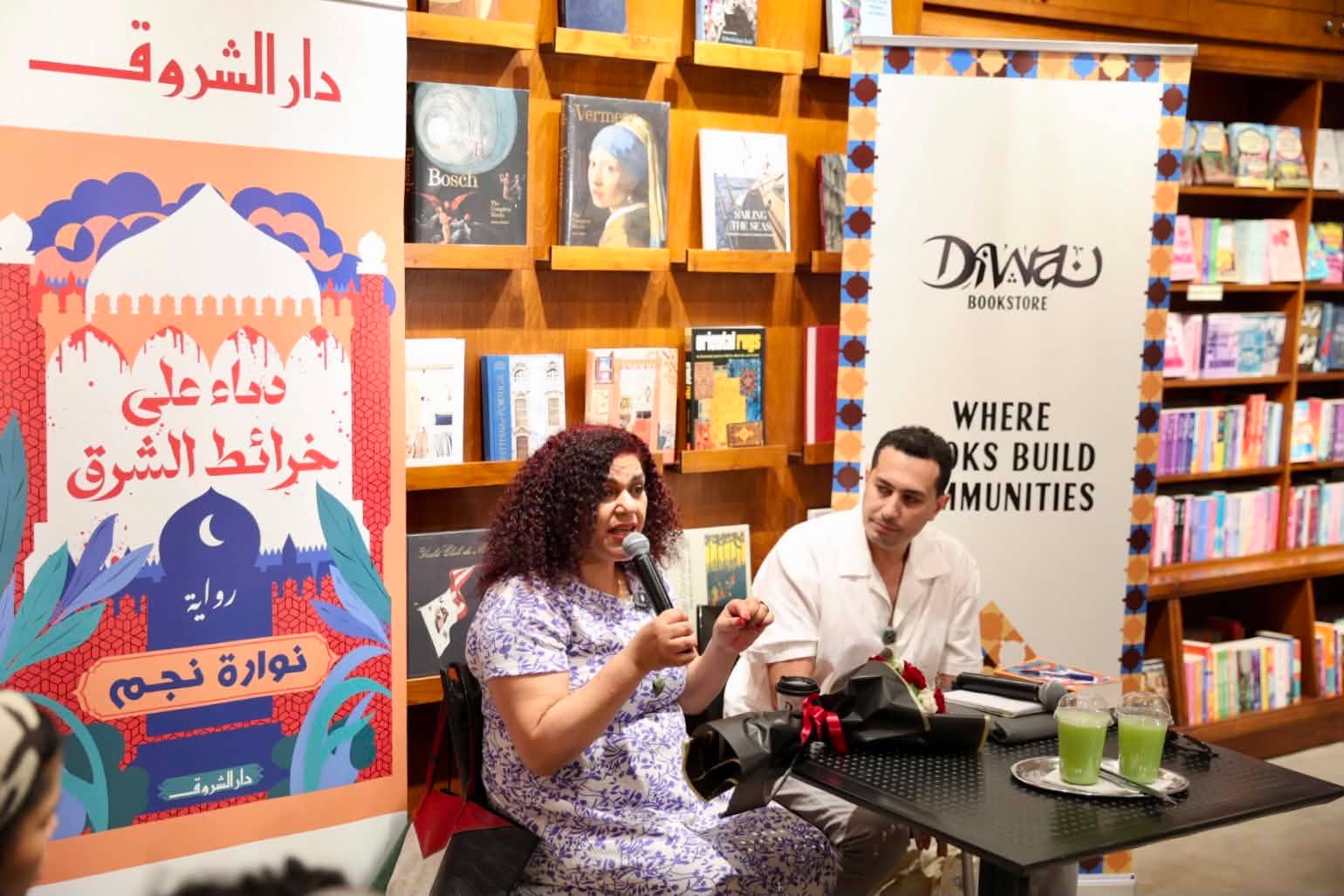

Egyptian author and journalist Nawara Negm says the women in her latest novel, Blood on the Maps of the East, were shaped not only by imagination but also by generations of family memories, oral histories, and the lived experiences of Egyptian women who carried the values and collective memory of their families.
Speaking during the launch event for the novel at Diwan Bookstore in Heliopolis, Cairo, Negm explained that while some names in the book pay tribute to people who influenced her life, she deliberately avoided creating direct copies of real individuals.

“I did not want the novel to become a story about specific people,” she said, noting that tying characters too closely to reality would limit their independence and artistic development within the narrative.
Family Archives and Oral Histories
Negm revealed that the novel was informed by extensive research into family manuscripts, inherited stories, and oral narratives passed down across generations. While she drew on historical and human elements from these accounts, she reshaped them creatively so that the characters remained fictional, even when rooted in real experiences.
She stressed that imagination ultimately served as the framework that connected these fragments of memory and transformed them into a cohesive literary world.
The Enduring Role of Egyptian Women
The author said her particular interest in female characters—especially Egyptian women—comes from a long-held belief that women have consistently been the backbone of the family and the guardians of values, ethics, and collective memory.
According to Negm, women often define what is right and wrong within the home while preserving family stories and passing them from one generation to the next.
She added that this portrayal was not created in isolation but emerged from memories of the women in her own family and the stories she heard from mothers and grandmothers throughout her life.
Whether in rural communities or urban settings, she believes Egyptian women have continued to carry this responsibility, even as circumstances and environments changed over time.
Women, Resistance, and National Identity
Negm also emphasized that the struggle of Egyptian women has historically been deeply intertwined with the nation’s broader struggles. For that reason, she wanted her female characters to reflect the overlap between personal battles and collective national experiences.
Rather than portraying women as flawless or symbolic figures, she aimed to write them as complete human beings with strengths, vulnerabilities, and contradictions.
This approach, she explained, allows female characters to exist beyond stereotypes and better reflects the complexity of women’s lived experiences.
Reality Reimagined Through Fiction
The novelist acknowledged that some events included in Blood on the Maps of the East were not entirely invented. Certain incidents originated from inherited family stories or oral accounts she encountered during her research.
However, she emphasized that these stories were reconstructed and reimagined within the novel’s artistic framework, ensuring that fiction remained central to the work.
By blending memory, history, and imagination, Negm said she sought to create characters that feel authentic while still belonging entirely to the world of literature.
The launch event was attended by a number of prominent figures from Egypt’s literary and cultural scene, including Salwa Bakr, Parween Habib, Khaled Mansour, Emad El Adly, journalist Sayed Mahmoud, and publishing executives from Dar El Shorouk.