
Egypt’s Social Solidarity Minister Attends Launch of Vodacom Conference on Accessibility and Disability Inclusion
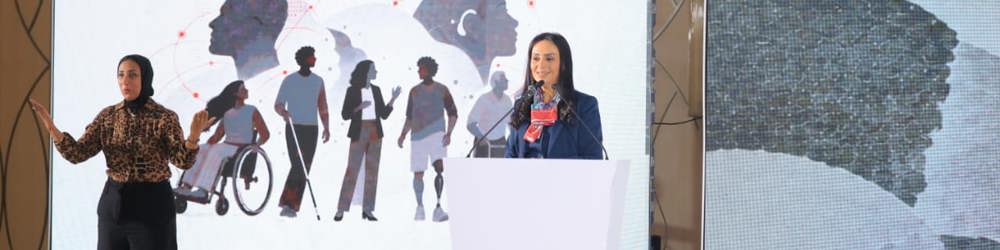
Dr. Maya Morsi, Minister of Social Solidarity, attended the launch of the third edition of Vodacom Group’s Annual Conference on Accessibility and the Inclusion of Persons with Disabilities, organized by Vodafone Egypt. The event is considered the first international conference to focus directly on accessibility and improving services provided to customers with disabilities.
The conference was attended by Eng. Mohamed Abdallah, CEO of Vodafone Egypt and Head of International Markets at Vodacom Group; Eng. Ayman El-Saadany, Deputy CEO; Ayman Essam, Deputy CEO of Vodacom Group; Mai Yassin, Head of Sustainability; Dr. Randa Mostafa, Chairperson of the House of Representatives’ Committee on Social Solidarity, Family and Persons with Disabilities; MP Ahmed Badawy, Chairperson of the House of Representatives’ Communications and Information Technology Committee; Zeina Tawkol, Executive Director of the Qaderoon Bekhtilaf Fund for Supporting Persons with Disabilities; as well as a number of international and public figures.
Accessibility as a Foundation for Digital Transformation
Dr. Maya Morsi expressed her appreciation for participating in the event, thanking Vodafone Egypt and Vodacom Group for organizing a conference addressing one of the fundamental issues shaping the future of development and digital transformation: ensuring that persons with disabilities can access services and technology and participate fully in all areas of life.
She emphasized that the conference theme, “Every Connection Starts with Accessibility,” carries an important message, particularly at a time when technology has become an essential part of everyday life. Access to communication, information and services is increasingly linked to digital solutions.
Today, mobile phones allow people to access government services, conduct financial transactions, follow educational programmes, search for employment opportunities, communicate with institutions and participate in a wide range of economic, social and cultural activities. More than 260 electronic services have become central to daily government transactions.
The Minister explained that accessibility is fundamentally connected to an individual’s right to independence, participation and equal opportunities. It goes beyond removing physical or architectural barriers to creating an integrated system that protects human dignity and ensures full citizenship.
She noted that activities that may seem routine to some people can make a significant difference in the lives of others. These include enabling a student to reach university, allowing an employee to perform their work, helping a woman with a disability use banking services independently, enabling a person with a hearing disability to communicate with a service provider, or ensuring that a person with a visual disability can access information through appropriate tools.
Such everyday situations reveal the true meaning of accessibility and demonstrate that inclusion begins with how spaces, services and technologies are designed, as well as the ability to accommodate the diverse needs of citizens.
Egypt’s Progress in Protecting the Rights of Persons with Disabilities
Dr. Morsi stressed that persons with disabilities possess diverse abilities, skills and experiences, and that society has a responsibility to ensure that surrounding barriers do not restrict their participation or opportunities in education, employment and public life.
She highlighted that Egypt’s 2014 Constitution provided for the National Council for Persons with Disabilities, which proposes policies and serves as an independent national mechanism for promoting and protecting their rights.
She also pointed to the significant progress Egypt has made in recent years in strengthening the rights framework for persons with disabilities, supported by the attention given to this issue by President Abdel Fattah El-Sisi. This progress has included legislative and institutional developments, alongside the expansion of services, social protection programmes, rehabilitation and empowerment initiatives.
The issuance of Law No. 10 of 2018 on the Rights of Persons with Disabilities reaffirmed the Egyptian state’s commitment to protecting and advancing these rights. The establishment of the Qaderoon Bekhtilaf Fund for Supporting Persons with Disabilities further provided an institutional mechanism to coordinate efforts and expand opportunities for empowerment and inclusion.
In 2026, the Cabinet also approved the National Strategy for the Empowerment of Persons with Disabilities for 2026–2030, under the slogan “An Inclusive and Empowering Society.” The strategy was developed through broad participation involving government entities, civil society organizations, experts and persons with disabilities themselves, under the leadership of the National Council for Persons with Disabilities.
Expanding Services and Support Across Egypt
The Minister explained that the government is working to translate these priorities into services and programmes reaching citizens across different governorates.
The Ministry of Social Solidarity has issued approximately 1.6 million Integrated Services Cards to persons with disabilities, helping beneficiaries access the services and benefits guaranteed to them by law.
The Ministry has also provided rehabilitation and therapeutic services to approximately 1.3 million persons with disabilities through 596 entities. In addition, it has supplied 56,946 prosthetic limbs and assistive devices.
The total cost of services provided by the Ministry to persons with disabilities has reached approximately EGP 1.803 billion, covering the development of rehabilitation services, support for care institutions, the provision of assistive devices and improvements in accessibility.
Efforts have also extended to public transportation, with initiatives aimed at facilitating access to 15 railway stations and 35 metro stations on the first and second metro lines.
Dr. Morsi noted that while these figures reflect the scale of the efforts made, their real value lies in the impact they have on beneficiaries’ lives. An Integrated Services Card provides a means of accessing rights, an assistive device can improve mobility and independence, and an accessible public transportation station can open a path to education or employment for someone who previously faced daily challenges reaching their destination.
Strengthening Partnerships Through the Qaderoon Bekhtilaf Fund
Dr. Morsi emphasized that expanding services also requires building institutions capable of sustaining and developing these efforts.
In this context, the Qaderoon Bekhtilaf Fund plays an important role in strengthening cooperation between government entities, the private sector and civil society organizations, while developing partnerships that support the rights of persons with disabilities and expand their opportunities for participation.
Among the initiatives highlighted by the Minister was the cooperation between the Qaderoon Bekhtilaf Fund, the Sawiris Foundation and El Gouna Film Festival to promote accessibility and inclusion during the festival’s ninth edition.
The collaboration included improving mobility and access throughout the festival venues, providing suitable ramps and pathways, offering sign language services, and enhancing the accessibility of information, digital platforms, services, programmes and selected film screenings, in cooperation with organizations specializing in social inclusion.
Dr. Morsi stressed that persons with disabilities have the right to participate in cinemas, theatres, libraries, sports activities and cultural events as a natural part of community life, without having to rely on exceptional arrangements every time.
She added that the partnership also extends to developing a national guide for inclusive cultural activities, environments and events. The aim is to build on this experience and develop models that can be applied by other institutions and event organizers.
Digital Accessibility and the Role of Technology Companies
The Minister highlighted that digital accessibility represents another essential dimension of these efforts. Access to technology has a direct impact on opportunities for education, employment, economic independence and community participation.
As applications and digital services increasingly become the primary means of interacting with public and private institutions, accessibility must be an integral part of service design. The needs of persons with disabilities should be considered from the earliest stages of developing websites, applications, platforms and communication channels.
An inclusive digital service, she explained, includes applications compatible with screen readers, visual content supported by appropriate tools for understanding and following information, customer service channels that accommodate different communication methods, and clear procedures that can be completed without unnecessary barriers.
She also highlighted the importance of assistive technology and artificial intelligence in developing solutions that better meet the needs of persons with disabilities, strengthen their independence and expand their opportunities to participate in society.
In this regard, telecommunications and technology companies, particularly Vodafone, have an important role to play through their technical expertise, extensive reach and direct relationships with millions of users. Their contribution can include developing inclusive solutions, making digital services more accessible, training employees to respond to different needs, creating more accessible workplaces, and integrating accessibility standards into the design of products and services.
Making Accessibility Part of Everyday Institutional Practice
Dr. Morsi emphasized that one of the most important priorities is to make accessibility a natural part of how institutions think and operate.
Whether designing a building, launching an application, organizing an event, developing a service, publishing a press release or producing a video, institutions must recognize that citizens have different needs and interact with services in different ways. These differences must be considered from the beginning.
She stressed that full inclusion cannot be achieved if persons with disabilities are repeatedly forced to find exceptional ways to access services that should be available to everyone.
True accessibility begins when differences in people’s needs no longer become a reason for exclusion from opportunities, denial of services or restrictions on participation in society.
Presidential Directives to Advance Accessibility and Inclusion
Concluding her remarks, the Minister highlighted the latest directives issued by President Abdel Fattah El-Sisi, which include establishing a sustainable and integrated national system to make services accessible and enable digital communication through artificial intelligence for persons with hearing disabilities.
The directives also include providing vocational rehabilitation programmes and suitable employment opportunities, in addition to delivering religious education services in sign language.
Dr. Morsi reaffirmed that accessibility and inclusion ultimately reflect the kind of society Egypt seeks to build and its ability to provide fair opportunities for all members of society.
She noted that Egypt has made important progress in developing legislation, services and institutions, while continuing to advance these efforts through broader partnerships and a stronger role for technology in improving access to services and opportunities.