
A black-and-white photograph taken more than seven decades ago has revived the debate over Meretneith, the Egyptian woman who may have ruled the country during the First Dynasty, around 5,000 years ago.
A recent study, which used digital techniques to enhance an old archaeological image, has revealed details that may support the possibility that she occupied the throne, although researchers continue to disagree over the nature of her authority.

The significance of Meretneith rests on archaeological evidence indicating her exceptional position within the royal institution, including a substantial tomb bearing her name and inscriptions linking her to the administration of the state.
The possibility that her name appeared within a royal symbol reserved for kings, known as a serekh, has also raised questions over whether she ruled independently or governed as regent for her son.
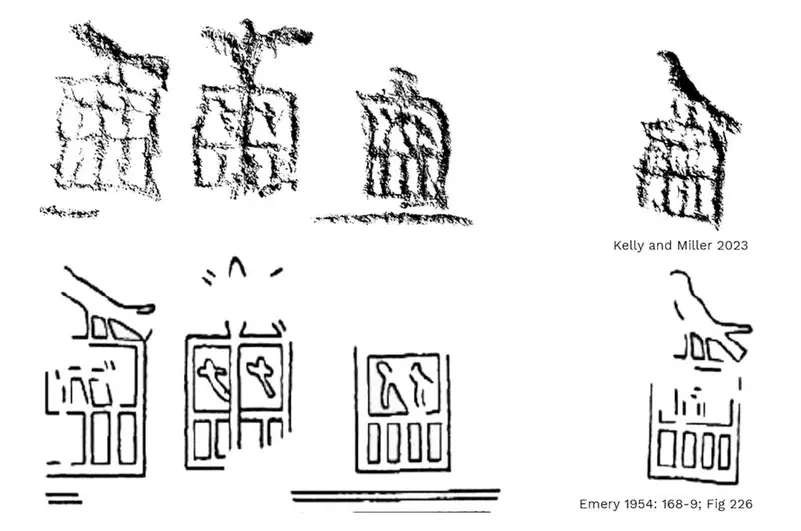
The debate began in the 1940s, when archaeologist Walter B. Emery discovered 13 mud stoppers near the entrance to a tomb shaft at Saqqara. The stoppers bore inscriptions containing serekhs, frames used to write the names of ancient Egyptian kings. Emery identified some of the signs as belonging to King Djer and suggested that others referred to Meretneith, leading him to conclude that she may have ruled Egypt.
An Old Photograph at the Center of the Investigation
Emery published his findings in 1954, accompanied by a photograph of one of the mud stoppers. However, its poor quality raised doubts about the accuracy of his reading. The original mud stoppers were later lost, along with the glass plate used to produce the photograph, leaving only the published image.
In a recent study published in Prague Egyptological Studies, researchers Susan Kelly of Macquarie University in Australia and Crystal Miller used digital techniques to enhance the photograph and reveal details of the inscriptions.
They concluded that signs appearing in the name portion of two of the serekhs are consistent with the principal sign used to write Meretneith’s name. The finding provides new visual support for Emery’s interpretation, without resolving the question of Meretneith’s precise political role.
Between the Title of “King’s Mother” and the Exercise of Power
The evidence associated with Meretneith is not limited to the mud stoppers. Other inscriptions bear titles such as “king’s mother” and indicate that she assumed administrative responsibilities, including oversight of the treasury.
Researchers have suggested that this position may have enabled her to exercise authority when necessary while retaining her influence within the royal family alongside a male king.
Some hypotheses suggest that she may have shared rule with Djer, who may have been her father, before later acting as regent for her son, Den, during his childhood. Her tomb, which excavations in 2023 revealed to be comparable in size and construction to the tombs of rulers, further supports evidence of her high status, although the tomb alone does not establish that she formally occupied the throne.
Eva-Maria Engel, a historian at Humboldt University of Berlin, has questioned the study’s reading, arguing that the enhanced images show only the name of King Djer and do not include Meretneith’s name within the serekh.
However, she does not dispute Meretneith’s influence, pointing to the location of her tomb among those of kings and to inscriptions that may indicate that she exercised authority on behalf of her son, Den.
The debate therefore centers on whether Meretneith was a formal ruler or a regent. In either case, the rediscovered details in the old photograph demonstrate how a limited archaeological image can reopen fundamental questions about authority, legitimacy and the role of women in the earliest periods of the Egyptian state.