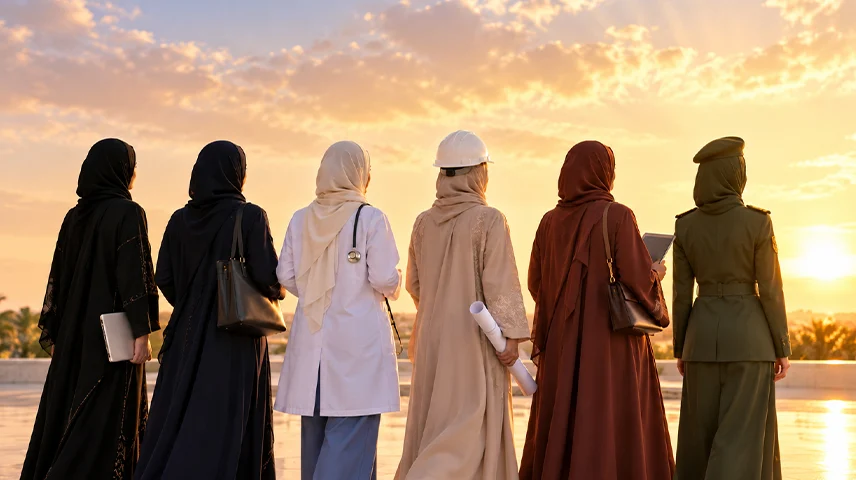

Women’s political and social empowerment across Arab countries took different forms and developed at varying levels in 2026. These efforts included greater recognition of women’s role in national development, stronger representation in public life, increased female representation in legislative councils through quota systems, and expanded opportunities for women to join the military.
Together, these developments have contributed to women’s participation in decision-making and strengthened opportunities for them to contribute to sustainable national development.

Key Indicators
Several developments during 2026 reflected the growing focus on women’s empowerment across a number of Arab countries.
- Emirati Women’s Day extended to a full month
For the first time in the UAE’s history, the 2026 Emirati Women’s Day celebrations were extended to a full month, following the directives of Her Highness Sheikha Fatima bint Mubarak, Chairwoman of the General Women’s Union, President of the Supreme Council for Motherhood and Childhood, and Supreme Chairwoman of the Family Development Foundation, known as the “Mother of the Nation.”
The celebrations ran from August 28 to September 28, 2026, under the theme “We Emerge Stronger and Better,” highlighting the collective strength and continuing achievements of Emirati women and their role in shaping the future.
The initiative focused on highlighting inspiring women across strategic sectors, including artificial intelligence, space, science and diplomacy, while also highlighting women’s role in strengthening families, building communities and reinforcing national identity. The programme included seminars, dialogue sessions, councils and initiatives supporting women across government departments and national institutions throughout the four-week period.
Emirati women currently hold prominent positions across state institutions and decision-making bodies. Women occupy 50% of the seats in the Federal National Council, while women hold 63% of federal leadership positions in government, according to the UAE Gender Balance Council. The UAE’s framework for supporting women’s rights includes the Constitution as well as federal laws and ministerial and local decisions.
- Women’s quota introduced in Oman’s Shura Council
On June 15, 2026, His Majesty Sultan Haitham bin Tarik directed that an additional seat be allocated to women in each governorate, bringing the total to 11 seats in the Shura Council. The additional seats are to be added to the general seats open for competition, while women will continue to contest seats representing their wilayats under the existing electoral system and in accordance with the Election Law.
The measure is intended to expand women’s representation in the Shura Council, particularly as female candidates remain eligible to compete for regular seats outside the additional allocation. Women may also be appointed by the Sultan to the State Council, the upper chamber of the Council of Oman.
Omani women have previously contested Shura Council elections, with varying levels of representation across electoral cycles. Two women won seats in the 2019 elections, while no woman won a seat in the most recent elections held in 2023.
A quota system allocates a specified number or proportion of seats to women in legislative bodies, establishing a minimum level of female representation in decision-making institutions.
The latest directive expands the institutional opportunities available to Omani women and is aligned with the objectives of Oman Vision 2040, which calls for the participation of different segments of society, including women and young people, in the country’s development.
- Increased representation of women in Morocco’s House of Representatives and the appointment of its first female Head of Government
Morocco’s House of Representatives has 395 seats, including 305 seats for local electoral districts and 90 seats for regional electoral districts. In the legislative elections held on September 23, 2026, the regional electoral districts were designated exclusively for women candidates.
The election results showed an increase in the number of women elected from local electoral districts, rising from six women in the 2021 elections to 17 women in the September 2026 elections. With the 90 regional seats, the total number of women in the current House of Representatives reached 107 out of 395 members.
Morocco first introduced a quota system in 2002, allocating 30 seats in the House of Representatives to women. In 2011, the number was increased to 60 seats as part of measures intended to strengthen women’s parliamentary representation and participation in shaping public policy.
In the 2021 elections, regional electoral districts replaced the national list and included 90 seats. Amendments introduced in 2026 made these districts exclusively open to women candidates. The changes therefore increased the number of women represented in Parliament while the 2026 election results also showed an increase in the number of women winning seats through local electoral districts.
Following the legislative elections, His Majesty King Mohammed VI appointed Fatima Ezzahra El Mansouri as Head of Government on September 29, 2026, making her the first woman to hold the position in Morocco.
- Amendments to Palestinian election law to strengthen women’s representation
President of the State of Palestine Mahmoud Abbas issued amendments to the General Elections Law in June 2026, followed by further amendments in August.
The June amendment increased the number of members of the Palestinian Legislative Council to 200 and required each electoral list to include at least one woman among every three candidates.
The August amendment repealed the June amendment and restored the number of Legislative Council members to 132, while retaining provisions designed to strengthen women’s representation through a quota of at least 33% on electoral lists. The amendment also maintained a 1% electoral threshold and lowered the minimum age for candidacy to 23.
Increasing the minimum level of women’s representation on electoral lists reflects the formal recognition of women’s participation in political life and decision-making. The Arab Labour Organization also highlighted the role of Palestinian women workers in a statement issued on March 7, 2026, marking International Women’s Day, noting their exposure to difficult circumstances and multiple forms of marginalization and violence while continuing to defend their rights, including the rights to life, justice and decent work.
- First batch of Kuwaiti female military officers graduates
The Kuwait Armed Forces reached a historic milestone on June 16, 2026, with the graduation of the first batch of Kuwaiti female officers holding university degrees and commissioned at the rank of lieutenant. The batch comprised 59 female officers and was attended by Minister of Defense Sheikh Abdullah Ali Abdullah Al-Salem Al-Sabah.
The graduation followed the decision issued in October 2021 allowing Kuwaiti women to join military service in the Kuwait Armed Forces, marking a new stage in women’s participation in the country’s defense institutions.
The initial decision limited women’s military participation to civilian specializations, including medical services and supporting military services. It subsequently became the subject of political and parliamentary discussion concerning the scope of women’s participation in the military institution.
In the following years, Kuwait took practical steps to integrate women into military service, including opening recruitment opportunities for women and ultimately graduating the first batch of female officers in June 2026.
In July 2026, the General Staff of the Kuwait Armed Forces also announced the reopening of recruitment for women seeking to join military service. The opportunity was extended to holders of university degrees, diplomas and secondary-school qualifications and their equivalents, as well as applicants with Grade 11 education or below, subject to age, medical fitness and other general requirements.
These developments reflect the continued expansion of women’s participation in Kuwait’s military institutions.
Institutional Support
Overall, Arab countries have introduced a growing range of efforts and strategies aimed at strengthening women’s institutional empowerment. Specialized organizations, including the Arab Women Organization, also contribute by building the capacities of women parliamentarians, providing candidates with the political knowledge needed to participate in elections, and developing regulatory and legislative frameworks that support equal opportunities and reduce gender gaps.
These efforts also include national strategies designed to strengthen women’s political and leadership participation, raise public awareness of women’s role as partners in development, and accelerate women’s participation in emerging fields such as artificial intelligence, digital government, cybersecurity and future industries.