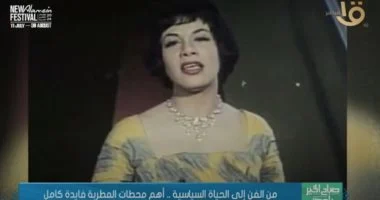

On July 12, 1932, a girl was born in Cairo who would go on to reshape Egypt’s political history and become one of the country’s most influential advocates for women’s rights. Faida Kamel combined a successful artistic career with an extraordinary record in public service, becoming the first Egyptian artist elected to Parliament and one of the longest-serving female parliamentarians in the country’s history.
Although she first gained national recognition as a celebrated singer and actress, Kamel ultimately chose public service over artistic fame. When she entered political life, she gradually stepped away from performing to devote herself entirely to legislative work and public representation.

Her parliamentary career began in 1971 when she was elected to represent the El Khalifa constituency in Cairo. She retained her seat continuously until 2005, serving for more than three decades during periods of significant political and legislative transformation in Egypt. Her exceptional tenure earned international recognition and secured her a place in Guinness World Records as one of the world’s longest-serving female parliamentarians.
Throughout her years in Parliament, Kamel established herself as one of Egypt’s most influential legislators. She chaired the Committee on Culture, Media and Tourism, where she championed numerous national issues. However, her most enduring legacy remains her advocacy for women’s rights and gender equality.
Guided by her belief that “women are half of society,” Kamel consistently pushed for legislative reforms that expanded women’s legal protections. She was among the prominent parliamentary voices supporting reforms to Egypt’s personal status laws, advocated for the introduction of khul’ legislation that strengthened women’s legal rights in divorce proceedings, and strongly supported granting Egyptian nationality to children born to Egyptian mothers married to foreign nationals—a reform that later became law after years of public debate.
Beyond Parliament, Kamel represented Egyptian women at numerous Arab, African, and international conferences, helping showcase Egypt’s experience in advancing women’s participation in public life. While she was married to former Minister of Interior Nabawi Ismail, her political identity was defined by her own achievements, independent voice, and legislative record rather than her family connections.
Kamel’s political career also mirrors the broader evolution of women’s parliamentary representation in Egypt. Women’s participation in Parliament remained extremely limited after they first gained political rights, accounting for only around 0.6% of parliamentary seats in 1957. Representation gradually increased during the 1960s before the introduction of a women’s quota in 1979, which reserved additional seats for female candidates and raised women’s parliamentary representation.
Following the repeal of the quota system in 1986 and subsequent changes to Egypt’s electoral laws, women’s representation declined sharply. Despite these shifting electoral systems and increasingly competitive political conditions, Kamel consistently retained her parliamentary seat through successive elections, reflecting both her popularity among constituents and her reputation as an experienced legislator.
Egypt later reintroduced a parliamentary quota for women in 2009 by allocating 64 reserved seats, marking another milestone in the country’s efforts to strengthen women’s political participation. Yet long before these reforms, Kamel had already demonstrated that women could succeed as influential legislators through sustained public service and effective parliamentary leadership.
Faida Kamel passed away on October 21, 2011, at the age of 79, leaving behind an enduring legacy of public service, legislative reform, and women’s empowerment. Her life remains one of Egypt’s most remarkable examples of a woman who successfully bridged culture and politics, proving that artistic influence and political leadership can together drive lasting social change.
Today, her legacy continues to inspire generations of Egyptian women seeking leadership roles in public life, reinforcing the importance of women’s full participation in shaping the nation’s future.