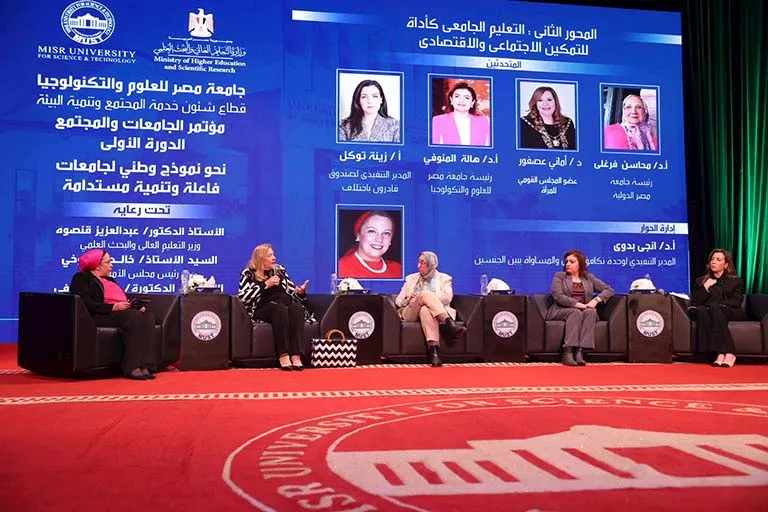

Egypt’s higher education sector is becoming a key driver of social inclusion and sustainable development as leaders gather for the inaugural “Universities and Society” conference hosted by Misr University for Science and Technology (MUST) under the theme: “Toward a National Model for Effective Universities and Sustainable Development.”

Representing the National Council for Women Chairwoman, Amal Ammar, Dr. Amani Asfour delivered a keynote intervention emphasizing how strategic partnerships between universities and national institutions are reshaping opportunities for women across Egypt.
Universities as Engines of Empowerment
Speaking during a panel titled “University Education as a Tool for Social and Economic Empowerment,” Asfour underscored that collaborations between the National Council for Women and Egyptian universities have yielded “tangible, on-the-ground results,” particularly in advancing gender equality within academic institutions.
“These partnerships have significantly strengthened women’s leadership, protection, and participation across university campuses,” she said.
Institutionalizing Gender Equity on Campus
Since 2015, the council has spearheaded the establishment of specialized units to combat violence against women and promote equal opportunities within universities. These units serve as institutional mechanisms to safeguard female students, foster leadership, and build capacity.
Key milestones highlighted include:
- Establishment of 52 anti-violence and equal opportunity units across Egyptian universities
- Signing of 23 cooperation protocols
- Providing 21 units with operational infrastructure and resources
- Development of regulatory frameworks and ethical charters guiding unit operations
These initiatives have been implemented in partnership with the United Nations Population Fund, reinforcing international collaboration in gender-focused development.
Training, Awareness, and Measurable Impact
Beyond institutional setup, the council has invested heavily in training and awareness programs:
- 50 capacity-building workshops for unit coordinators and administrators
- 8 student camps involving faculty and volunteers
- A 30% increase in student volunteer participation since program inception
Awareness campaigns have addressed a wide range of issues affecting women on campus, helping to normalize dialogue and strengthen reporting and response mechanisms.
International Recognition
Egypt’s model has drawn global attention. According to Asfour, UNESCO has recognized the initiative as a regional best practice in addressing gender-based violence in academic settings.
The experience has also been showcased at major international forums, including the World Urban Forum 2024 and a 2025 conference organized by the Arab Women Organization in Morocco.
Expanding Reach Across Faculties
Asfour stressed the importance of appointing dedicated coordinators for anti-violence and equal opportunity units within every university faculty. Such decentralization, she noted, would improve communication with students, enhance responsiveness, and ensure early detection and resolution of issues.
“This structure is essential for achieving real and sustained impact within the academic community,” she said.
Broad Stakeholder Engagement
The session featured participation from leaders across academia and civil society, including representatives from the “Qaderoon Bekhtelaf” fund, Misr International University, and Misr University for Science and Technology. The discussion was moderated by gender equality expert Engy Badawy.