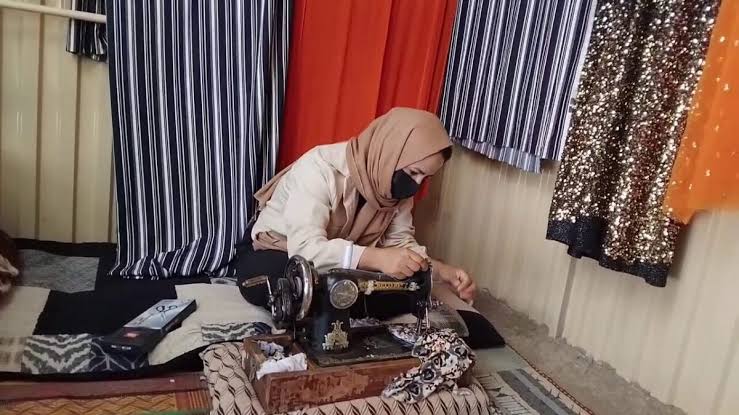

In the face of mounting economic hardship and strict societal limitations that have severely curtailed formal employment for women across Afghanistan, the women of Bamyan Province are turning to tradition, artistry, and sheer determination. Through home-based workshops and small-scale entrepreneurship, they are relying on heritage handicrafts to gain financial independence, support their families, and keep their skill sets alive.
From carpet weaving, embroidery, and tailoring to jewelry making, leather crafting, and homemade food production, female artisans are carving out a livelihood from inside their homes. Amid soaring unemployment and a broader financial crisis, these traditional trades have become a crucial lifeline. While some local and international organizations assist by offering training courses, hosting exhibitions, and establishing digital marketplaces, many women continue to build their businesses entirely from the ground up.

Beyond serving as a vital income stream, these artistic endeavors allow women to preserve cultural heritage while maintaining a dynamic economic presence. Yet, the road remains steep. Female entrepreneurs routinely battle a lack of direct market access, shortages of raw materials, limited capital, and tight constraints on mobility and public participation.
Basira Haidari: A Story of Determination and Skill
Among these resilient women is Basira Haidari, a skilled artisan from the Mulla Ghulam area in central Bamyan. Specializing in high-end embroidery and custom women’s fashion, Basira creates modern, intricate Afghan garments that are currently in high demand across local markets.
“I work in tailoring—specifically in hand embroidery and decorative embellishment on clothing,” Basira explains. “I have been running my independent business for about three years now, following two years of dedicated training in the craft.”
Basira’s path to launching her own business was sparked by an unexpected challenge. When a relative’s wedding was approaching, her family found a unique dress design online that was impossible to locate in local shops. Upon finding a workshop capable of creating the piece, the quoted price for a set of six dresses was far beyond their budget.
“I already had a basic understanding of sewing at the time,” Basira recalls. “My older sister encouraged me, saying that since I possessed foundational skills, I should ask to work at the workshop to cover the cost of the garments while mastering the trade. That idea, combined with my sister’s constant encouragement, gave me the drive to push forward until I reached the level of expertise I have today.”
Overcoming Financial and Social Barriers
While some female artisans in Bamyan receive institutional backing, Basira’s journey has been entirely self-funded. She built her enterprise using her personal savings and the support of her family, operating without external organizational aid.
In addition to financial hurdles, women-led spaces in Bamyan encounter daily scrutiny. Representatives from the Ministry for the Propagation of Virtue and the Prevention of Vice regularly conduct unannounced site visits to enforce strict hijab compliance—a procedure that Basira notes often disrupts her daily operations without prior permission.Despite the daily obstacles, Basira remains steadfast in her message to women across Afghanistan, emphasizing that self-reliance is vital for survival and dignity.
“Women must never give up,” Basira emphasizes. “They should start, even with the smallest project, until they can rely on themselves and no longer depend entirely on husbands or fathers for their personal expenses. In times like these, becoming an active contributor to the family economy is more essential than ever.”