
At 2 a.m. in Al-Moneeb, Giza, women are not waiting for buses to visit relatives. They are standing in galabeyas, carrying heavy construction tools and competing for a place on cement trucks in the hope of securing a day’s work.
Hours later and several kilometers away, in the polished streets of New Cairo, another woman speeds through the midday heat on a motorcycle. When she reaches her destination, she removes her helmet and delivers a hot meal to a family living far removed from the economic pressures that brought her onto the road.

These contrasting scenes offer a stark picture of the pressures facing Egyptian women in 2026, as growing financial responsibilities push increasing numbers into physically demanding and largely informal jobs.
From construction and transportation to motorcycle delivery and other forms of gig work, women are entering occupations that have traditionally been dominated by men. Their stories reveal not simply a shift in employment patterns, but a deeper transformation in how women support their families when conventional sources of income are no longer enough.
Egyptian Women Have Long Carried the Burden of Hard Labor
Women working in physically demanding occupations are not an entirely new phenomenon in Egypt.
For generations, women in rural communities have worked alongside men in agriculture and other labor-intensive activities, carrying heavy loads, cultivating land and contributing directly to household income.
What has changed is the environment.
The agricultural fields of previous generations have increasingly been replaced, for some women, by construction sites, crowded roads, motorcycles and delivery platforms. Traditional physical labor has moved into an urban economy shaped by traffic, rising costs and digital platforms.
The tools may have changed, but the underlying reality remains familiar: when a family’s financial security is threatened, women often become a critical source of income.
Women Workers Face Pressure on the Road and at Work
Behind employment statistics are women navigating difficult working conditions with limited protection.
A female delivery driver identified as S.M. described the pressure of working late at night and traveling to unfamiliar areas to complete orders.
“I do not fear the darkness or crowded roads as much as I fear the platform’s algorithms,” she said, describing what she believes are penalties for rejecting deliveries in areas where she does not feel safe.
According to her account, she can work for as many as 12 hours and return home with only a small portion of her earnings after platform commissions and motorcycle maintenance costs.
For women working in construction, the challenge is equally physical.
A daily construction worker identified as A.R. said women perform many of the same tasks as men, including carrying bricks and mixing cement, but may receive lower daily wages.
Her account highlights a wider concern surrounding informal employment: workers with little bargaining power can be forced to accept unfavorable conditions because they cannot afford to lose a day’s income.
Driving Becomes a Lifeline for Women Supporting Their Families
Transportation has also become an increasingly important source of income for women facing financial pressure.
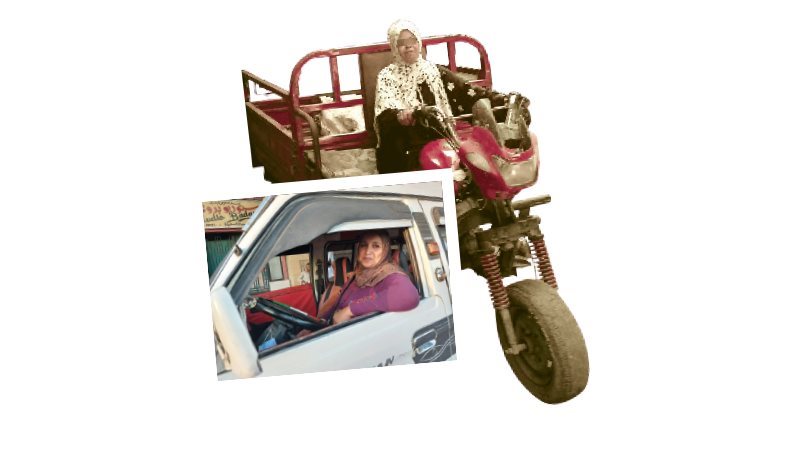
A female minibus driver identified as N.A. said she entered the profession after her husband became ill and she needed to support her children.
Her challenge, she explained, goes beyond navigating traffic and working long hours. She also faces resistance from male drivers and the struggle to establish herself in an environment where women remain underrepresented.
“I am not only fighting to drive,” her account suggests. “I am fighting to be respected.”
Another woman working as a tuk-tuk driver in Helwan described a different set of challenges, including verbal harassment and the absence of basic facilities for female workers.
For her, the job was not a lifestyle choice or a symbol of independence. It was a financial necessity.
When Gig Work Offers Flexibility Without Security
The expansion of app-based delivery work has opened another route into employment for women, but it has also created questions about worker protection.
One female scooter rider described an accident that left her injured and unable to work. She said that because she was classified as an independent worker rather than an employee, she was left responsible for medical expenses and without the employment protections she expected.
Her experience reflects a broader debate surrounding the gig economy: digital platforms can create new income opportunities, but workers may also carry the risks traditionally absorbed by employers.
For women, those risks can be particularly difficult when an injury immediately threatens household income.
The Hidden Cost of Women’s Economic Survival
The financial calculations behind informal work can be deceptive.
A delivery worker may generate several hundred Egyptian pounds in a day, but platform commissions, fuel or battery costs, motorcycle maintenance and other expenses can substantially reduce her take-home income.
Construction workers face another problem: irregular employment.
A woman may work only a limited number of days each month, making it difficult to rely on a stable monthly income even when the daily wage appears relatively significant.
The result is an economic model in which women may be working longer and harder without necessarily achieving greater financial security.
Women’s Rising Economic Responsibilities
The growing number of women entering demanding occupations also reflects the changing economic role of women within Egyptian households.
The source material cites estimates suggesting that women are the primary breadwinners in a significant share of Egyptian households. It also points to an increase in the number of women working in delivery services and small-scale construction.
However, such figures should be treated carefully unless supported by official labor-force or household-income data.
What is less difficult to see is the broader trend: Egyptian women are increasingly participating in forms of work that were once considered almost exclusively male, particularly when household income comes under pressure.
The Impact Extends Beyond the Workplace
The consequences of physically demanding work do not necessarily end when the working day does.
A woman who spends 10 or 12 hours performing strenuous labor may return home physically exhausted while still carrying responsibility for childcare, household management and other unpaid work.
This creates what economists and social researchers often describe as a double burden: paid employment combined with disproportionate responsibility for domestic and caregiving duties.
The pressure can affect family relationships, children’s care and women’s physical and emotional well-being.
The issue is therefore larger than employment.
It concerns whether women entering difficult jobs have access to safe transportation, fair wages, healthcare, insurance, childcare, sanitary facilities and meaningful legal protection.
Economic Empowerment Must Mean More Than Employment
The growing presence of Egyptian women in construction, transportation and delivery work can be viewed as evidence of determination and economic resilience.
But celebrating women’s ability to survive difficult working conditions should not obscure the conditions themselves.
True economic empowerment requires more than giving women access to jobs. It means ensuring that women can work safely, receive fair compensation, access social and health protection, and build sustainable livelihoods without being forced to sacrifice their health and security.
Egyptian women have repeatedly demonstrated their ability to enter spaces once considered exclusively male.
The next challenge is ensuring that their participation is accompanied by dignity, protection and genuine economic opportunity — so that resilience becomes a choice and a source of strength, rather than a requirement for survival.