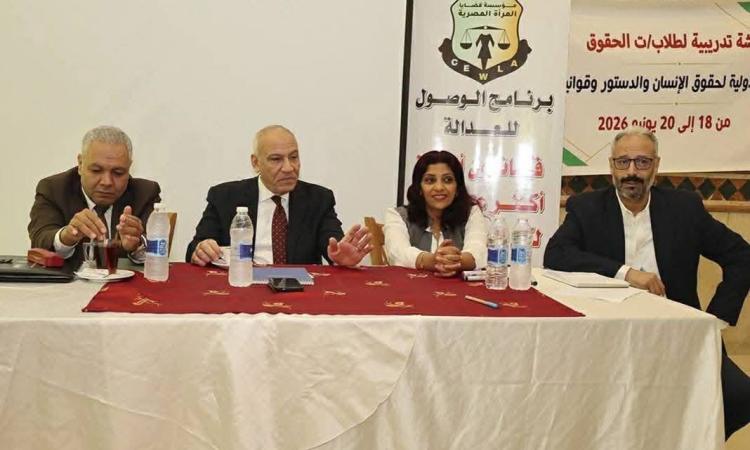

The Egyptian Women’s Issues Foundation (EWIF) has taken another step toward promoting legal literacy and human rights awareness by organizing a specialized workshop for students at Minya University’s Faculty of Law.
Held over three consecutive days in Minya Governorate, the workshop was organized through EWIF’s Access to Justice Program in cooperation with the Faculty of Law at Minya University. The training brought together 30 law students and focused on international human rights mechanisms, Egypt’s Constitution, and family law legislation.
The initiative reflects the foundation’s broader commitment to empowering young people with legal knowledge and preparing a new generation of legal professionals capable of advancing justice, equality, and human rights within Egyptian society.
Opening the workshop, Jawaher El Taher, Director of the Access to Justice Program at the Egyptian Women’s Issues Foundation, highlighted the importance of engaging university students—particularly law students—in community service and legal awareness activities. She emphasized the foundation’s ongoing efforts to support and prepare young lawyers who can advocate for vulnerable groups facing discrimination and legal challenges while contributing to the development of a more equitable justice system.
The program featured contributions from several prominent legal experts and academics. Professor Hassan Sand, Dean of the Faculty of Law at Minya University, delivered a lecture on international humanitarian law, explaining its core principles and its role in protecting civilians and vulnerable populations during conflicts. He stressed the importance of linking legal education with humanitarian values that uphold human dignity.
Professor Gamal Atef, Vice Dean of the Faculty of Law, explored the historical development of personal status laws in Egypt. His presentation examined key legislative milestones, the challenges facing family law amid evolving social realities, and the importance of modernizing legal frameworks to ensure fairness and justice for all parties.
Participants also attended a series of practical training sessions led by Mahmoud Abdel Fattah, a lawyer before Egypt’s Court of Cassation. These sessions focused on Egypt’s legislative hierarchy, the status of international agreements within the legal system, and the relationship between domestic legislation and international commitments. Discussions also covered constitutional provisions supporting women’s rights and the significance of the Convention on the Elimination of All Forms of Discrimination Against Women (CEDAW) in promoting equality and non-discrimination.
A key feature of the workshop was its interactive learning approach. Students worked in groups to analyze legal texts, review international agreements, and engage in collaborative discussions. This methodology helped strengthen critical thinking, legal research skills, and the practical application of theoretical concepts related to human rights and family law.
Throughout the three-day program, participants engaged in dynamic discussions and hands-on exercises that deepened their understanding of constitutional rights, international human rights mechanisms, family legislation, and the role of law in protecting freedoms and promoting social justice.
At the conclusion of the workshop, certificates of participation were awarded to the students in recognition of their commitment and active engagement. Professor Gamal Atef praised the participants’ enthusiasm and emphasized the importance of continued collaboration between academic institutions and civil society organizations in preparing socially conscious legal professionals equipped to address contemporary human rights challenges.
The workshop forms part of the Egyptian Women’s Issues Foundation’s ongoing efforts to expand legal knowledge among young people, encourage civic participation, and nurture a generation of lawyers committed to equality, human dignity, and the rule of law.