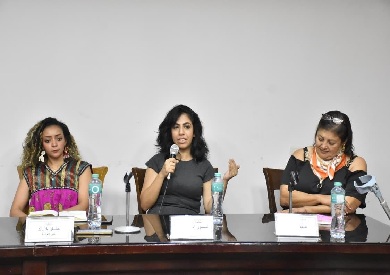

The 19th Egyptian National Theatre Festival brought together leading female theatre practitioners to examine the evolving concept of women’s theatre, its artistic identity, and the challenges facing women working in Egypt’s performing arts sector.
Held as part of the festival’s Wasla discussion series under the presidency of actor Mohamed Riyad, the panel titled “Women’s Theatre: Its Identity and Challenges” featured theatre critic Manar Khaled, director and playwright Efat Yehia, director, playwright, and critic Nesreen Nour, and director and playwright Nour Ismail.

The discussion explored whether women’s theatre represents a distinct artistic category or simply reflects authentic creative experiences shaped by individual perspectives.
A Concept That Raises More Questions Than Answers
Opening the session, theatre critic Manar Khaled described “women’s theatre” as one of the most debated concepts within Egypt’s theatre movement.
She argued that the value of the term lies less in providing fixed definitions and more in encouraging meaningful discussions about artistic identity, representation, and creative freedom.
Rather than following a traditional lecture format, the session encouraged an open exchange of personal and professional experiences among the participating artists.
Authentic Expression Beyond Labels
Director and playwright Efat Yehia reflected on a career spanning more than three decades, explaining that she never deliberately set out to create feminist theatre.
Instead, she said her work has always been driven by an emotional connection to the stories she chooses to stage.
According to Yehia, critics and journalists later classified several of her productions as feminist because they addressed women’s experiences, even though she has also directed productions exploring entirely different social issues, including political change and addiction.
She emphasized that artistic honesty should remain the primary criterion for selecting theatrical works, encouraging young directors to engage only with projects they genuinely believe in.
Yehia also discussed her experience co-founding the independent theatre troupe Al-Qafila, her early production Virginia, and later experimental productions developed through devised theatre, highlighting the importance of directors understanding every creative element of a performance, from scenography to lighting.
Despite producing more than 35 theatrical performances, she noted that funding has remained one of the greatest challenges throughout her career, adding that belief in the artistic vision has consistently motivated her to continue creating.
Human Stories Create Stronger Theatre
Playwright and critic Nesreen Nour explained that her theatrical choices have always been guided by personal conviction rather than a desire to produce works under any particular label.
She reflected on her involvement in street theatre following Egypt’s January Revolution, including performances presented inside Alexandria’s tram system and along the city’s coastline, experiences that broadened her understanding of audience engagement beyond conventional theatre spaces.
Nour argued that major issues—including women’s rights and the Palestinian cause—often lose emotional authenticity when writers approach them with overt messaging.
Instead, she believes such themes become more powerful when they emerge naturally through compelling human stories.
As a theatre critic, she also expressed reservations about productions that address women’s issues in an overly direct or didactic manner, while praising theatre-based rehabilitation projects involving incarcerated women for their genuine emotional impact.
Theatre Begins with Human Questions
Director and playwright Nour Ismail described her journey from studying literature at Ain Shams University to working in criticism, playwriting, contemporary dance, and ultimately theatre directing.
She explained that she selects projects based on questions that resonate with her personally rather than pursuing commercial success or production opportunities.
Her production Expired (Montaha Al-Salahiya) emerged from reflections on retirement and the emotional challenges faced by individuals who feel excluded from active participation in society.
Ismail stressed that every visual element of a performance—including movement, costumes, and scenography—must contribute meaningfully to the dramatic narrative.
She also discussed the production challenges she encountered while working within Egypt’s Cultural Palaces system, noting that her greatest obstacle early in her career was not simply being a woman but also directing productions at a relatively young age.
According to Ismail, earning the trust of collaborators depends on possessing a clear artistic vision and a comprehensive understanding of every aspect of theatrical production.
Celebrating Diverse Voices in Egyptian Theatre
The panel highlighted the richness and diversity of women’s contributions to Egypt’s contemporary theatre scene while questioning traditional classifications surrounding women’s artistic expression.
Rather than defining women’s theatre through rigid labels, participants emphasized authenticity, creative integrity, and human storytelling as the foundations of meaningful theatrical work.
By creating space for dialogue among directors, playwrights, critics, and audiences, the Egyptian National Theatre Festival continues to foster conversations that strengthen the country’s vibrant cultural landscape and encourage new perspectives within the performing arts.