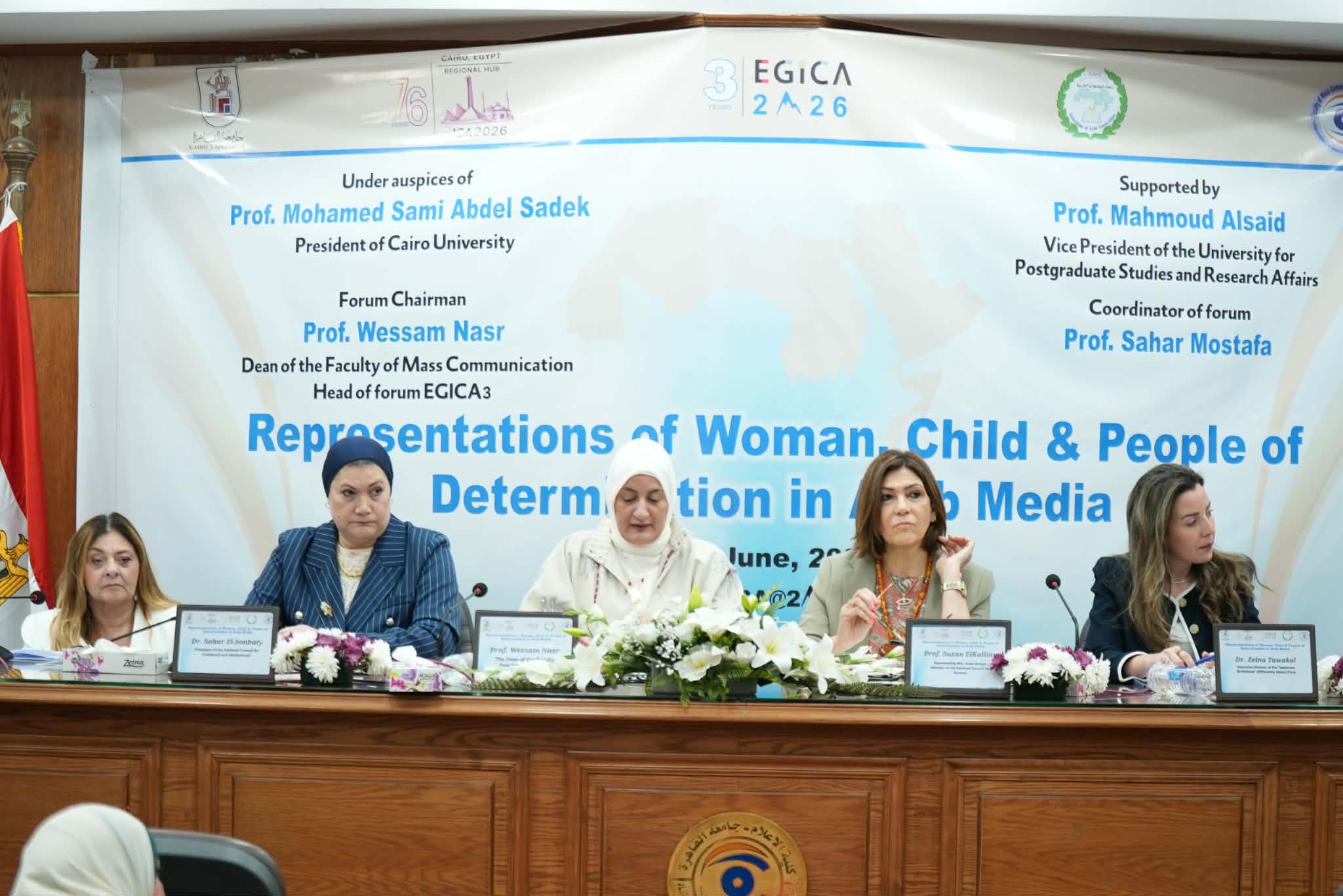

Cairo University’s Faculty of Mass Communication has launched the third edition of the International Scientific Forum EGICA 3 under the theme “Representations of Women, Children, and Persons with Disabilities in Arab Media,” bringing together government institutions, national councils, international organizations, researchers, and media professionals to discuss how media can contribute to a more inclusive society.
The forum is held under the patronage of Dr. Mohamed Sami Abdel Sadek, President of Cairo University, and under the supervision of Dr. Mahmoud El-Saeed, Vice President for Graduate Studies and Research. The event is chaired by Dr. Wessam Nasr, Dean of the Faculty of Mass Communication, with Dr. Sahar Mostafa serving as General Coordinator.

Advancing Inclusive Media Representation
Dr. Sahar Mostafa emphasized that media representation has become increasingly important in light of rapid digital transformation and evolving communication technologies. She noted that women, children, and persons with disabilities are fundamental pillars of society and that fair representation of these groups is essential to achieving social inclusion and sustainable development.
The forum seeks to encourage cooperation between academic institutions, national councils, and policymakers to help shape more equitable media policies and develop a media code of ethics that promotes balanced representation.
Media’s Role in Shaping Public Perception
Dr. Wessam Nasr highlighted that media today is not simply a channel for delivering information but a powerful force that shapes public awareness and influences social attitudes. She stressed that women, children, and persons with disabilities are active contributors to society and should be represented accordingly.
She pointed out that some media narratives still portray women through outdated stereotypes or depict persons with disabilities primarily through a lens of sympathy rather than empowerment. Addressing these portrayals, she said, is essential to creating a more balanced and inclusive media landscape.
Research as a Tool for Change
Dr. Mahmoud El-Saeed explained that persistent stereotypes surrounding women, children, and persons with disabilities continue to affect public perceptions. He stressed the importance of evidence-based research in addressing these challenges and highlighted Cairo University’s efforts to support these groups through specialized initiatives, interdisciplinary studies, and community engagement programs.
National Institutions Highlight Their Efforts
During the opening session, a panel discussion explored how state institutions contribute to empowering women, children, and persons with disabilities.
Dr. Sahar El Sonbaty, President of the National Council for Childhood and Motherhood, described childhood issues as a national priority and highlighted the importance of integrating legislation, public policies, and institutional partnerships to protect children’s rights. She also emphasized the role of the Child Helpline in supporting vulnerable children and promoting positive parenting practices.
Strengthening Women’s Representation in Media
Representing Counsellor Amal Ammar, President of the National Council for Women, Dr. Suzanne El-Qalini, Member of the National Council for Women and Chair of its Media Committee, stressed that the current stage requires professional and responsible media that reflects the true image of women and keeps pace with the significant achievements made in women’s empowerment.
She emphasized that women, children, and persons with disabilities are central to family and community development, making accurate media coverage of their issues essential for supporting comprehensive national development.
Dr. El-Qalini explained that legislation and legal protections are important foundations for empowerment, but their impact depends on responsible media capable of raising awareness, challenging stereotypes, and highlighting successful female role models across different sectors.
She also reviewed some of the National Council for Women’s most prominent media initiatives, including the widely recognized “Ta’a Marbouta: The Secret of Your Strength” campaign. In addition, she highlighted the Women’s Issues Media Observatory, the first government observatory of its kind in Egypt dedicated to monitoring and analyzing the portrayal of women across traditional media outlets and social media platforms. The observatory also places particular focus on issues affecting women with disabilities.
Dr. El-Qalini further emphasized the importance of institutional partnerships, particularly with academic institutions. She pointed to the ongoing collaboration between the National Council for Women and the Women Studies and Research Center at Cairo University’s Faculty of Mass Communication, which supports research, advocacy, and greater visibility for women’s issues within both media and society.
Promoting Inclusion for Persons with Disabilities
Dr. Eman Karim, Chairperson of the National Council for Persons with Disabilities, described media as a key partner in achieving social inclusion and correcting misconceptions surrounding disability. She noted that the council continues to raise awareness of disability rights and relevant legislation while ensuring access to support services and information.
Dr. Zeina Tawkol, Executive Director of the Qaderoon Bekhtelaf Fund, highlighted Egypt’s progress toward greater inclusion and participation for persons with disabilities. She emphasized the importance of showcasing positive role models and celebrating diversity as a source of social strength.
Addressing Emerging Digital Challenges
Dr. Marwa Alam El-Din, Acting Head of the Egypt Office of UN Women, noted that media does more than reflect reality—it actively shapes it. She explained that while digital platforms have expanded opportunities for participation and expression, they have also introduced challenges such as cyberbullying, hate speech, and online violence.
She stressed the importance of relying on research-based solutions and practical strategies to combat these issues and create safer digital environments for all members of society.
Toward a More Equitable Media Future
Held on June 7 and 8, EGICA 3 reflects a growing commitment among academic institutions, government bodies, and international organizations to improve media representation across the Arab world. Through dialogue, research, and collaboration, the forum aims to promote media practices that accurately reflect the contributions, rights, and aspirations of women, children, and persons with disabilities while supporting broader goals of equality, inclusion, and social empowerment.