
14 Egyptian Leaders Named to Forbes Middle East’s Sustainability Leaders 2026 List
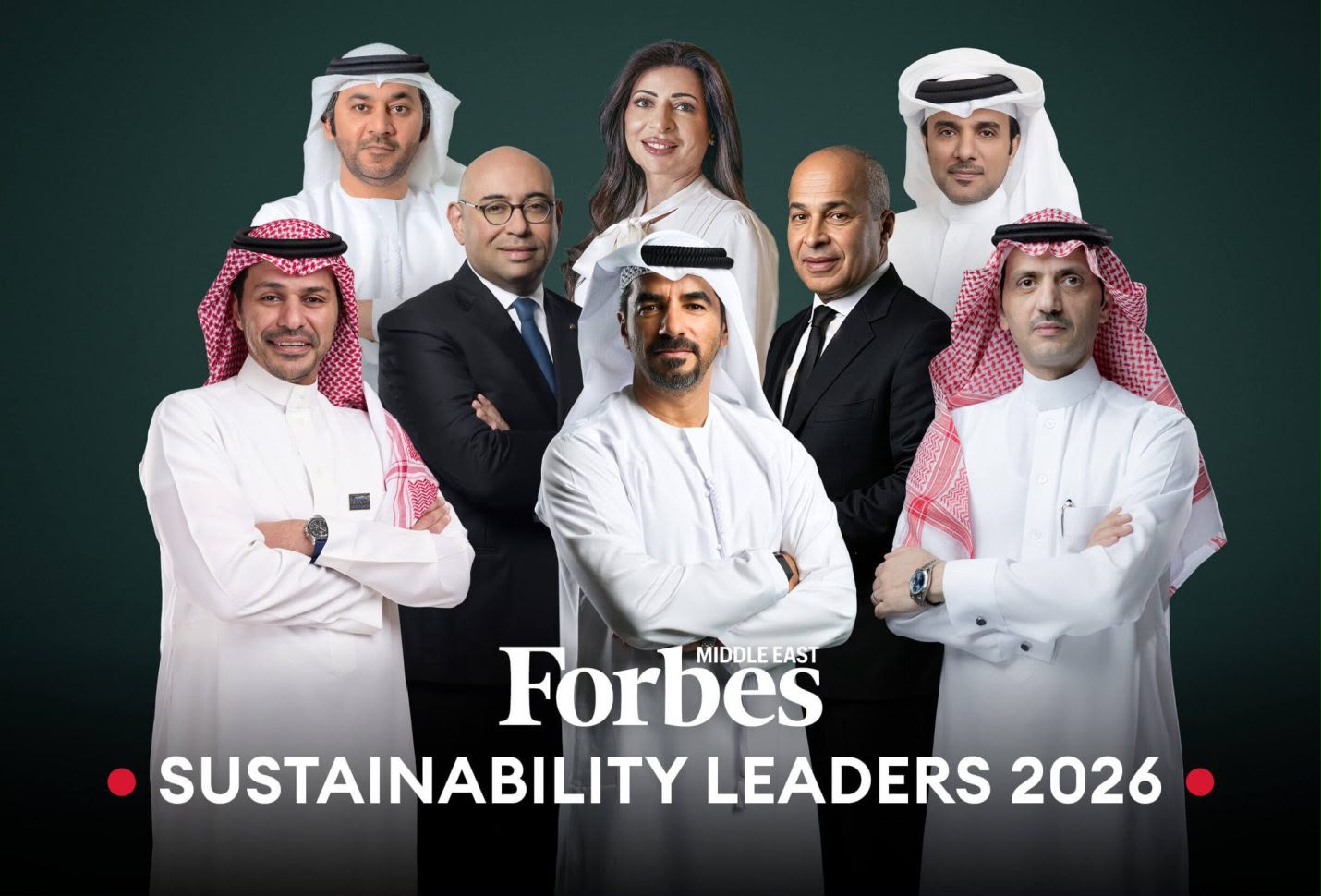
Egypt accounts for 14 entries in Forbes Middle East’s Sustainability Leaders 2026 list, which features 145 entries across 17 categories and recognizes executives advancing sustainability initiatives across the region.

The UAE leads with 75 entries, followed by Saudi Arabia with 29, while Qatar and Egypt each have 14. The list spans sectors ranging from financial services and manufacturing to renewable energy, real estate, technology and telecommunications.
Egyptian Leaders Across 10 Categories
Egypt’s entries span financial services, family businesses, food and agriculture, free zones, investment and holdings, manufacturing and industrials, real estate and construction, renewable energy, and technology and telecom.
In financial services, Dalia Khorshid, Group CEO and Managing Director of Beltone Holding, ranks third. Forbes cites the company’s $20 million in sustainable funding secured in June 2025 and six sustainable lending products covering areas such as energy efficiency, renewable energy, green buildings and sustainable agriculture.
Hanaa Helmy, Group Chief Sustainability Officer at EFG Holding, ranks fourth. Forbes highlights Bank NXT’s $47.8 million social-financing portfolio as of the fourth quarter of 2025 and the 4.6 TWh of clean energy delivered by Vortex Energy, which displaced approximately 4.5 million metric tons of CO₂ equivalent.
In the family businesses category, Hassan Allam and Amr Allam share one entry, ranked fourth, representing Hassan Allam Holding. According to Forbes, Hassan Allam Utilities contributes to more than $3.5 billion in renewable-energy investments, with 3.3 GW of projects under development. The group has also achieved IFC EDGE certification at its headquarters and five YANMU facilities.
Seif Thabet, CEO and Deputy Chairman of Juhayna Food Industries, ranks ninth in food and agriculture. Forbes points to the company’s sustainable agriculture and livestock activities across 10,000 feddans, as well as its partnership with the Egyptian Food Bank on the five-month Ebny Bokra programme, announced in November 2025.
Moustafa Shaikhon, head of the Suez Canal Economic Zone (SCZONE), ranks third among free-zone leaders. Forbes highlights the $210 million ATUM Solar complex in Ain Sokhna, a 100-MW green-hydrogen project that began partial production by January 2026, and a $50 million Sungrow energy-storage systems factory expected to reach annual output of 10 GWh.
In investment and holdings, Ghada Hammouda, Group Chief Sustainability and Marketing Officer at Qalaa Holdings, ranks 10th. Forbes reports that Qalaa’s first holding-level carbon-footprint report recorded an 11.5% year-on-year reduction in total greenhouse-gas emissions in 2025. Its subsidiary GlassRock also introduced a glass-wool pipe-insulation line, with products that can reduce end-user energy consumption by up to 40%.
In manufacturing and industrials, Manal Hassan, Group Chief Sustainability Officer at Elsewedy Electric, ranks eighth. Forbes reports a 38% reduction in the company’s Scope 1 and 2 emissions intensity in 2025 compared with its 2023 base year, alongside 44 third-party-verified Environmental Product Declarations covering more than 600 products.
Real Estate, Renewable Energy and Telecommunications
The real estate and construction category includes four Egyptian entries.
Ayman Amer of SODIC ranks 11th. Forbes cites solar installations, electric-vehicle charging facilities and residential designs intended to use less energy and water.
Mohamed Amer, associated with El Gouna and Orascom Development Egypt, ranks 12th. El Gouna’s solar-generation capacity more than doubled in 2025 to 15.8 MW, while the destination also recycles wastewater through treatment plants.
Abdallah Sallam of Madinet Masr ranks 13th. Forbes highlights the Buyut Al-Khalifa urban-renewal project in historic Cairo, along with plans for electric-vehicle charging and other resource-efficiency measures.
Ahmed Shalaby of Tatweer Misr ranks 15th. The company established a dedicated sustainability function in 2025 and uses smart infrastructure, Internet of Things technologies and centralised resource management across its developments.
In renewable energy, Mohamed Ismail Mansour, co-founder and chairman of Infinity Power, ranks third. Forbes describes Infinity Power as Africa’s largest renewable-energy company, with operating projects totalling approximately 1.3 GW across Egypt, South Africa and Senegal. These projects avoid more than 3 million tons of carbon dioxide emissions and supply electricity to more than 1.7 million African homes annually. The company aims to reach 10 GW of operating renewable-energy capacity by 2032.
In technology and telecommunications, Ayman Essam of Vodafone Egypt ranks seventh. Forbes says the company matched 100% of its purchased electricity consumption with renewable energy by April 2025 and reduced market-based Scope 1 and 2 emissions by 54% year-on-year as of March 2025.
Hesham Mahran of Orange Egypt ranks 10th. Orange sources 44% of its electricity from renewable energy and is expanding solar-powered network sites and technical facilities as it works towards net zero by 2040. Its circular-economy programme had collected more than 3,600 devices through over 40 shops for refurbishment and recycling.
Regional Sustainability Initiatives
The wider list also highlights sustainability-related investments across the region.
First Abu Dhabi Bank mobilised $31.1 billion in sustainable and transition finance in 2025, reaching 76% of its $136 billion target. Masdar’s operating projects generated 40.2 TWh of clean electricity that year, up 38% year-on-year.
In July 2026, Masdar reached financial close on a $6.1 billion project combining 5.2 GW of solar capacity with 19 GWh of battery storage. Emirates Global Aluminium also inaugurated the UAE’s largest aluminium recycling plant in 2026, taking its total recycling capacity above 400,000 tons annually.
Forbes’ Methodology
Forbes says it compiled the list using questionnaires, sustainability or ESG reports, official disclosures and recent news. Entries were ranked separately within each category, with greater weight given to measures relevant to each sector.
The criteria included sustainability reporting and disclosure transparency, green and sustainable financing, initiatives undertaken in 2025–2026, greenhouse-gas emissions trends, resource consumption, renewable-energy use, energy-efficient technologies, company size relative to climate impact, and other current or previous roles held by the leaders.
The list highlights the range of sustainability initiatives being pursued across the Middle East, with Egyptian executives represented in sectors including finance, industry, real estate, renewable energy and telecommunications.