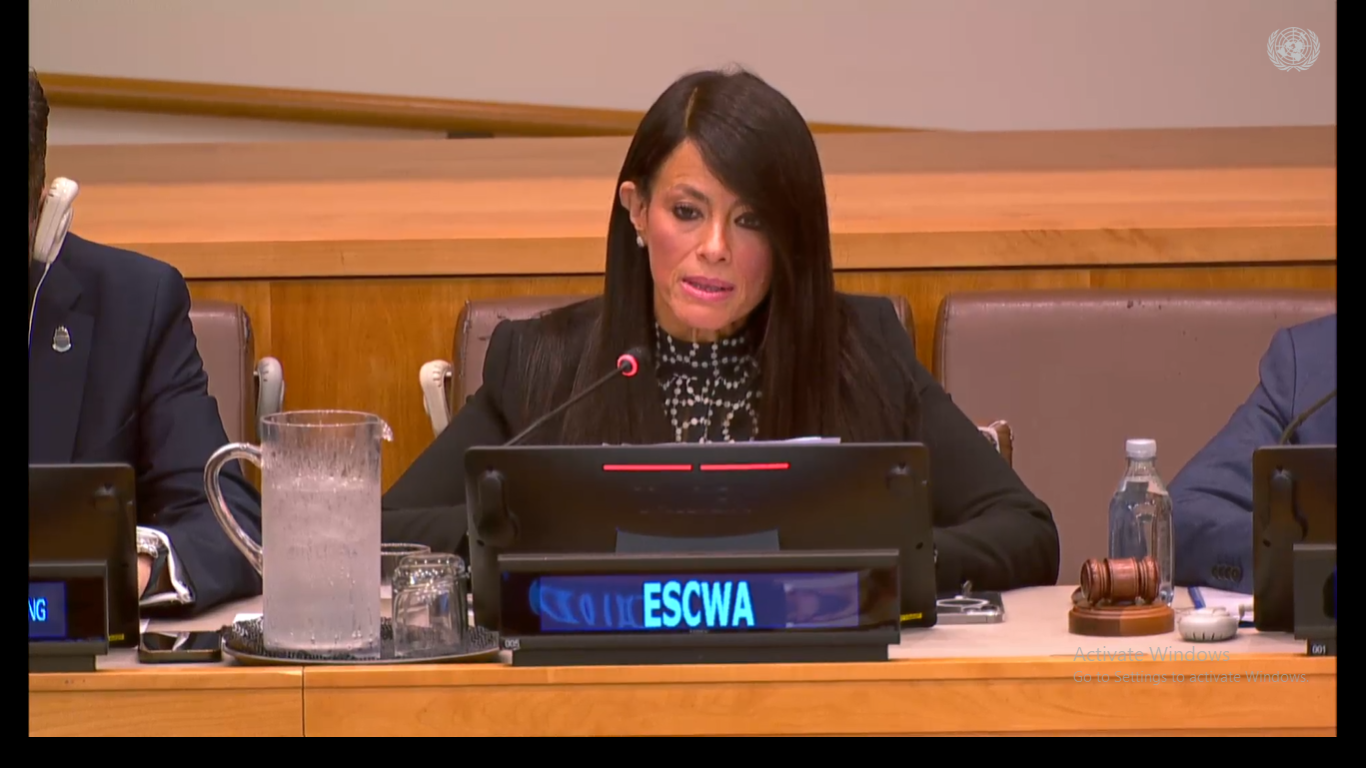

UN Under-Secretary-General and ESCWA Executive Secretary at the Security Council: Stability of Maritime Corridors Is No Longer Merely a Security or Navigation Issue, but a Direct Prerequisite for Protecting Development Pathways in the Arab Region
Beirut, September 18, 2026 – Dr. Rania Al-Mashat, UN Under-Secretary-General and Executive Secretary of the United Nations Economic and Social Commission for Western Asia (ESCWA), affirmed that the stability of maritime corridors is no longer merely a security or navigation issue, but has become a direct prerequisite for protecting development pathways in the Arab region and around the world. She warned that any disruption to these corridors can quickly evolve from a security shock into an economic cost, and then into a social and development crisis.

Al-Mashat made the remarks in an address delivered at an Arria-formula meeting of the United Nations Security Council, organized by the Kingdom of Bahrain under the title “Safe Seas, Shared Security: Protecting Freedom of Navigation in an Evolving Security Environment,” at United Nations Headquarters in New York.
Al-Mashat opened her remarks by stressing the interconnected nature of maritime corridors, saying, “Geography has returned… and with force,” explaining that technology has shortened distances and globalization has connected markets, “but it has not erased the seas, straits and corridors through which the world’s movement takes place.” She noted that the seas, straits and ports stretching from the Gulf through the Strait of Hormuz to the Red Sea through Bab al-Mandab are connected as a single system carrying energy, food and trade, “and if one link is disrupted, the chain is shaken,” emphasizing that having multiple routes alone is not enough “unless they are managed as an interconnected system.”
The Executive Secretary commended the ability of countries in the region to confront the challenge through their institutions and capabilities, by rerouting shipments, activating multimodal transport and utilizing alternative routes. She stressed that the impact “is determined not only by the severity of the shock, but also by the speed of the response and the quality of its tools.” She warned that the crisis comes at a time when the region’s economies had been achieving growth and advancing reforms, “only for the crisis to threaten to set that progress back,” saying, “We are not only losing opportunities for the future; we also risk losing the gains of years of reform and investment.”
Al-Mashat stressed that the cost of the crisis “is not distributed equally,” and that the shock “begins at sea, passes through the market, and ends in people’s lives,” warning that Arab countries experiencing or emerging from conflict are the least able to absorb it. She also drew attention to the situation of small and medium-sized enterprises, which represent the majority of Arab businesses, considering their survival “a matter of employment and social stability, not merely a commercial issue.”
She affirmed that “a ship carries more than goods; it carries prices, investments, jobs and food security,” linking the stability of maritime corridors to the prosperity of coastal states and emphasizing that “the security of maritime corridors is a prerequisite for protecting development.” She outlined three interconnected priorities: safeguarding freedom of navigation and the security of maritime corridors in accordance with international law; preventing the conflict from widening and containing its cross-border repercussions; and strengthening regional preparedness and resilience.
She highlighted ESCWA’s role in facilitating collective thinking and regional integration, noting that the Commission, together with Arab countries, established a regional transport, logistics and supply-chain team focused on developing mechanisms for early monitoring and coordination, including operations rooms that can be activated when needed. She called for increased investment in ports and in land, maritime and rail connectivity, stressing that “opening the corridors is a necessity, and building resilience is another.”
Al-Mashat concluded her remarks by emphasizing that “geography determines, but it does not dictate,” calling for “meeting the force of geography with the force of regional cooperation.” She concluded that “what happens in our region does not stay there, and what protects the stability of the region protects the global economy.”