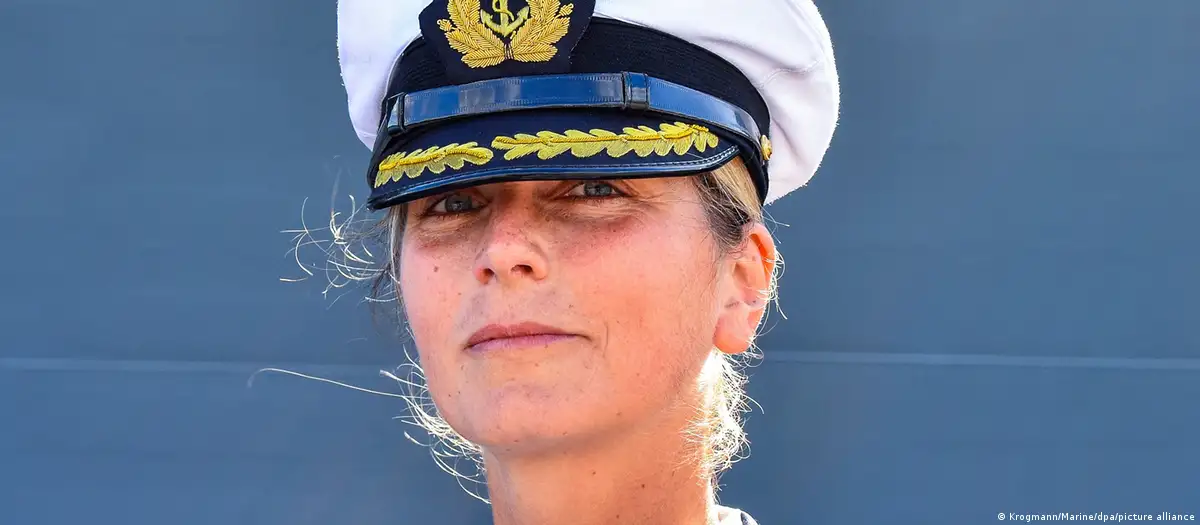

The German Navy has marked a historic milestone with the appointment of Ute Niklas as the first woman to command a German warship frigate. Her promotion reflects the gradual expansion of women’s roles in military leadership, while also highlighting the challenges that remain, from limited female representation to balancing military service with family life.
Leading the Rheinland-Pfalz

Niklas assumed command of the frigate Rheinland-Pfalz during a ceremony in Wilhelmshaven, northern Germany. The handover was attended by Volker Kupsch, commander of the 4th Frigate Squadron, who transferred responsibility from Captain Benedikt Eichhorn to Niklas.
Commenting on her appointment, Niklas said: “I am taking command at an exciting and challenging time. It will require a great deal from the entire crew.”
She also expressed her satisfaction at preparing to return the vessel to sea following a period in a shipyard. According to the German Navy, her immediate priority will be restoring the Rheinland-Pfalz to full operational readiness and active service.
Niklas brings extensive experience with F125-class frigates to her new role. She previously served as the ship’s executive officer, giving her detailed knowledge of its missions, crew structure and operational procedures. More recently, she worked as a staff officer for operations at the Brandenburg State Operations Command.
A Milestone for Women in the German Military
Niklas’s appointment comes within a broader transformation of women’s participation in the German Armed Forces. Although the achievement may appear long overdue to some observers, women were not granted full access to all military career paths in Germany until 2001.
This timeline helps explain why it took nearly a quarter of a century for a woman to reach command of a German warship. Positions at this level generally require 20 years or more of professional experience and career progression.
Her appointment can therefore be seen both as the result of expanded opportunities for women in the military and as the beginning of a new phase that could see more women advance to senior leadership positions.
Women Still Represent a Minority
Despite this progress, women remain underrepresented in the German Armed Forces. Official statistics released at the beginning of the year showed that more than 25,000 women served among a total military personnel of over 184,000, representing approximately 13% of the force, according to figures reported by Der Spiegel.
The figures underline the gap between current female participation and the level of representation the German military hopes to achieve, particularly as it continues working to address personnel shortages and attract new groups from across society.
The Importance of Female Role Models
In its latest report, Germany’s Parliamentary Commissioner for the Armed Forces stated that the potential of female service members had not yet been fully utilized. The report also emphasized that successful women in senior military positions could help encourage more women to consider military careers.
In this context, Niklas represents a practical example of a woman reaching one of the highest leadership positions in a combat unit.
At the same time, reports and observers continue to identify the difficulty of reconciling family responsibilities with the demands of military service as one of the main factors limiting women’s recruitment and retention.
Equipment and Workplace Challenges
Institutional progress has not eliminated the practical challenges faced by women in the German military. A report by Bavarian public broadcaster BR found that equipment specifically designed for women remains insufficient, even 25 years after women gained access to all military specialties.
One prominent example is the shortage of protective vests adapted to women’s physical characteristics. Major General and physician Nicole Schilling said that addressing the issue is among the military’s priorities, although procurement and equipment procedures remain at an early stage.
The situation demonstrates that equality requires more than opening professional opportunities. It also depends on providing working conditions and equipment that take the needs of all service members into account.
Jana: Another Example from a Combat Unit
At 29, soldier Jana offers another example of women serving in Germany’s combat units. She is stationed with Armored Artillery Battalion 131 in Weiden, where she supervises a self-propelled Panzerhaubitze 2000 and a five-member crew, according to a report by Tagesschau published in mid-June.
Jana had not originally planned to work in artillery. She had previously trained in the culinary profession and hoped to pursue that field within the military. However, a lack of suitable positions led her to join the artillery, where she went on to build her military career.
She advises women considering military service to assess their physical and practical abilities carefully and select a specialty that suits them. Some duties require considerable physical strength, including handling shells weighing up to 42.8 kilograms.
Military Identity Beyond Gender
Jana’s experience also draws attention to the cultural aspects of military life. According to Tagesschau, military ranks are still often expressed in traditional masculine forms when addressing women, including titles such as “female captain” or “female senior sergeant.”
Jana, however, does not consider this a major issue. “You are a soldier, regardless of your gender,” she said.
Ute Niklas’s appointment, alongside the experiences of service members such as Jana, illustrates the changing presence of women in Germany’s armed forces. It also shows that while access to leadership positions is expanding, meaningful inclusion requires continued progress in representation, equipment and the practical conditions of military life.