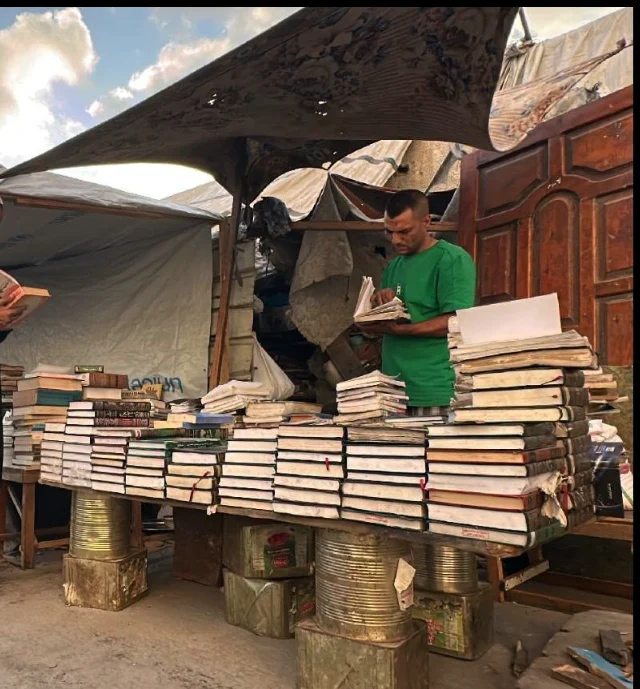

In Gaza, where war and displacement have disrupted daily life and severely affected access to education, Nevine Al-Gharabli has transformed an unexpected discovery into a small but meaningful initiative. While searching for firewood with her husband, she found books scattered among the rubble. Instead of leaving them behind or allowing them to be used as fuel, she decided to rescue them.
Nevine carried the damaged books back to her tent, where she began cleaning, sorting, repairing, and organizing them. What initially appeared to be a simple act of collecting abandoned items gradually became an effort to preserve knowledge and provide students and displaced people with access to reading and educational resources.

From Searching for Firewood to Saving Books
During one of her trips to collect firewood, Nevine noticed books lying among the remains of damaged buildings. Although the books were dirty, worn, incomplete, or damaged, she believed they still held value for anyone seeking knowledge.
She brought the books home and began restoring what she could. For Nevine, the books were not merely old papers. They represented an important part of the educational and intellectual life that war and displacement had placed under severe pressure.
A Small Library Built from the Rubble
As the collection grew, Nevine discovered books covering a range of subjects, including medicine, engineering, computer science, psychology, English language studies, and religious studies. The collection also included copies of the Quran.
With the support of her husband and children, she continued collecting books from different locations. The family cleaned and repaired the books before arranging and displaying them in their small library.
The initiative gradually developed into a community resource for students, displaced people, and anyone hoping to continue learning despite the difficult conditions in Gaza.
Making Books Accessible to Students and Displaced People
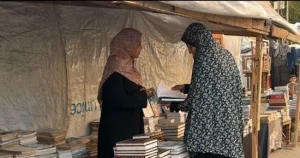
Nevine sells some books for a symbolic price of around two shekels to people who can afford to pay. Those who cannot pay receive books free of charge.
Her goal is not to make a profit. Instead, she wants to ensure that books reach people who need them and that access to knowledge remains possible for those trying to continue their education.
In Gaza, where war and displacement have made educational materials increasingly difficult to access, even a small collection of rescued books can provide students with valuable support.
Preserving Knowledge During War
Nevine cannot rebuild a destroyed school or restore a library buried beneath the rubble. However, she can rescue a book, clean its pages, repair its cover, and place it in the hands of a student who may need it.
Her initiative reflects the importance of protecting education and knowledge during times of crisis. Each book she saves offers another opportunity for reading, learning, and continuing education.
Her story also highlights a striking contrast. She leaves home searching for firewood to meet her family’s immediate needs, but returns carrying books that may help others build a better future.
Between firewood and books, Nevine continues to do what she can. While firewood supports daily survival, books preserve knowledge and create possibilities for tomorrow. By rescuing books from the rubble, she is helping ensure that education does not become another casualty of war.