
The Egyptian Embassy in Austria hosted a cultural and humanitarian gathering this week, spotlighting Egypt’s enduring civilizational legacy and the historical role of women as agents of governance, sustainability, and social balance.
The event, organized by Marwa El-Moslemany, spouse of Ambassador Mohamed Nasr, Egypt’s envoy to Austria and permanent representative to the United Nations and international organizations in Vienna, brought together members of the United Nations Women’s Guild.
Reframing ancient Egypt for a modern audience
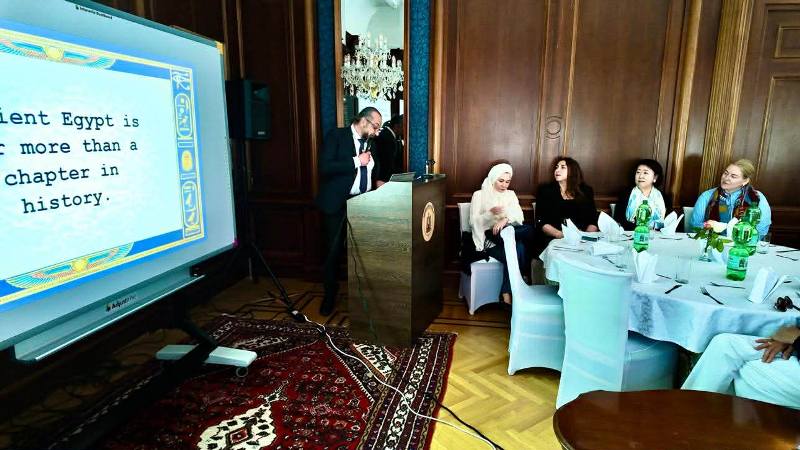
At the center of the gathering was a lecture titled “Ancient Egypt: A Timeless Model for Governance, Sustainability, and Women’s Empowerment,” which positioned Egypt not as a relic of the past, but as a continuous human experience capable of informing present-day global challenges.
In her opening remarks, El-Moslemany emphasized that women’s empowerment in Egypt is not a recent response to international discourse but rather “a natural extension of a civilizational awareness shaped over thousands of years.”
Women at the heart of Egyptian civilization
The lecture, delivered by embassy translator and Egyptologist Mohamed El-Ashry, traced the evolution of women’s roles in Egypt from antiquity to the modern era. He argued that principles aligned with the United Nations Sustainable Development Goals — particularly gender equality — were deeply embedded in ancient Egyptian society long before their formal articulation.
Women in ancient Egypt, he noted, enjoyed advanced legal and economic rights, including:
- Ownership of property
- Management of businesses
- Authority to sign contracts
- Participation in judicial and administrative roles
In some cases, women ascended to the highest levels of power, reflecting an early understanding of gender balance within both family and state structures.
Symbolism and continuity
The presentation also explored the symbolic dimension of women in ancient Egyptian belief systems. Goddesses embodied values such as justice, love, and strength, with Isis highlighted as an enduring symbol of protection and devotion.
This legacy was echoed through a cultural reference to the “Hymn of Isis,” performed during Egypt’s globally televised Pharaohs’ Golden Parade by soprano Amira Selim, linking ancient heritage with contemporary artistic expression.
A modern embodiment
The discussion extended into the present by highlighting Ghada Waly, head of the United Nations Office in Vienna and Executive Director of the UN Office on Drugs and Crime, as a modern example of Egyptian women’s global leadership.
Her role was presented as part of a broader continuum, demonstrating how historical foundations continue to shape Egypt’s contributions on the international stage.
Cultural diplomacy through experience
Alongside the intellectual program, the embassy hosted a traditional Egyptian breakfast, offering guests a sensory introduction to the country’s rich culinary heritage.
Participants left with a deeper appreciation for Egypt’s unique civilizational narrative, where women have consistently played a central role in shaping societal progress.
As organizers framed it, the story of Egyptian women is not merely historical — it remains a living influence, continuing to inform contemporary conversations on equality, leadership, and sustainable development.