
When women hold leadership positions, societies become stronger, economies become more resilient, and outcomes improve for everyone. Yet equal representation in senior positions across public and private institutions remains far from reality, according to a new United Nations report on gender equality.
The report found that progress across the dimensions of the 2030 Agenda for Sustainable Development—including peace, education, poverty reduction and climate action—is stronger when women have meaningful decision-making power.

However, it warned that institutions built over decades to advance gender equality are facing systematic weakening, threatening to stall or reverse progress at a time when the world cannot afford to move backward.
The 2026 Gender Snapshot was prepared by UN Women and the United Nations Department of Economic and Social Affairs. Its key findings include:
- One in three institutional mechanisms responsible for gender equality has experienced an erosion of its institutional mandate over the past two years.
- Funding for gender equality has fallen to its lowest level since 2021.
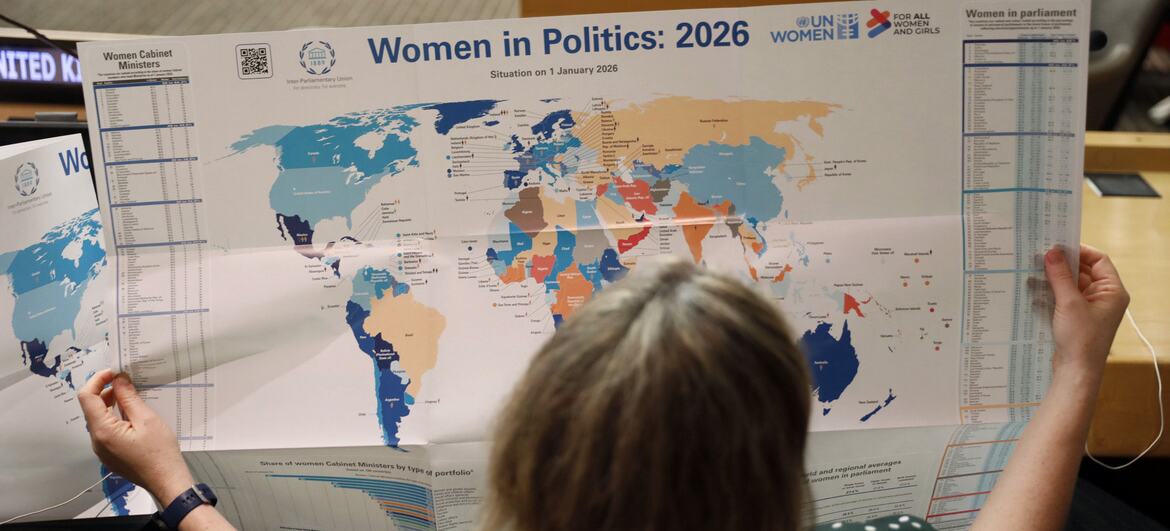
- Political power remains heavily concentrated, with men leading six out of every seven countries.
- Up to eight in 10 women candidates for public office experience violence in public life.
- Nearly nine in 10 defence ministers and more than eight in 10 finance ministers are men.
- Women hold only 6% of chief executive officer positions globally.
- Women head fewer than 20% of the highest judicial bodies.
Equality Without Power Is Not Equality
UN Women Executive Director Sima Bahous said that as long as power remains concentrated in institutions that systematically exclude women, societies will be unable to reach their full potential.
She stressed that equality cannot be achieved without equal opportunities to access power, stating that equality without power is not equality at all.
United Nations Under-Secretary-General for Economic and Social Affairs Li Junhua said that, based on current rates, gender equality remains 171 years away.
He stressed that investing in gender equality, as well as in institutions and statistical systems that ensure accountability, should not be viewed as a cost. Instead, he described such investment as the fastest route toward fulfilling the 2030 Agenda’s promise of sharing power equally among all.
UN Women and the United Nations Department of Economic and Social Affairs called for the reversal of the political backsliding on gender equality and for power to be shared more equitably.