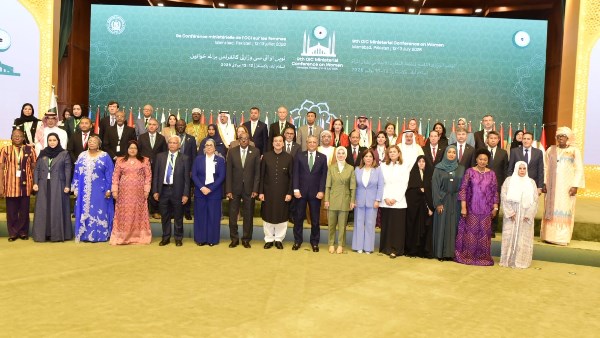

Egypt reaffirmed its commitment to advancing women’s empowerment during the Ninth Ministerial Conference on Women of the Organization of Islamic Cooperation (OIC), held in Islamabad, Pakistan, under the theme “Social, Economic and Political Empowerment of Women in the OIC Member States: Challenges and the Way Forward.”
Representing Egypt, Counselor Amal Ammar, President of the National Council for Women (NCW), delivered the country’s official statement at the two-day ministerial meeting, which brought together ministers, senior government officials, and representatives from OIC member states to discuss strategies for strengthening women’s participation in sustainable development.
The conference was attended by Syed Yousaf Raza Gilani, Chairman of the Senate of Pakistan and former Prime Minister of Pakistan; Ambassador Tarig Ali Bakheet, Assistant Secretary-General for Humanitarian, Cultural and Social Affairs at the Organization of Islamic Cooperation; and Afshan Shafiq, Executive Director of the Women Development Organization, alongside ministers and senior officials from OIC member states.
Ammar expressed Egypt’s appreciation to the Government of Pakistan for hosting the conference and praised the OIC General Secretariat for its continued efforts to strengthen cooperation among member states. She stressed that investing in women and men alike remains fundamental to achieving sustainable development and resilient societies.
Addressing the conference, Ammar noted that today’s global challenges—including armed conflicts, humanitarian crises, economic uncertainty, rapid technological transformation, and climate change—disproportionately affect women and girls. She emphasized that empowering women is no longer solely a social objective but a strategic development priority directly linked to national stability and sustainable growth.
She highlighted Egypt’s comprehensive approach to women’s empowerment under President Abdel Fattah El-Sisi, noting that the country has introduced constitutional, legislative, and institutional reforms while implementing the National Strategy for the Empowerment of Egyptian Women 2030, the first national strategy in Egypt aligned with the United Nations Sustainable Development Goals.
As Egypt’s independent national mechanism for women’s empowerment under Article 214 of the Constitution and Law No. 30 of 2018, the National Council for Women continues to implement this vision through partnerships with government institutions, the private sector, civil society organizations, and international development partners.
Ammar highlighted several flagship national initiatives, including the Noura Programme, launched under the patronage of Mrs. Entissar El-Sisi, Spouse of the President of the Republic, to invest in the development of girls aged 10 to 14. The initiative has already benefited more than 18,000 girls and has since expanded through the Noor Programme to engage boys in promoting mutual respect and shared responsibility.
She also presented the Tahwesha Programme as a leading national model for women’s financial inclusion and economic empowerment, helping women adopt digital savings and lending tools while supporting the establishment of thousands of small businesses that improve household incomes.
In discussing women’s economic participation, Ammar pointed to Egypt’s launch of the Egyptian Gender Equity Seal, awarded to 31 leading companies that have demonstrated their commitment to gender equality in the workplace.
She also outlined significant gains in women’s leadership and public representation. Nearly 3,968 women now serve as judges and prosecutors across Egypt’s judicial bodies, with women occupying senior judicial positions, including the presidency of the Administrative Prosecution Authority. Women also account for 26% of deputy governors, while senior advisory positions to the President of the Republic now include female advisors for National Security and Economic Affairs.
Women’s political representation has likewise continued to expand, with women holding approximately 26.8% of seats in the House of Representatives and around 10.6% of seats in the Senate.
Ammar emphasized that women’s empowerment across the Islamic world is fully consistent with the principles of Islam, which uphold women’s dignity and recognize their equal responsibility alongside men in building prosperous societies. She called on OIC member states to translate these values into practical policies that ensure equal opportunities in education, employment, finance, technology, and leadership while strengthening cooperation and sharing successful national experiences.
She also underscored the urgent humanitarian situation facing Palestinian women, particularly in the Gaza Strip, stressing that women and girls continue to bear an immense burden amid ongoing conflict, displacement, and deteriorating humanitarian conditions. Ammar called for greater international action to ensure compliance with international humanitarian law and provide effective protection for civilians.
Concluding Egypt’s statement, Ammar reaffirmed the importance of expanding cooperation within the Organization of Islamic Cooperation through knowledge exchange and capacity building to support national women’s empowerment policies. She also encouraged OIC member states that have not yet joined the Women Development Organization to complete their accession procedures, strengthening the institution’s capacity to advance women’s development across the Islamic world.