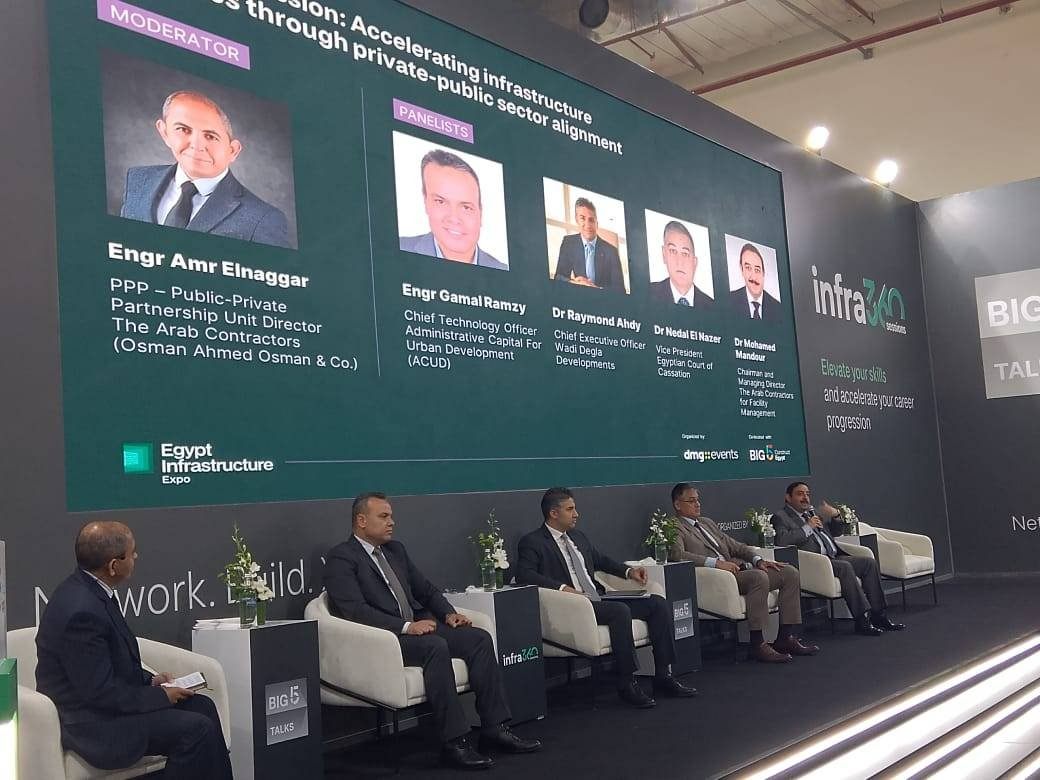


CAIRO – Big 5 Construct Egypt’s held at the Egypt International Exhibition Center (EIEC), hosted a high-level panel discussion, under the The Egypt Infrastructure Exp. It focused on optimizing project delivery through enhanced collaboration between the public and private sectors. The session, titled “Panel Discussion on Accelerating Infrastructure Timelines through Public-Private Sector Alignment,” was part of the infra360 series and brought together key stakeholders to discuss the operational and legislative frameworks required to meet national development objectives.

The discussion was moderated by Eng. Amr Elnaggar, Public-Private Partnership (PPP) Unit Director at The Arab Contractors (Osman Ahmed Osman & Co.). The session focused on the growing shift toward PPP models as a primary mechanism for infrastructure delivery in Egypt. Participants examined how aligning the strategic objectives of government entities with the technical agility of the private sector can reduce project lead times while improving resource allocation, legal and operational lifecycle management, and sustainability.
Technological and Legal Perspectives
Eng. Gamal Ramzy, Chief Technology Officer of the Administrative Capital for Urban Development (ACUD), addressed the role of digital infrastructure in managing large-scale urban centers. His contribution focused on how integrated technology systems facilitate faster decision-making and more efficient project monitoring.
He revealed significant developments regarding construction permits in Egypt, stating that, “For the first time, ACUD has officially launched an E-Permit platform through which project managers and contractors can apply for permits electronically, upload the required documentation, and track the entire process online.”
This initiative represents one of ACUD’s many efforts to streamline procedures and mitigate project risks.
Representing the legal and regulatory perspective, Dr. Nedal El Nazer, Vice President of the Egyptian Court of Cassation, discussed the importance of a stable legislative environment. He emphasized that clear contractual frameworks and streamlined dispute-resolution mechanisms are essential for attracting long-term private investment and ensuring project continuity.
He noted that, “Many contractual disputes can be substantially mitigated when their management is clearly defined in advance rather than left ambiguous.” He cited force majeure as an example of a frequently overlooked issue, alongside future currency fluctuations and legislative changes introduced through state policy decisions.
Development and Asset Management
From a real estate and investment perspective, Dr. Raymond Ahdy, Chief Executive Officer of Wadi Degla Developments, highlighted the importance of infrastructure readiness for private-sector commercial and residential developments. He noted that early-stage alignment on utility and transportation networks is critical to maintaining project delivery schedules.
Dr. Raymond stated that, “The state relies on the private sector for nearly 47% of its infrastructure projects.” While describing this as a significant responsibility, he also characterized it as a substantial opportunity for private-sector participants, provided that contracts are clearly and effectively drafted. Otherwise, projects risk falling into what the average holding period, which in Egypt has risen to approximately 20 months; which is “shocking” as he describes.
The conversation concluded with a focus on the post-construction phase. Dr. Mohamed Mandour, Chairman and Managing Director of The Arab Contractors for Facility Management, argued that project success should be measured across the entire lifecycle of an asset. He stressed that integrating facility management considerations into the earliest design and construction stages is vital to achieving long-term sustainability and cost efficiency. These considerations include establishing an appropriate budget and conducting a rigorous feasibility study, particularly for international projects.
In support of this approach, Dr. Mohamed shared exclusive news, stating that, “Egypt is currently finalizing its first comprehensive code governing project and facility tendering, management, and operations, which is expected to be released by the New Year.” He added that meetings are being held throughout the month with leading industry experts to develop the code in accordance with internationally recognized standards and best practices.
Outlook
The session underscored a clear consensus among industry leaders: accelerating Egypt’s infrastructure agenda requires moving beyond traditional procurement models toward integrated public-private partnerships. More importantly noting that sustainability and integrating technology are no longer optional.
By combining state-led planning with private-sector innovation and legal certainty, the panel identified a practical pathway for sustaining the current momentum of the country’s national development projects.