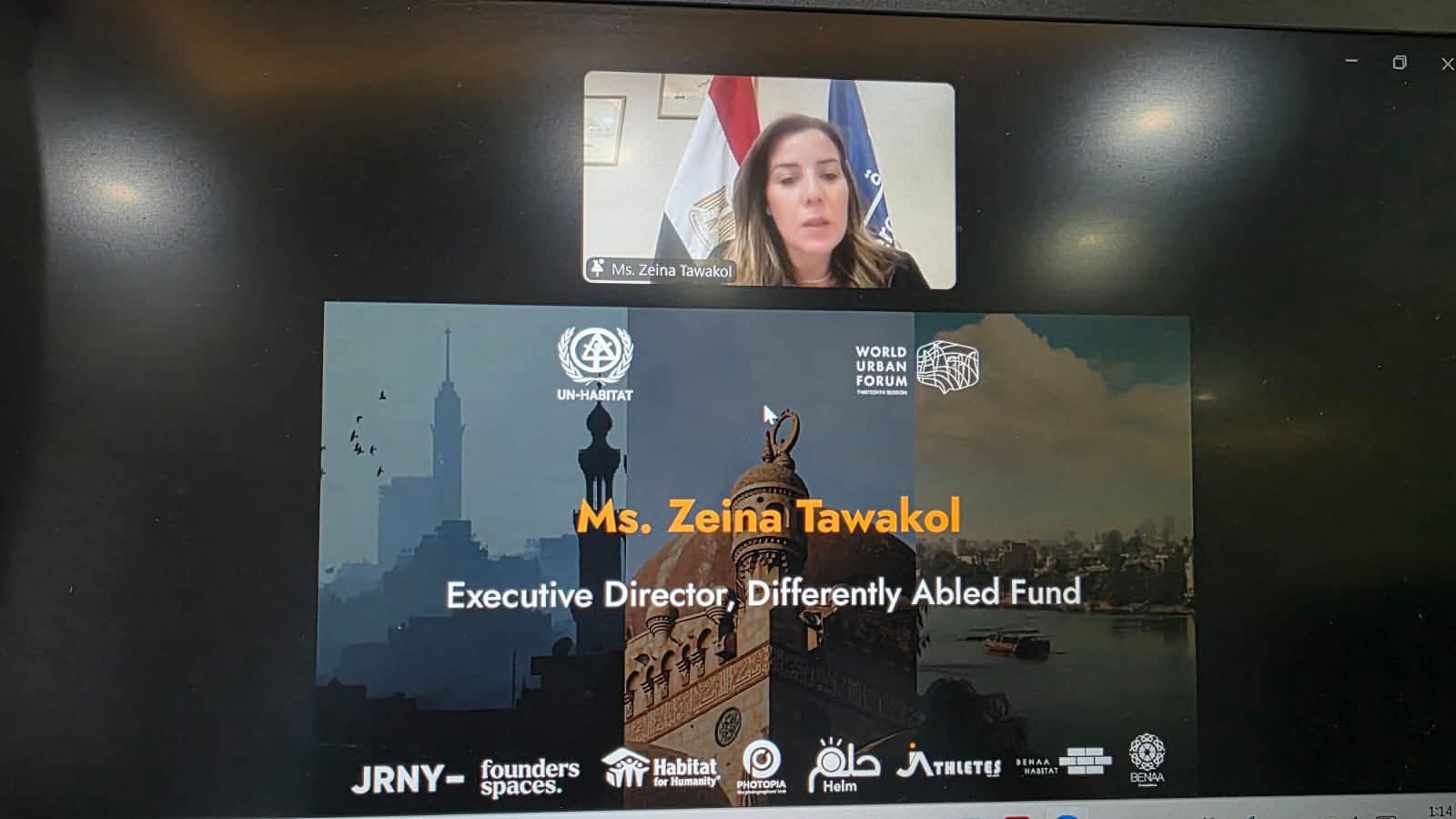

Egypt pushes inclusive housing agenda as Zina Tawakkol calls for accessibility-first urban design at Urban Week. Speaking during Egypt Urban Week, held under the theme “Together for Housing,” Zina Tawakkol, Executive Director of the Qaderoon Bikhtilaf Fund, underscored the importance of integrating universal design principles into all urban development projects from the outset.
The event was organized by the United Nations Human Settlements Programme in collaboration with Egypt’s Ministry of Housing, Utilities and Urban Communities (Egypt), Ministry of Local Development (Egypt), and Ministry of Environment (Egypt), bringing together policymakers and urban development experts to advance sustainable and inclusive housing strategies.

Accessibility as a foundation of urban planning
During a high-level panel discussion on inclusive housing and universal design, Tawakkol stressed that equitable urban communities cannot be achieved unless accessibility is treated as a fundamental requirement rather than an optional feature added later in the design process.
She emphasized that persons with disabilities are fully integrated members of society and key partners in development, not secondary beneficiaries of urban policy.
Expanding Egypt’s disability inclusion framework
Tawakkol highlighted Egypt’s growing focus on disability inclusion over recent years, noting that 2018—declared the Year of Persons with Disabilities—marked a turning point in national policy.
That year also saw the introduction of Law No. 10 of 2018, Egypt’s first comprehensive legislation guaranteeing the rights of persons with disabilities and requiring state institutions to ensure accessible and supportive environments.
This was followed by the establishment of the National Council for Persons with Disabilities and the launch of the Qaderoon Bikhtilaf Fund, alongside expanded partnerships with civil society and the private sector to strengthen service delivery.
Accessibility in rural development projects
Tawakkol also highlighted the role of the Hayah Karima (“Decent Life”) initiative in advancing accessibility standards across Egypt’s villages and rural communities.
She noted that accessibility codes have been implemented in infrastructure projects, schools, youth centers, and public service buildings. These include ramps, tactile pathways for visually impaired individuals, accessible sanitation facilities, and digital inclusion tools aimed at improving independence and safety.
Rehabilitation services and economic empowerment
On the social and medical front, Tawakkol pointed to the expansion of rehabilitation services, including speech therapy, physical rehabilitation, and psychological support centers established in rural areas.
She also highlighted nationwide medical convoys providing assistive devices such as wheelchairs, prosthetics, hearing aids, and mobility supports, alongside free medical examinations and surgeries.
In addition, she noted efforts to promote economic inclusion through small business financing, microcredit schemes, and vocational training programs designed to enable persons with disabilities to access stable employment and sustainable livelihoods.
Data-driven coordination for inclusive services
Tawakkol concluded that the Qaderoon Bikhtilaf Fund operates as a coordination and development platform guided by data-driven planning and cross-government collaboration, ensuring that services are aligned with the real needs of persons with disabilities across Egypt.