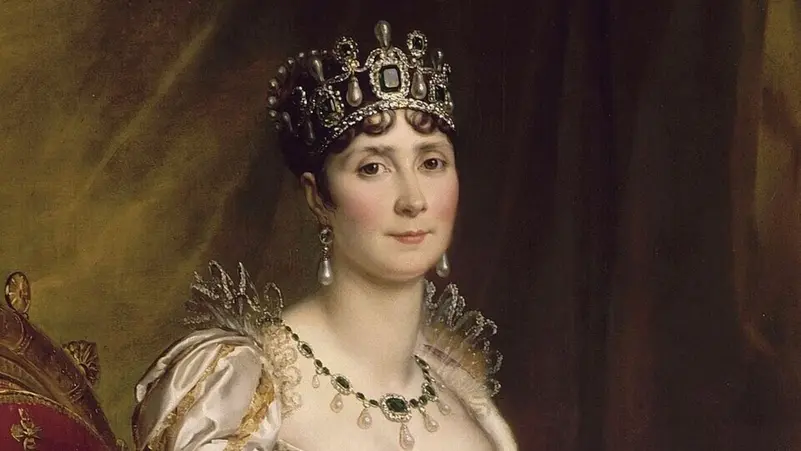

Few women in French history experienced a life as turbulent as Joséphine de Beauharnais. Born in Martinique in 1763, she survived political upheaval, imprisonment and the threat of execution during the French Revolution before eventually becoming the first wife of Napoleon Bonaparte and Empress of the French.
Her life took a dramatic turn during the Reign of Terror in 1794, when she was imprisoned and faced the possibility of following her first husband, Alexandre de Beauharnais, to the guillotine. Her release came only days after the fall of Maximilien Robespierre, bringing an end to one of the most dangerous periods of the French Revolution.

From Martinique to France
Joséphine was born Marie-Joseph-Rose de Tascher de La Pagerie on June 23, 1763, at the Trois-Îlets plantation in Martinique. She was the eldest daughter of a French noble family living on the Caribbean island.
At the age of 16, she travelled to France with her father to marry Alexandre de Beauharnais, an aristocrat and military officer who was also born in Martinique. The couple married on December 13, 1779, in Noisy-le-Grand, near Paris. They later had two children, Eugène and Hortense.
The marriage was troubled, and the couple separated in 1785 without divorcing. Joséphine faced financial difficulties and eventually returned to Martinique with her daughter Hortense, before later coming back to France.
A Marriage Marked by Conflict
Alexandre de Beauharnais became involved in French political life during the Revolution. He served as a member of the Constituent Assembly and later became president of the National Constituent Assembly before returning to military service.
His military career suffered a major setback after the surrender of Mainz during the French Revolutionary Wars. Alexandre subsequently resigned his command and returned to his estates. He was arrested in March 1794 and accused of failing in his military duties and of conspiracy.
The Revolutionary Tribunal sentenced him to death, and he was guillotined on July 23, 1794.
Joséphine and the Threat of the Guillotine
Joséphine was arrested during the same period and imprisoned at the Carmes prison in Paris. Her political connections and activities placed her under suspicion at a time when revolutionary authorities were carrying out executions on a large scale.
Her fate, however, changed dramatically in the summer of 1794.
On July 27, 1794 — 9 Thermidor according to the French Revolutionary calendar — Robespierre was overthrown. He was executed the following day, bringing the Reign of Terror to an end.
Joséphine was released from prison on August 6, 1794. Her release meant that she escaped the fate that had already overtaken her first husband only weeks earlier.
From Survivor to Empress
Joséphine’s life changed again after she met Napoleon Bonaparte. The couple married in 1796, when Napoleon was a rising military commander.
After Napoleon’s coup of 18 Brumaire in November 1799, he became First Consul of the French Republic. Joséphine increasingly occupied a prominent public role, particularly through her social connections and her residence at Malmaison near Paris.
Napoleon and Joséphine were crowned Emperor and Empress of the French on December 2, 1804, at Notre-Dame Cathedral in Paris. Joséphine thus became the first Empress of the French.
Her position at the imperial court also became closely associated with fashion, art and the gardens of Malmaison. She developed extensive collections and cultivated rare plants and exotic species at the estate, turning the residence into one of the best-known places associated with her life.
Divorce and the Final Years at Malmaison
Despite their imperial status, Napoleon and Joséphine eventually separated because their marriage had produced no heir. Their divorce was formally pronounced in December 1809.
Joséphine retained her imperial title and withdrew to Malmaison, where she continued to devote herself to art, gardens and her family.
In 1814, Napoleon abdicated and was exiled to Elba. Joséphine remained at Malmaison and never saw him again before his departure for the island.
Joséphine died at Malmaison on May 29, 1814, at the age of 50 according to the calendar-year calculation, although official historical sources commonly record her age as 51. The cause of death is described by the Fondation Napoléon as fulminant pneumonia. Her funeral was held four days later at the Church of Saint-Pierre-Saint-Paul in Rueil.
Today, Joséphine de Beauharnais remains a significant historical figure whose life connected the French Caribbean, the French Revolution and the First French Empire. Her story encompasses political upheaval, imprisonment, survival and an eventual rise to the imperial court — making her one of the most notable women of Napoleonic France.