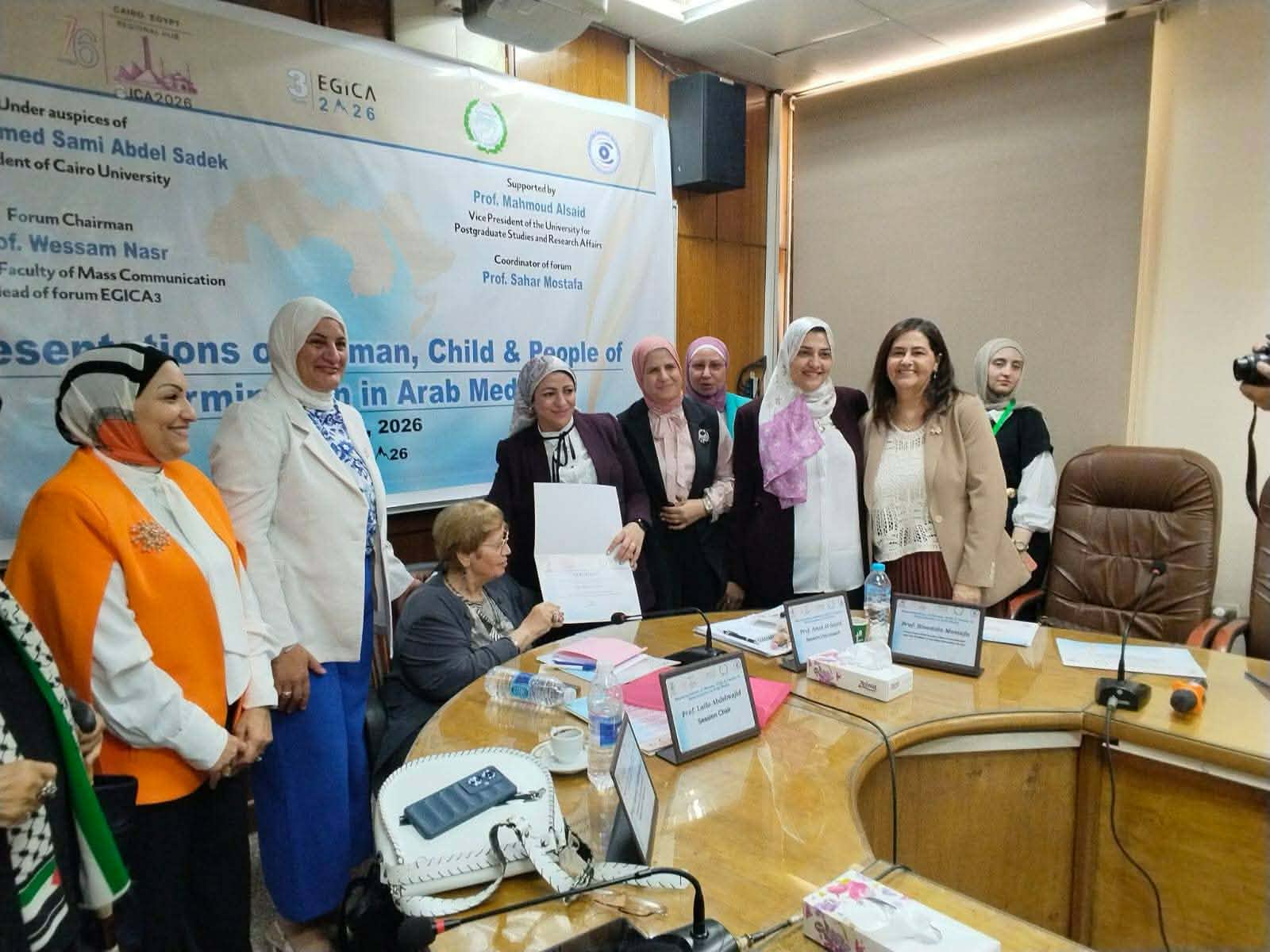

The Faculty of Mass Communication at Cairo University hosted a panel discussion titled *“Arab Women in the Digital Space”* as part of the third edition of the annual international EGICA Forum 2026.
The session was chaired by Dr. Laila Abdel Meguid, former Dean of the Faculty of Mass Communication, and Dr. Amal El Sayed, Head of the Journalism Department. It brought together a distinguished group of academics, researchers, and media specialists to examine the opportunities and challenges shaping the digital experiences of Arab women.

Examining Women’s Presence in the Digital Environment
Opening the discussion, Dr. Laila Abdel Meguid highlighted the growing importance of digital platforms in shaping public awareness and social attitudes.
She stressed that the digital space has become one of the most influential arenas affecting contemporary societies, making it essential to examine both the opportunities and challenges associated with Arab women’s participation online. She also emphasized the value of academic and professional perspectives in strengthening women’s roles and supporting their empowerment in the digital era.
Participants discussed the current reality of Arab women’s presence in digital spaces, exploring how online platforms have expanded opportunities for social and professional engagement while also creating challenges linked to online violence, hate speech, and persistent stereotypes.
The discussion also addressed the impact of rapid technological transformation on the representation of Arab women within the evolving media landscape and explored ways to create a more supportive and empowering digital environment.
Technology and Social Context
Dr. Awatef Abdel Rahman, Professor of Journalism at the Faculty of Mass Communication, addressed the challenges facing Arab women in digital spaces.
She argued that discussions about technological advancement and the dominance of digital platforms often overlook the broader social realities that shape women’s experiences.
According to Abdel Rahman, technology cannot be separated from the social and cultural environment in which it operates. Understanding the position of Arab women online requires examining the economic, cultural, and social conditions that influence their participation rather than focusing solely on technological factors.
She also noted that perceptions of women have been shaped over decades by a variety of intellectual and social influences, resulting in diverse and sometimes conflicting narratives about women’s roles and status within society.
Reprioritizing Women’s Issues
Abdel Rahman further emphasized the importance of reassessing societal priorities when addressing women’s issues in Egypt.
She suggested that discussions should begin with issues most closely connected to everyday social realities, particularly matters related to family life and women’s rights, before expanding to broader international issues affecting women. Such an approach, she explained, would help balance local cultural contexts with global conversations about women’s rights.
Digital Media Creates New Opportunities
Dr. Hoda Mostafa, former Dean of the Faculty of Mass Communication and Vice Chairperson of the State Information Service, highlighted the opportunities created by digital transformation for women.
She explained that digital platforms have enabled women to become active contributors rather than passive recipients of media content. Unlike traditional media, digital tools provide greater opportunities for participation, self-expression, and engagement in public discourse.
Mostafa also noted that digital platforms support skill development through self-learning, continuous training, and practical experimentation. These opportunities can enhance women’s professional capabilities, open new pathways for creativity and production, and strengthen their presence in the evolving digital economy.
She added that content creation has allowed many women to establish themselves in fields that were previously less accessible, whether in media, creative industries, or professional sectors.
Expanding Access to Knowledge and Skills
Digital technologies have also made knowledge and information more accessible, helping women develop new skills and increase awareness across a wide range of fields.
According to Mostafa, these developments represent the beginning of a broader societal shift in perceptions of women’s roles and contributions. She stressed that sustaining this progress requires continued institutional support and policies that place women’s issues among national priorities.
Women as Influential Content Creators
Dr. Nermeen Agwa, Professor at the Faculty of Mass Communication and Director of the Center for Women’s Research and Media, highlighted the positive opportunities available to Arab women in the digital sphere.
She noted that Arab women have maintained a strong presence across both traditional and digital media, contributing to public awareness and bringing greater attention to women’s issues.
Agwa added that women have become key participants in content creation and media messaging across multiple platforms, reflecting their growing influence in shaping public discourse and communication in the digital age.
Building a More Inclusive Digital Future
The discussion underscored the importance of creating digital spaces that enable women to participate safely, develop professionally, and contribute meaningfully to society.
As technology continues to transform communication and media, participants agreed that empowering women in the digital environment remains essential to achieving inclusive and sustainable development across the Arab region.