
Abdel Azim Othman: Choosing the Right Funding for Startups Depends on Their Business Activities and Growth Plans
Ahmed Wadi: Money Fellows Has Transformed the Traditional Gam‘eya Model into a Digital Platform Providing Access to Liquidity
Amr Gamal: Octane Generates EGP 1.5 Billion in Monthly Sales and Serves 3,500 Companies
Cairo, November 26, 2026
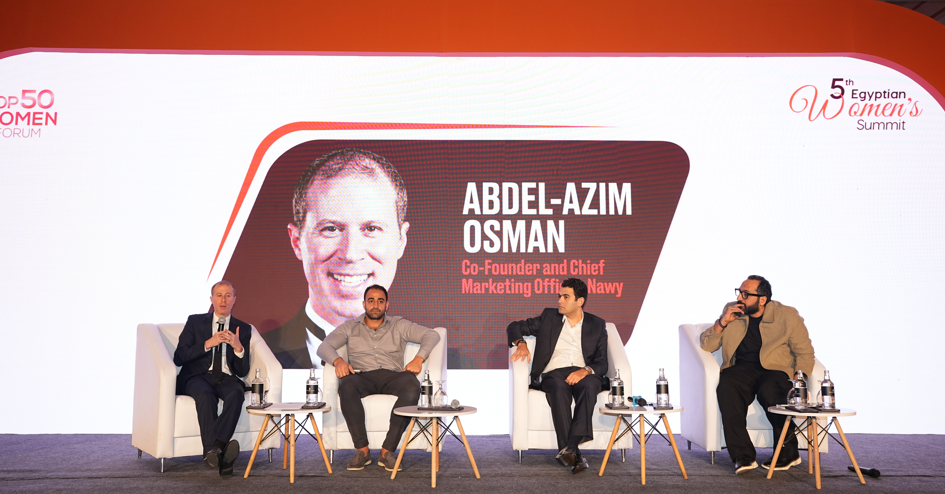
A session titled “The Founders’ Generation: How Do You Build a Company Ahead of Its Time?” at the fifth edition of the Egyptian Women’s Summit 2026 explored the founding and development journeys of Nawy, Money Fellows and Octane. The founders shared how they built innovative business models designed to address market challenges and unlock new growth opportunities, as well as the obstacles they encountered during establishment, expansion and competition.
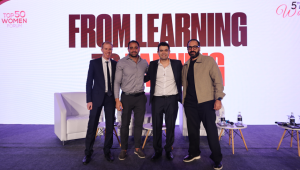
The session featured Abdel Azim Othman, Co-Founder of real estate company Nawy; Ahmed Wadi, Founder and CEO of Money Fellows; and Eng. Amr Gamal, CEO and Co-Founder of Octane. It was moderated by Ahmed Talaat, Founder and Host of the “Beta‘ Eqtisad” podcast.
The discussion examined the factors that enable startups to achieve sustainability and growth, from identifying market needs and turning problems into investment opportunities to developing products and services that meet customer requirements, securing suitable funding and navigating regulatory and operational challenges.
Abdel Azim Othman, Co-Founder of Nawy, shared the company’s founding story and the evolution of its business model. He explained that the idea emerged from one of the founders’ personal experiences when trying to purchase a property and struggling to find sufficient information online about real estate projects and developers. This experience revealed a gap in the availability of information and transparency in Egypt’s real estate market.
He added that this prompted the founders to establish a platform that gives customers clearer access to market information and helps them make purchasing decisions based on reliable data. He noted that the company has received more than 500 positive customer reviews to date.
Othman said that studying the Egyptian market revealed that property purchases operate differently from those in other markets. Transactions still rely largely on direct, offline dealings, while access to mortgage financing remains limited. This prompted the company to develop solutions tailored to the nature of the market and customers’ needs.
In this regard, he explained that Nawy Shares enables individuals to invest in real estate with amounts starting from EGP 5,000, opening the market to wider segments of society without requiring them to purchase an entire property.
On startup financing, Othman stressed that external funding is not essential for every company during its establishment and growth stages. He explained that Nawy relied on reinvesting its profits during its early years to finance expansion and development, without resorting to external funding rounds.
He added that the company turned to investment funds when it reached a stage at which it sought to accelerate growth and expand its operations, requiring funding sources aligned with its expansion plans. Investment funds seek opportunities that generate returns, while companies need capital to support growth, creating shared interests between the two sides.
He emphasized that funding requirements vary from one startup to another, depending on the nature of its business and growth plans. Some companies can expand using their own resources and profits, while others require external financing to reach their desired scale of operations.
For his part, Ahmed Wadi, Founder and CEO of Money Fellows, said the idea behind the company emerged from a personal experience in which he struggled to secure financing while living in Germany because he did not have a sufficient credit history to qualify for a loan. This prompted him to consider transforming the traditional gam‘eya model into a digital platform that gives individuals access to liquidity.
Wadi explained that his background in computer engineering encouraged him to use technology to address real-world problems, leading him to study the traditional savings association model, which millions of people around the world rely on to save money and access financing.
He added that the idea was to enable people in different countries to join digital savings groups. This would allow someone living in Germany, for example, to participate in a group with members from Egypt, India or Pakistan, without geographical restrictions. However, turning the model into a digital service required building a system that would ensure customers trusted the platform to manage their money and financial commitments.
He noted that building trust was one of the company’s biggest challenges, given that the nature of the risk varies according to each member’s position in the group. Those receiving funds earlier must be carefully assessed to ensure they can meet their subsequent repayment obligations, while members scheduled to receive their funds later must have confidence in the company’s ability to fulfil its commitments.
Wadi pointed out that the company initially struggled to complete savings groups. Attracting customers to earlier positions was easier, while filling later positions presented a greater challenge. This prompted the company to improve its customer assessment mechanisms, strengthen trust, enhance service quality and ensure that it consistently honoured its commitments to users.
Regarding regulatory challenges, Wadi explained that determining the appropriate legislative framework for the company’s business model was one of its main obstacles. The activity was relatively new and did not fit directly within existing financial services categories, such as microfinance and consumer finance. This required engagement with regulatory authorities to explain the model and how it operates.
He added that the company joined the Central Bank of Egypt’s Regulatory Sandbox, which allowed it to test its business model in a controlled environment and work towards developing the rules and regulations governing its activities. He confirmed that the company currently operates under the Central Bank of Egypt’s supervision and is in the process of graduating from the Regulatory Sandbox.
Wadi also revealed that the company intends to undertake a major investment round in 2027, having successfully attracted more than $60 million from sovereign funds, foreign investors and development finance institutions.
He explained that fundraising presented significant challenges, particularly during the company’s first investment round, which took the longest to complete. Given the novelty of its business model and the absence of an extensive operating track record, investors focused on assessing the founders’ capabilities, the size of the target market and the company’s growth potential.
He added that convincing investors of the unconventional business model was difficult because there were no clear international precedents that could position the company as a version of an already successful model in another market. This made completing the early funding rounds even more challenging.
He noted that, during its early stages, the company focused on attracting angel investors, who typically provide relatively smaller investments, rather than approaching major venture capital funds directly. It succeeded in attracting around 21 angel investors during its initial phase.
Wadi explained that the company’s strategy focused on using its initial funding efficiently and maximizing return on investment, while demonstrating the viability of its business model and its ability to achieve sustainable growth. This, in turn, strengthened its negotiating position with investors in subsequent funding rounds.
Meanwhile, Amr Gamal, CEO and Co-Founder of Octane, outlined the motivations behind establishing the company. He explained that the idea grew out of his previous experience working with leading international consulting firms that provide restructuring and strategy services to governments and major organizations, often outside Egypt.
He said that his work in the field gave him insight into how major challenges in developing countries could be addressed through tailored solutions. At the same time, he identified a fundamental problem in the Egyptian market that existing local and international solutions were not adequately addressing at its roots. This prompted him and his co-founder to examine the issue in depth before rushing to launch a product or adopt a conventional solution.
Gamal explained that the team explored several potential solutions involving fuel, cards and related systems, as well as fuel and fleet expenses. They ultimately focused on fuel and fleet operating expenses, given the significant spending involved and the urgent need for practical solutions.
He noted that Octane began operations in 2022 with a proof-of-concept (POC) model and a limited solution. Its monthly sales in June of that year stood at approximately EGP 2,000. Since then, the company has grown rapidly, reaching around EGP 1.5 billion in monthly sales, serving approximately 3,500 companies and covering around 350,000 vehicles. According to Gamal, this represents more than 17% of the targeted market or vehicle segment.
He stressed that Octane’s solution has achieved product-market fit and expanded across a wide range of sectors. The company works with government entities and major institutions, including the Presidency, the Cabinet, the Central Bank of Egypt and Parliament, as well as entities and companies involved in national projects such as Mostakbal Misr.
In the private sector, he highlighted the company’s work with major businesses in food and beverages, telecommunications, contracting and construction, including Pepsi, Coca-Cola and Juhayna. This reflects the diversity of sectors served by the platform.
Gamal added that the company subsequently expanded into managing other fleet operating expenses, including fuel and card systems, in partnership with entities involved in roads and related services. He noted that the company had achieved approximately 95% of the project’s scope or the targeted digital transactions in the Egyptian market.
The company’s activities have also expanded to include maintenance services, enabling payments and transactions to be managed directly by Octane rather than relying on conventional point-of-sale (POS) systems, alongside partnerships with major service and maintenance centres.
Addressing the challenges encountered in the company’s early stages, Gamal explained that the first was building a customer base. Given the novelty of the solution, companies questioned whether it could be adopted and implemented effectively. Some initially believed that it would add an extra cost on top of their fuel consumption, despite the business model’s aim of controlling expenditure and generating savings that exceed its cost.
He noted that overcoming this challenge required practical demonstrations and trials to prove the solution’s financial and operational impact on the ground.
The second challenge involved working with government sectors and state-owned entities, which operate under specific regulatory and legal frameworks and contractual procedures. However, he said that the government’s drive to modernize and improve operational efficiency helped the company overcome these challenges and move forward with its operations.
The session was part of the fifth edition of the Egyptian Women’s Summit 2026, organized by the 50 Most Influential Women Forum under the theme “From Learning to Earning”. The summit was inaugurated by Ahmed Kouchouk, Minister of Finance, and Counsellor Amal Ammar, President of the National Council for Women. It brought together around 4,000 students and graduates from various academic disciplines, alongside leaders from the economic, financial, technology and industrial sectors, entrepreneurs and policymakers.
The summit is held under the patronage of seven ministries: Finance; Social Solidarity; Agriculture and Land Reclamation; Housing, Utilities and Urban Communities; Communications and Information Technology; Industry; and Investment and Foreign Trade. It also involves the National Council for Women, the Micro, Small and Medium Enterprise Development Agency (MSMEDA), the United Nations Population Fund (UNFPA) and the Italian Agency for Development Cooperation. The event also features an employment, training and career counselling fair with the participation of more than 70 exhibitors.