
Hoda Mansour: Transferable Skills Open New Career Pathways for Young People in Non-Traditional Sectors
Sionara El Asmar: Technological Advancements and Artificial Intelligence Have Fundamentally Transformed Banking Services
Mohamed El Naggar: Identifying Target Customers and Securing Liquidity Are Essential to Establishing a Successful Business
Rania El Ghoneimi: Preparing Graduates for the Workforce Requires Aligning Their Skills with Companies’ Actual Needs
Cairo, November 26, 2026
During a session titled “Inside the Business World: Opportunities Graduates Don’t See,” the fifth edition of the Egyptian Women’s Summit 2026 highlighted the transformations taking place across the business environment and labor market, the impact of technological advancements and artificial intelligence on the nature of jobs and required skills, emerging career opportunities for young people across various economic sectors, and the requirements for establishing small and medium-sized enterprises.
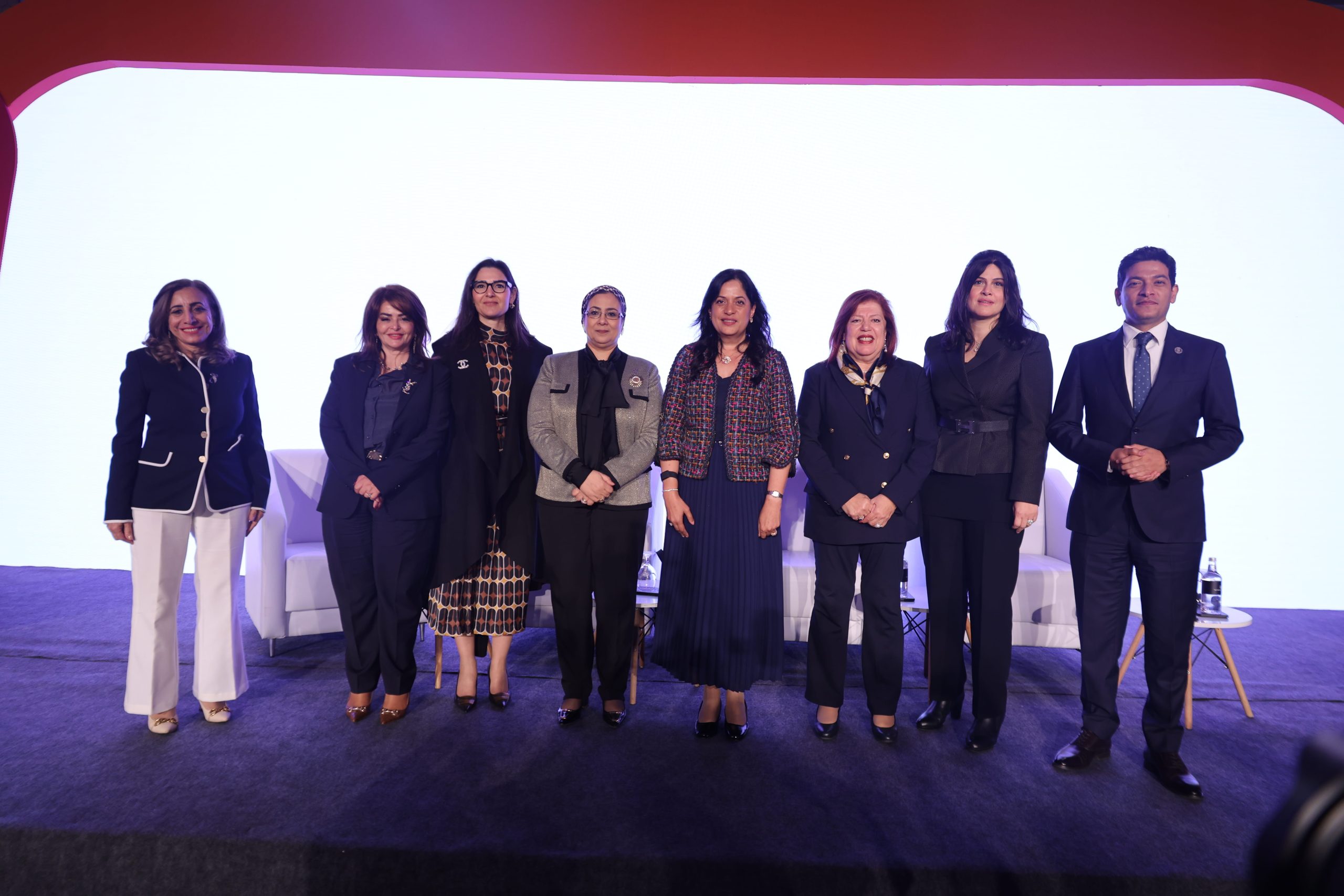
The session featured Engineer Hoda Mansour, Regional President of AngloGold Ashanti and Board Member of Sukari Gold Mines; Sionara El Asmar, Executive Vice President and Managing Director of the Egyptian Credit Bureau (i-Score); Dr. Mohamed El Naggar, Head of the Central Sector for Non-Financial Services and Business Development Services at the Micro, Small and Medium Enterprise Development Agency (MSMEDA); and Rania El Ghoneimi, Chairperson of the Skills Development Bank. The session was moderated by Basant Fouad, Chief Marketing and Public Relations Officer at Valmore Holding.
Engineer Hoda Mansour emphasized that possessing transferable skills that can be applied across different sectors, together with the ability to learn and adapt to labor market requirements, are essential factors in opening new career pathways for young people, beyond the limitations of academic specializations and traditional perceptions of certain industries.
She said her professional journey demonstrates how individuals can transition between different fields. She began her university studies in architectural engineering before moving into technology and subsequently assuming leadership positions at several multinational companies, including Oracle, SAP, and Microsoft.
She added that her architectural studies helped her develop important skills, particularly attention to detail, resilience, and flexibility in addressing challenges. These skills enabled her to move into different professional fields. She stressed that what people learn during their academic years provides a foundation they can build upon and develop to achieve advanced career positions.
She noted that her work at global technology companies allowed her to engage with approximately 25 different industries, broadening her expertise and preparing her to serve on the boards of companies operating in sectors unrelated to her academic background. These appointments included the Board of Directors of Commercial International Bank (CIB) and Centamin, the former foreign partner in the Sukari Gold Mine, despite her lack of specialized experience in financial services or mining.
Regarding employment opportunities in the mining sector, Mansour explained that the industry is undergoing development in Egypt, with plans to increase its contribution to GDP from less than 1% to more than 6%, creating investment and employment opportunities across multiple fields.
She pointed out that mining jobs are not limited to graduates of engineering, geology, and chemistry programs, but also encompass other specializations and occupations, including heavy equipment operation, drilling and blasting, as well as administrative, medical, nursing, and operational support roles.
She stressed that entering the sector depends not only on academic qualifications but also on possessing the right skills and demonstrating a willingness to learn and work within multidisciplinary teams. She highlighted the importance of soft skills, particularly communication, teamwork, and openness to listening to others.
Mansour also revealed joint efforts to remove legislative restrictions that had limited women’s participation in certain mining activities, particularly working in underground mines and during night shifts. She explained that she was the first woman to serve as CEO of the Sukari Gold Mine before assuming her current responsibilities representing the foreign partner.
She added that women account for only around 70 of the mine’s total workforce of 2,500 employees. She said she raised the issue of legislative restrictions during a meeting of the National Council for Women, chaired by Counselor Amal Ammar, where a working paper outlining the required amendments was prepared in cooperation with Shaimaa Sebae, the company’s Head of Legal Affairs.
She continued that efforts included engaging with the Ministers of Labor and Petroleum and Mineral Resources, resulting in the removal of these restrictions in less than three months. This paved the way for the first woman in the history of Egypt’s mining sector to be assigned an underground geological position.
She urged young people to develop a diverse range of skills that would enable them to move between jobs and sectors, while demonstrating flexibility, humility, and a willingness to gain experience. She emphasized that a successful career does not require individuals to remain within their original academic specialization, but rather depends on continuous development and the ability to seize opportunities.
For her part, Sionara El Asmar emphasized that rapid technological advancements, process improvements, and changing market requirements have fundamentally transformed the banking and financial services sector. She noted that the transition from traditional banking systems to digital platforms has enabled customers to conduct transactions remotely without having to visit bank branches.
She explained that this transformation has extended to the use and analysis of data and the application of artificial intelligence in developing both financial and non-financial services. She pointed to the emergence of new jobs and fields, including data science, analytics, dashboards, and insights generation, which have also created opportunities for remote and home-based work.
She stressed the importance of ensuring data quality and establishing controls to verify its accuracy before using it for analysis and decision-making. She also highlighted the need for young people to develop their skills, learn to use modern tools and technologies, apply artificial intelligence in appropriate fields, and verify information sources to avoid relying on inaccurate content.
El Asmar shared an experience from the early stages of her banking career, explaining that she faced a major challenge while working on a share allocation project for an initial public offering (IPO), after her colleague assigned to the project was removed and she had to complete the work independently.
She added that she relied on her technical skills and experience with the systems available at the time, successfully completing the allocation process and preparing the required letters and statements in a single night, delivering the work by the following morning’s deadline.
She noted that this experience marked a turning point in her professional career, which saw her move from banking operations, automation, and process improvement to becoming CEO and subsequently Executive Vice President and Managing Director of i-Score. She emphasized the importance of continuous learning, self-confidence, discipline, and attention to detail.
For his part, Dr. Mohamed El Naggar stressed that building a strong and diversified economy requires reliance on the small and medium-sized enterprise sector as a key component of economic activity. He emphasized that entrepreneurial success depends not simply on having a good idea, but on the ability to turn it into a viable business that generates tangible returns.
He explained that the first step in establishing any business is identifying target customers and understanding their needs, assessing the idea’s suitability for the market, and developing a clear strategy for convincing customers of the value of the product or service, while ensuring adequate cash flow and liquidity to sustain operations.
He added that the current environment offers young people and students various opportunities for training, professional development, and learning from the experiences of entrepreneurs, alongside technological tools that help startups develop their ideas and reach customers more effectively.
He pointed out that the Egyptian market is characterized by its large size and the diversity of its opportunities and economic activities, requiring entrepreneurs to explore these opportunities and approach them with a practical vision based on market needs and the capabilities of their projects. He emphasized the importance of determination, perseverance, and hard work in overcoming challenges.
For her part, Rania El Ghoneimi emphasized that preparing young people for the labor market requires aligning the skills acquired by graduates with the actual needs of companies and economic sectors. She explained that the capabilities required for professional success are built around three main pillars: knowledge, technology, and behavioral skills.
She added that the Skills Development Bank operates as an accreditation center and serves as an intermediary between labor market requirements and educational and training outcomes. It does so by identifying the needs of companies and various sectors and working to equip graduates with the skills required to meet those needs, helping narrow the gap between available and demanded skills.
She stressed the importance of identifying actual labor market demand before designing training and qualification programs. She also highlighted the need to distinguish between the impact of the technological revolution on the nature of jobs and required skills and its impact on the education system and methods of preparing learners.
She noted that the Skills Development Bank’s activities extend across more than six sectors, with success rates ranging from 60% to 70%.
The session was held as part of the fifth edition of the Egyptian Women’s Summit 2026, organized by the 50 Most Influential Women Forum under the theme “From Learning to Earning.” The summit was inaugurated by Ahmed Kouchouk, Minister of Finance, and Counselor Amal Ammar, President of the National Council for Women, with the participation of around 4,000 students and graduates from various academic disciplines, alongside leaders from economic, financial, technological, and industrial institutions, entrepreneurs, and policymakers.
The summit is held under the auspices of seven ministries: Finance; Social Solidarity; Agriculture and Land Reclamation; Housing, Utilities and Urban Communities; Communications and Information Technology; Industry; and Investment and Foreign Trade. It also involves the National Council for Women, the Micro, Small and Medium Enterprise Development Agency (MSMEDA), the United Nations Population Fund (UNFPA), and the Italian Agency for Development Cooperation. The event also features a recruitment, training, and career counseling exhibition with the participation of more than 70 exhibitors.