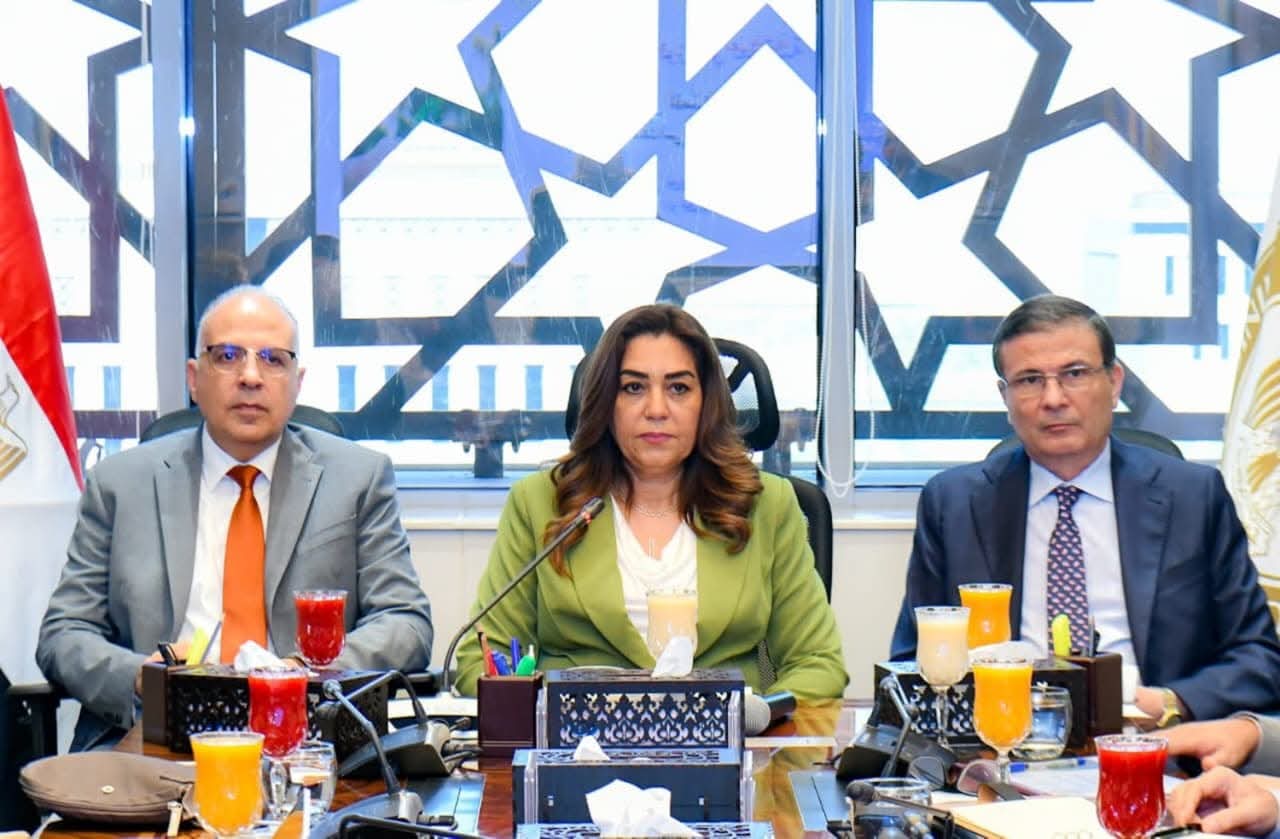

Egypt’s key ministries convened a high-level joint meeting to address the growing impacts of climate change on national food security, aligning with directives from the country’s political leadership to develop a comprehensive national vision for climate resilience and sustainable agricultural growth.
The meeting brought together Dr. Manal Awad, Minister of Local Development and Acting Minister of Environment; Dr. Hani Sewilam, Minister of Water Resources and Irrigation; and Mr. Alaa Farouk, Minister of Agriculture and Land Reclamation. Senior representatives from several ministries and national bodies also participated.

Coordinated National Action on Climate Resilience
In her opening remarks, Dr. Manal Awad emphasized that the session reflects Egypt’s commitment to inter-ministerial coordination in developing a unified national framework to counter the effects of climate change on food security. She underscored the need for data-driven research, including meteorological data, land use mapping, and crop distribution analysis, to strengthen early warning systems and guide adaptive agricultural planning.
Dr. Awad outlined proposals from the Ministry of Environment aimed at improving resilience, including expanding agricultural research, enhancing rural community development, empowering women, and promoting education and health initiatives as integral elements of adaptation strategies. She also highlighted measures to reduce greenhouse gas emissions in the agriculture and forestry sectors, through better waste management, soil preservation, and sustainable farming practices.
Awad further called for investment in agricultural technology, improved irrigation systems, mechanization, and rural infrastructure to enhance market access and reduce costs. She stressed the importance of creating financial mechanisms and insurance systems to help farmers withstand unexpected climate shocks.
Water Resource Management and Climate Adaptation
Dr. Hani Sewilam detailed Egypt’s extensive efforts to enhance the resilience of its water management system against climate-related threats. He cited large-scale projects and policies implemented in recent years, including expanding wastewater treatment and reuse, modernizing irrigation canals and drainage systems, and constructing flood protection and rainwater harvesting projects.
The Ministry, he noted, has developed 27 digital applications for monitoring and managing water resources, utilizing satellite imagery, drone technology, and mathematical models. A smart irrigation project in collaboration with Spain is also underway.
Further, Dr. Sewilam proposed an executive roadmap to expand solar- and wind-powered desalination plants, establish decentralized wastewater treatment units, strengthen early warning systems for heatwaves and drought, and promote smart irrigation practices through farmer training and digital tools.
Sustainable Agriculture and Food Security
Minister Alaa Farouk highlighted the central role of the agriculture sector in national climate adaptation efforts, stressing the need for practical implementation rather than relying solely on recommendations. He called for a clear, action-oriented plan that builds on current achievements and aligns priorities across ministries.
Farouk emphasized the integration of research institutions, financing bodies, and farmers, with a focus on climate-smart agricultural practices, such as developing drought- and heat-tolerant crop varieties, adopting modern irrigation techniques, and improving water-use efficiency. These initiatives, he said, are vital to ensuring agricultural productivity and food security amid escalating climate pressures.
Toward a Unified Climate-Food Security Strategy
The participating ministries reviewed the interconnected impacts of climate change on agriculture, water resources, and livestock, as well as existing national strategies on biodiversity, emissions reduction, and climate adaptation. They agreed to hold a follow-up meeting to review each sector’s detailed roadmap, timeline, and proposed measures to bolster food security under changing climatic conditions.
Egypt’s government views the integration of environmental, agricultural, and water policies as a cornerstone for achieving sustainable development and national resilience in the face of global climate challenges.