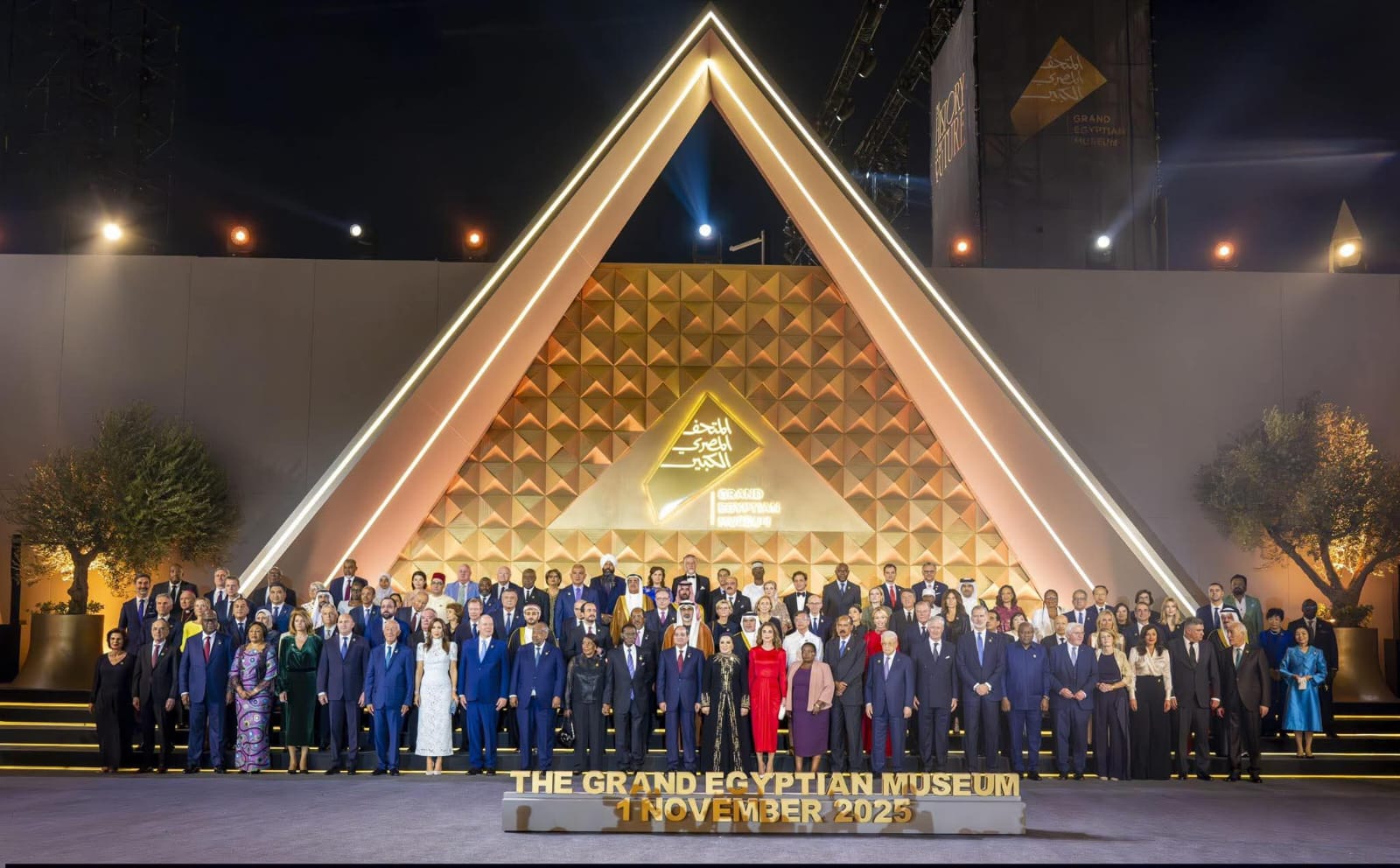

Under the golden glow of the Giza Plateau, President Abdel Fattah El-Sisi and First Lady Entissar El-Sisi led an historic celebration marking the official opening of the Grand Egyptian Museum (GEM) — a cultural event decades in the making.
The evening brought together delegations from more than 80 nations, alongside representatives of international organizations and global companies, in a ceremony that honored both Egypt’s ancient legacy and its modern ambitions.

A Global Tribute to Egypt’s Timeless Influence
The celebration opened with an orchestral performance titled “The World Plays One Melody,” symbolizing unity through art. A laser and drone show followed, illustrating the “Orion Belt Theory” — the cosmic alignment connecting the pyramids of Giza and the museum’s architectural design.
The audience was then taken on “A Journey of Peace in the Land of Peace,” a visual and musical narrative tracing Egypt’s genius in construction — from the Step Pyramid of Djoser to contemporary architectural marvels. The program seamlessly intertwined a Coptic hymn, Sufi chants, and a dazzling drone display forming the message:
“Civilizations Flourish in Times of Peace.”
El-Sisi: “A Living Testimony to Egyptian Genius”
In his keynote address, President El-Sisi welcomed world leaders and guests to “the oldest nation known to history — the land where civilization wrote its first letters.”
He described the Grand Egyptian Museum as more than a repository of antiquities, calling it “a living testament to the genius of the Egyptian people, who built the pyramids and carved on stone the story of eternity.”
El-Sisi expressed appreciation for the international partnerships that helped realize the project — notably the Government of Japan, which provided technical and financial support — and commended the thousands of Egyptian engineers, archaeologists, and workers who contributed to the museum’s creation.
An Emblem of Collaboration and Legacy
Following the address, President El-Sisi placed the final piece of the museum’s architectural model, engraved with the word “Egypt”, signaling the museum’s official completion.
Simultaneously, miniature replicas of the museum, inscribed with the names of attending nations, were presented to foreign leaders as tokens of friendship and shared heritage.
Guests were then immersed in a series of artistic performances — including a musical tribute to Ramses II, an exhibition of sun boats, and a lyrical reenactment of the discovery of Tutankhamun’s tomb, highlighting the young Egyptian boy Hussein Abdel Rasoul, whose chance discovery reshaped modern archaeology.
The evening concluded with a breathtaking fireworks display, laser show, and a guided tour through the museum’s Great Staircase and Tutankhamun Gallery, where Egypt’s treasures shimmered anew under carefully designed lighting.
A New Cultural Era for Egypt
Located just two kilometers from the Great Pyramids, the Grand Egyptian Museum is now the largest museum in the world dedicated to a single civilization. It houses more than 100,000 artifacts, including the full collection of King Tutankhamun, displayed for the first time in one place.
Architecturally, the museum bridges ancient geometry with modern design — a glass façade aligning directly with the pyramids, symbolizing continuity between past and present. Beyond exhibition halls, the museum includes research facilities, restoration labs, and educational centers, positioning it as a global hub for cultural diplomacy and archaeological innovation.
A Legacy for Generations
The opening of the Grand Egyptian Museum marks more than the unveiling of a building; it represents Egypt’s vision to connect its ancient heritage with its modern identity.
From the banks of the Nile to the halls of GEM, Egypt continues to remind the world that civilization is not only inherited — it is continuously renewed.