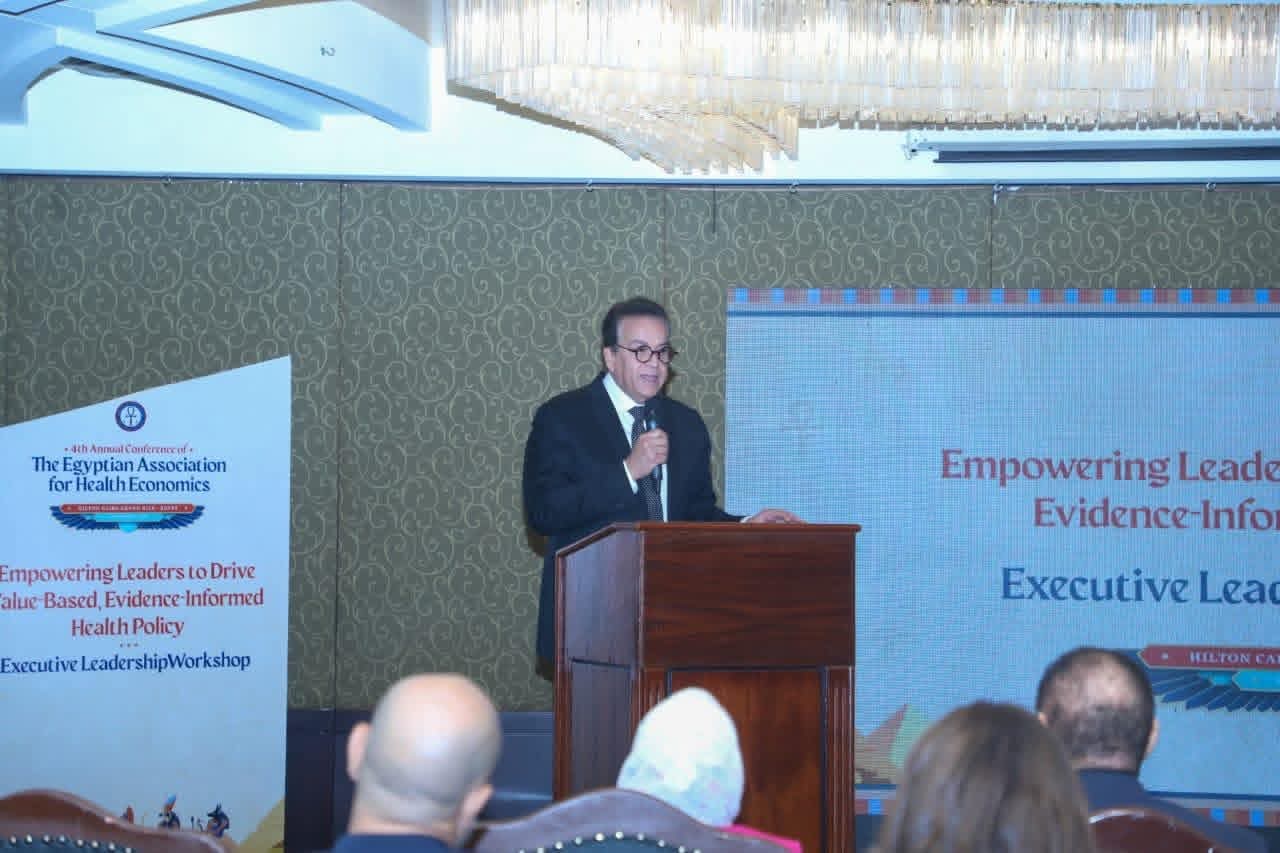

Dr. Khaled Abdel Ghaffar, Egypt’s Deputy Prime Minister and Minister of Health and Population, reaffirmed the nation’s strong commitment to health economics as a cornerstone of its healthcare strategy during the Fourth Annual Conference of the Egyptian Society for Health Economics held in Cairo today.
Speaking before a high-level assembly of health economists, policy-makers, and healthcare professionals, Dr. Abdel Ghaffar emphasized that “health economics is not merely an academic discipline—it is a vital tool for maximizing the efficiency and sustainability of healthcare systems.”

He added that Egypt’s Ministry of Health places significant focus on integrating health economics into all national policies and programs to optimize resource allocation and deliver long-term economic and health returns for the population.
Health Spending as Strategic Investment
Challenging the conventional perception of healthcare as a cost center, Dr. Abdel Ghaffar underscored that health expenditure is, in fact, “a strategic investment.” Every Egyptian pound allocated to prevention, early detection, and organized treatment yields tangible benefits—ranging from reducing the burden of disease to decreasing long-term treatment costs and boosting national productivity.
“100 Million Health” Initiative: A Transformative Model
At the heart of his address was the flagship “100 Million Health” initiative, launched by the Egyptian government in 2018. Initially aimed at enhancing public health through mass screenings and early intervention, the program has since evolved into a broader national framework encompassing approximately 15 health initiatives.
“These initiatives,” Dr. Abdel Ghaffar noted, “have transitioned from public health campaigns into promising national investments that deliver sustainable economic returns.”
He cited data-backed outcomes, such as:
- 359% economic return from the national Hepatitis C screening and early detection program.
- 57% return from the Women’s Health Support Initiative.
- 245% return from the early detection and treatment of hearing loss in newborns.
“These figures are not just statistics,” he said. “They are proof that strategic investment in healthcare translates into long-term economic and social gains.”
Reducing Future Costs Through Prevention
The Minister emphasized that preventive healthcare and early diagnosis have significantly curbed the future financial burden of treatment, particularly for chronic diseases. “This is among the smartest investments a country can make—not just from a health perspective, but from a broader developmental outlook,” he remarked.
Commitment to Strategic Resource Management
Acknowledging ongoing global challenges in the healthcare sector, Dr. Abdel Ghaffar stressed that Egypt continues to implement strategic decision-making processes to maintain system efficiency and sustainability. This includes minimizing waste and ensuring optimal use of available resources.
“Investing in human capital remains the foundation of human development,” he concluded. “The health of our citizens stands at the forefront of our national priorities, and we are committed to building a strong, resilient society.”
He also expressed his appreciation to the Egyptian Society for Health Economics for organizing a scientific platform that fosters knowledge-sharing and supports evidence-based policy development.
National and Regional Endorsements
Former Minister of Health, Dr. Adel Adawy, echoed Dr. Abdel Ghaffar’s remarks, stating: “Health economics is indispensable for expanding access to care and ensuring sustainability. We must optimize available resources to achieve the best possible health outcomes.”
Meanwhile, Dr. Ashraf Hatem, President of the Egyptian Society for Health Economics, emphasized the society’s role in supporting decision-makers with research and analysis. He highlighted the society’s mission to enhance healthcare spending efficiency and steer investment towards public health priorities.
“The society serves as a vital platform,” Dr. Hatem added, “for advancing research in health economics and informing national health policy through rigorous scientific discourse and periodic conferences.”
About the Egyptian Society for Health Economics:
Founded to promote research, collaboration, and policy development in the field of health economics, the Egyptian Society for Health Economics plays a central role in shaping the future of healthcare efficiency and sustainability in Egypt and the broader MENA region.
Tags: