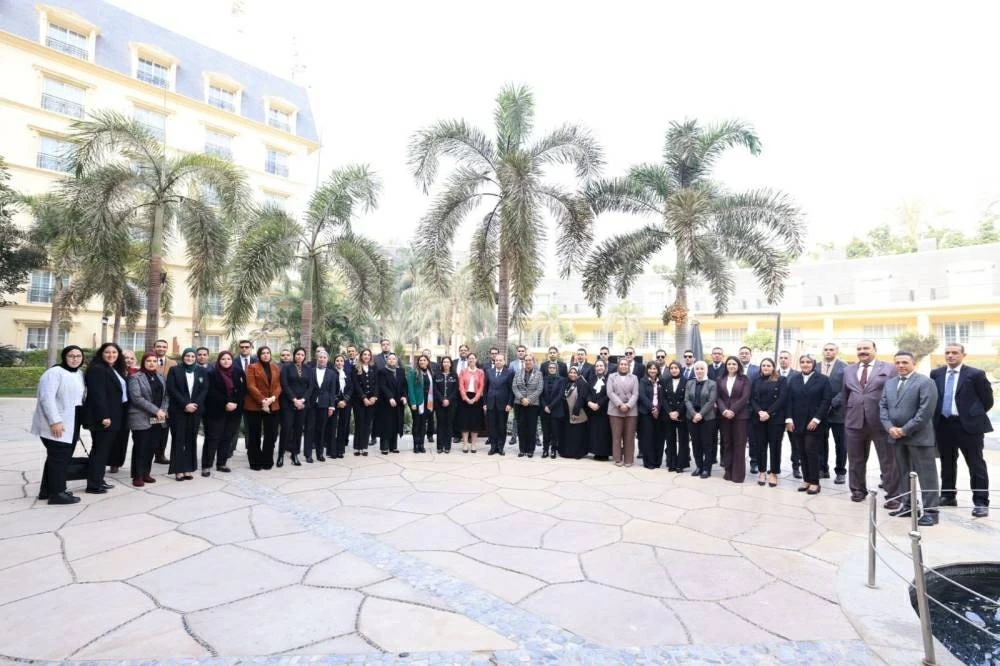


In a significant affirmation of Egypt’s advancing judicial reform and gender equality agenda, the Ministry of Justice, the National Council for Women, and UN Women jointly organized a high-level forum for women judges under the title: “Pioneering Egyptian Experiences Toward Empowerment, Equality, and Leadership in Light of the Beijing Platform for Action.”
The three-day forum brought together women judges and their male counterparts from primary courts, courts of appeal, and economic courts, highlighting Egypt’s evolving experience in integrating women across all levels of the judiciary.
High-Level Opening and National Partnership
The forum was inaugurated by Counselor Amal Ammar, President of the National Council for Women; Counselor Suzanne Abdel Rahman, Assistant Minister of Justice for Human Rights, Women, and Children; and Marwa Alam El-Din, Acting Head of UN Women in Egypt.
In her opening remarks, Ammar described the gathering as a reflection of the stature of the Egyptian judiciary and its foundational role in upholding justice, equality, and the rule of law. She emphasized that Egypt is witnessing a transformational phase in its judicial history—one in which women judges have moved from limited participation to full and equal presence across all judicial branches and ranks, including senior leadership positions based on merit and competence.
From Constitutional Guarantees to Real Change
Ammar stressed that Egyptian women now serve as judges in both trial and appellate courts, working alongside male colleagues in diverse litigation circuits—an evolution she described as evidence of the judiciary’s maturity and fairness. She noted that the expansion of women into leadership roles signals genuine empowerment within decision-making positions, not symbolic inclusion.
She attributed this shift to a national trajectory rooted in the Egyptian Constitution and supported at the highest levels of the state, including President Abdel Fattah El-Sisi, Chairman of the Supreme Council of Judicial Bodies. According to Ammar, presidential backing has reinforced the principle that equality in judicial appointments is a constitutional right, with competence as the sole standard.
Ministry of Justice Reforms Under Adnan Fanjari
Ammar highlighted the pivotal role played by the Ministry of Justice under Minister Adnan Fanjari in creating a supportive judicial environment for women. Among the key reforms cited were:
- Establishment of women-friendly zones in courts, particularly for cases involving violence against women
- Expansion of family dispute resolution offices
- Broader access to legal aid services in partnership with national and international organizations
- Accelerated digital transformation projects, simplifying procedures and expanding online judicial services
These measures, she said, have improved women’s access to justice and preserved dignity within the legal process.
National Council for Women and Global Commitments
Ammar underscored the National Council for Women’s role as Egypt’s official mechanism for women’s empowerment, working closely with the Ministry of Justice to support public policy, monitor progress, raise legal awareness, and institutionalize equality and non-discrimination.
She noted that the forum coincides with two milestones:
- 25 years since the establishment of the National Council for Women
- 30 years since the adoption of the Beijing Declaration and Platform for Action, a global framework for women’s rights
She described Egypt’s judicial experience as a practical embodiment of the Beijing Platform, achieved through concrete policies, legislation, and institutional reforms rather than rhetoric.
Constitutional History and International Standards
Speaking on behalf of Justice Minister Adnan Fanjari, Counselor Suzanne Abdel Rahman reviewed Egypt’s constitutional journey toward equality, noting that the 1956 Constitution marked a historic turning point by granting women political rights, while the 1971 Constitution expanded women’s participation in public life.
She emphasized that Egypt’s constitutions are living frameworks shaping public policy, and she highlighted Egypt’s adherence to the Convention on the Elimination of All Forms of Discrimination Against Women (CEDAW). Abdel Rahman recalled the appointment of Egypt’s first cohort of women judges in 2007, opening doors within the Public Prosecution and the State Council.
UN Women: Egypt as a Regional Model
UN Women’s Marwa Alam El-Din described the forum as a testament to Egypt’s sustained commitment to women’s role in justice and the rule of law. She noted that Egypt has translated the Beijing Platform into tangible national policies, positioning women on the judicial bench as a cornerstone of equality and institutional trust.
Best Practices, Technology, and Future Recommendations
The forum featured working sessions on international best practices in women’s judicial participation, presented by Rana Karim, UN Women’s Women’s Empowerment Program Manager. Discussions linked gender equality with judicial independence and quality of justice, drawing on examples from countries including the United Kingdom and Sweden.
Additional sessions addressed:
- Judicial leadership and mentorship
- Gender-responsive training for court staff
- Use of technology to improve women’s access to legal information
- Digital transformation across legal fields
The Ministry of Justice also highlighted innovations such as secure testimony rooms for survivors of violence, developed with UNODC, and AI-powered Braille printing systems to support women with disabilities.
A Moment of National Mourning
At the start of the third day, participants stood in silence at the request of Counselor Amal Ammar to honor the late Counselor Seham Al-Ansari, who passed away following a tragic accident after completing her national duty supervising the 2025 parliamentary runoff elections. The tribute underscored the forum’s tone of solemn commitment to public service and justice.
A Defining Moment for Women in Egypt’s Judiciary
The forum concluded with recommendations calling for stronger legal awareness campaigns, tougher penalties for violence against women, expanded judicial training for women judges, and deeper digital integration across the justice system.
As Egypt marks three decades since Beijing and a quarter-century of institutional advocacy for women, participants agreed that empowering women judges is no longer an aspiration—but a cornerstone of a modern, inclusive, and credible justice system.