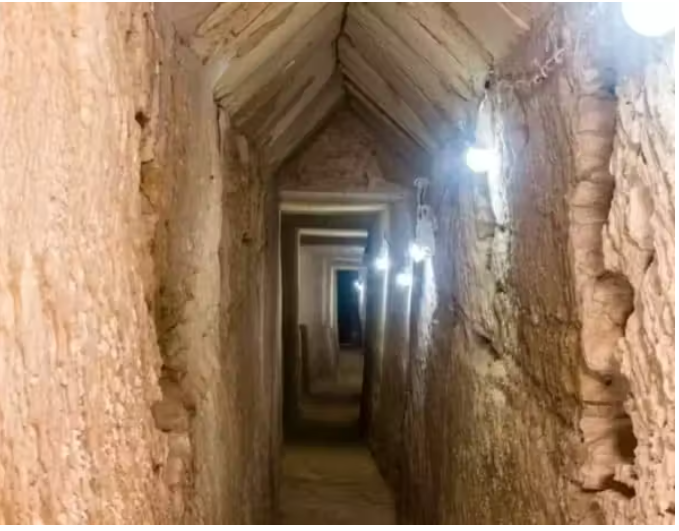


Archaeologists working at the ancient ruined city of Taposiris Magna, west of Alexandria, have uncovered a vast underground tunnel beneath a temple—an extraordinary discovery that experts have described as a “geometric miracle.”
The tunnel was found 13 meters (43 feet) below ground during an ongoing excavation led by Kathleen Martinez of the University of Santo Domingo in the Dominican Republic, alongside her research team. The structure, carved directly into sandstone, stands about two meters tall and stretches for an astonishing 1,305 meters (4,281 feet), reflecting remarkable precision and engineering skill.

According to Egypt’s Ministry of Tourism and Antiquities, the tunnel’s design closely resembles the famous Tunnel of Eupalinos, a 6th-century BC aqueduct on the Greek island of Samos. The Eupalinos tunnel—measuring approximately 1,306 meters—is widely regarded as one of the greatest feats of ancient engineering, making the similarities particularly striking.
Engineering Feat and Unanswered Questions
Archaeologists say the tunnel at Taposiris Magna demonstrates an advanced understanding of geometry and construction techniques. Despite its scale and sophistication, the purpose of the tunnel remains unknown. Some sections are currently submerged in water, limiting full exploration and leaving open questions about whether it served as an aqueduct, a ritual passage, or part of a larger underground complex.
Martinez, who has been conducting excavations at Taposiris Magna since 2004, believes the discovery could be a significant breakthrough. She has long focused her research on the possibility that the site holds clues to the lost tomb of Cleopatra VII, the last queen of the Ptolemaic dynasty.
Renewed Interest in Cleopatra’s Era
Taposiris Magna has long been considered a site of major religious and political importance during the late Ptolemaic period, blending Egyptian and Greco-Roman architectural traditions. The newly discovered tunnel has renewed global interest in the site and strengthened theories that important royal or ceremonial structures may still lie hidden underground.