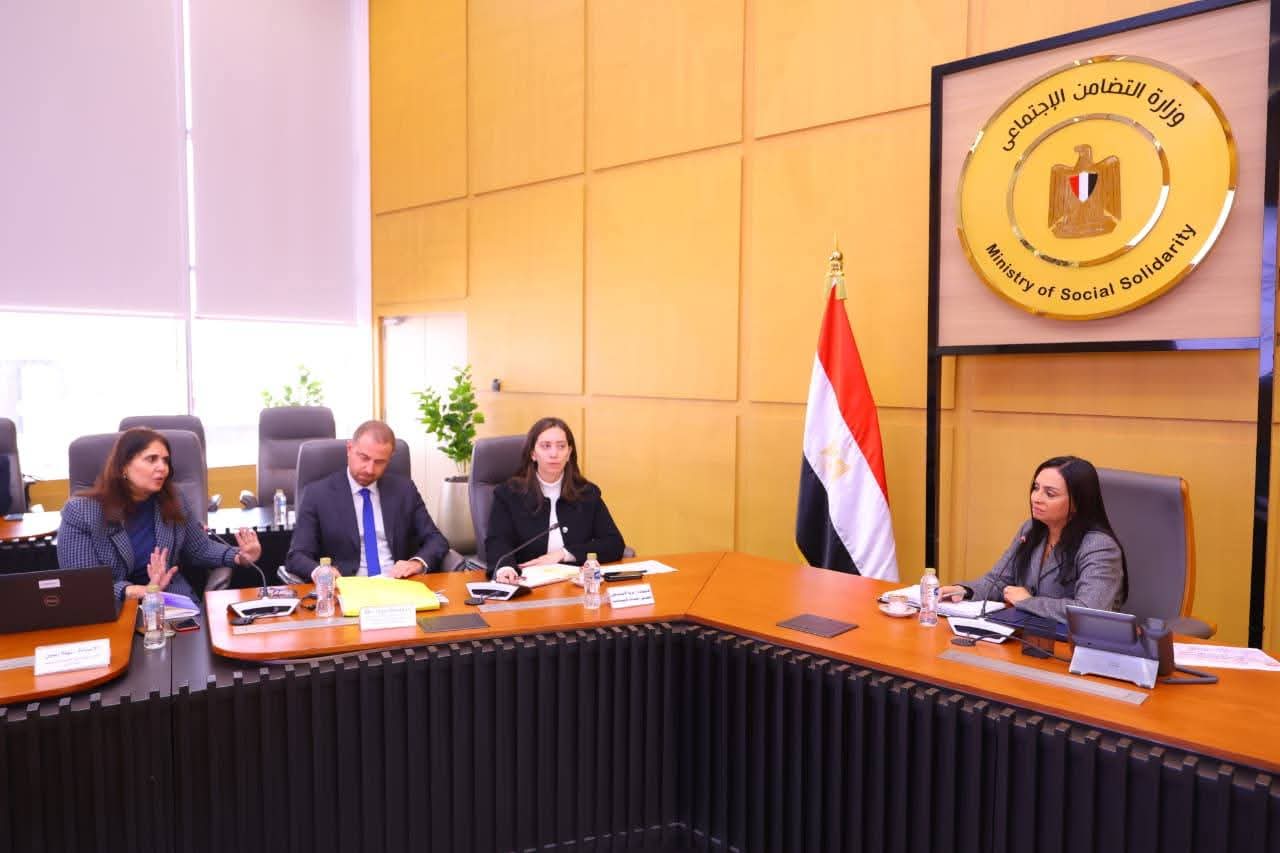

Egypt’s Minister of Social Solidarity, Dr. Maya Morsy, met with the mid-year monitoring delegation of the World Bank at the ministry’s headquarters in the New Administrative Capital, concluding a series of workshops conducted with various ministry sectors. The visit aimed to review and track the progress of the government’s flagship conditional cash transfer program, “Takaful and Karama.”
During the meeting, Dr. Morsy welcomed the World Bank delegation, praising ongoing cooperation and highlighting planned research activities designed to document and assess the program’s achievements after a decade of implementation.

“The current phase of Takaful and Karama focuses on transforming beneficiary households from cash assistance recipients into productive participants in the economy,” Dr. Morsy emphasized. She also underscored the ministry’s commitment to early childhood care services, noting upcoming initiatives to expand nursery facilities within schools and grant temporary licenses to daycare centers, aiming to support women’s workforce participation.
Program Milestones and Expansion
Rafat Shafik, Assistant Minister for Social Protection and Economic Empowerment Programs, along with the executive director of Takaful and Karama, provided an overview of the program’s achievements. Since Dr. Morsy took office, one million new beneficiaries have joined the program, increasing total coverage from 1.7 million households in 2015 to 4.7 million households in 2025—comprising 75% women and 25% men.
To date, 3.36 million households have successfully graduated from the program, bringing the cumulative number of beneficiaries over its ten-year history to 8.1 million households. The program’s budget for the current fiscal year is EGP 54 billion, with average household support at EGP 900, ranging from EGP 700 to 4,000, depending on eligibility across the Takaful and Karama programs.
Shafik also highlighted the new Social Insurance Law No. 12, issued in April 2025, describing it as a transformative legal framework. The law expands social services for vulnerable households, formalizes social assistance as a legal right, and links support programs to economic empowerment initiatives aimed at shifting families from dependency to productive engagement.
Economic Empowerment and Rural Development
Engy El-Yemany, Executive Director of the Fund for Supporting Rural and Environmental Industries, discussed efforts to transition Takaful and Karama beneficiaries toward economic self-sufficiency. The fund seeks to turn rural communities into dynamic hubs of sustainable development through local industry support, green technology adoption, innovation stimulation, and human capacity building—all under strict governance and transparency standards.
Other officials attending the meeting included Dr. Mohamed Al-Aqbi, Assistant Minister for Strategic Communication; Dina Al-Sirafi, Assistant Minister for International Cooperation and Agreements; and Dr. Ahmed Abdel Rahman, Head of the Central Administration for Social Protection, alongside staff from the Social Protection Administration and Takaful and Karama program.
The meeting reflects Egypt’s continued commitment to strengthening social protection, empowering vulnerable households, and ensuring that conditional cash transfer programs like Takaful and Karama evolve into tools for sustainable economic participation.