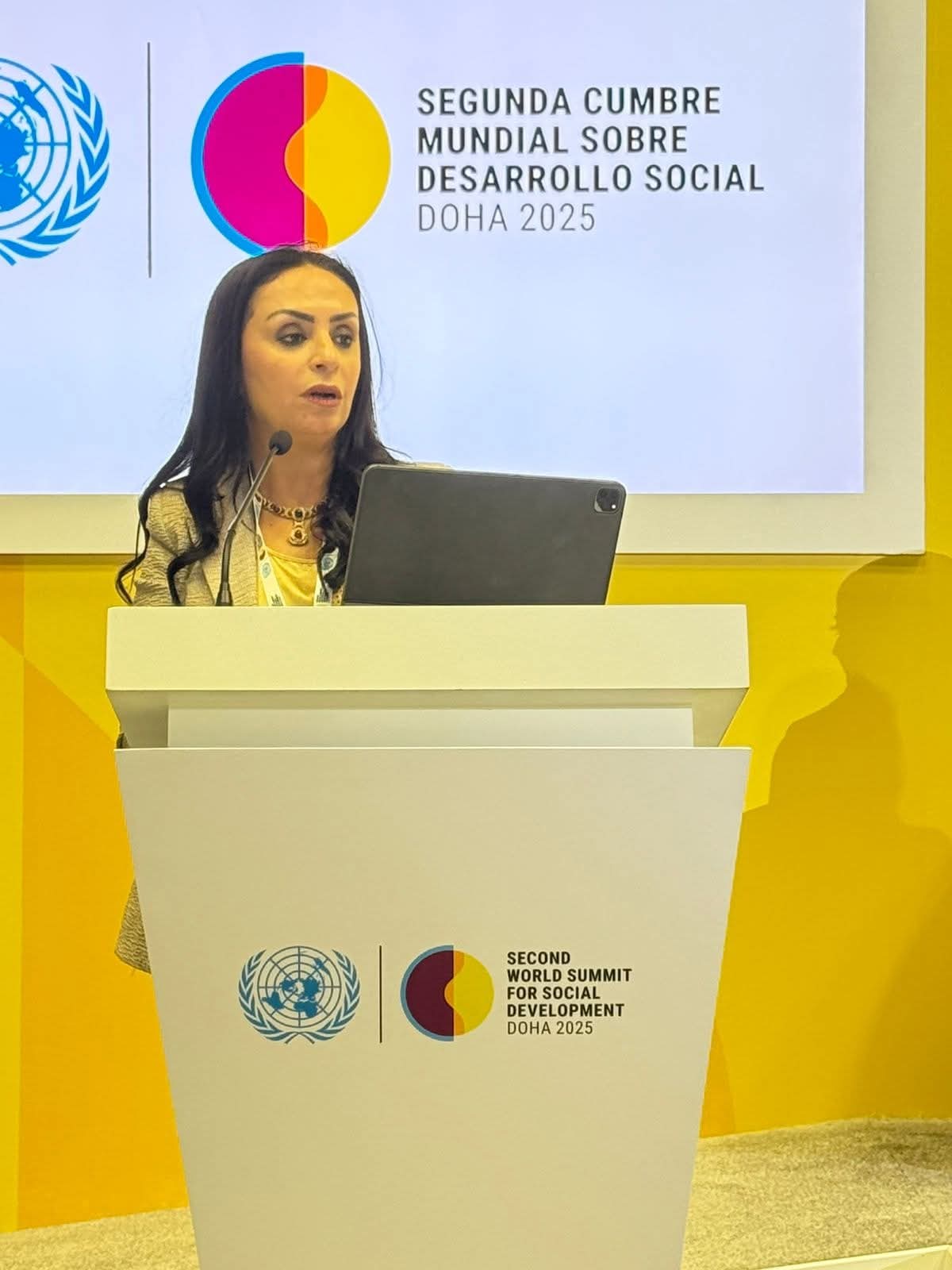

Dr. Maya Morsy, Egypt’s Minister of Social Solidarity, participated in a high-level session titled “Protecting Families in Wars and Conflicts: Policies and Programmatic Interventions” at the Second Global Social Development Summit, held from November 4 to 6 at the Qatar National Convention Center in Doha.
Addressing strategies for transitioning from short-term humanitarian aid to long-term family-centered recovery programs, Dr. Morsy emphasized that moving beyond crisis management requires a fundamental shift in approach. “Humanitarian relief ensures immediate survival — food, tents, medicine — but long-term recovery rebuilds social systems: how families thrive, how children are cared for, and how communities govern themselves,” she explained.

Dr. Morsy highlighted that family disruption often stems from cumulative pressures during displacement, including pre- and post-migration trauma, as well as the loss of family connections. “For families affected by conflict or forced migration, the disruption is not only geographic but existential,” she noted. Egypt, she added, has welcomed more than 10 million migrants, refugees, and displaced persons due to regional conflicts and wars.
The minister outlined Egypt’s family-centered programs, including immediate relief and urgent care services. The Egyptian Red Crescent has established humanitarian service points along the Egyptian-Sudanese border in response to the Sudanese crisis, providing life-saving support to families entering Egypt. Services include medical care, psychosocial support, and essential relief supplies, reaching nearly 1.5 million beneficiaries between 2023 and 2025.
In Cairo, the Red Crescent operates four permanent humanitarian centers that offer comprehensive assistance to migrants, refugees, and displaced families. These centers provide healthcare, psychosocial support, cash assistance, livelihood opportunities, vocational training, and family reunification services — combining immediate relief with long-term recovery support.
Dr. Morsy also emphasized the importance of family reunification. Many migrants lose contact with loved ones during displacement, prompting the Red Crescent to implement programs that restore connections through phone calls, online communication, handwritten letters, and official tracking systems. These efforts help ensure that families remain connected, whether within Egypt or abroad.
Highlighting Egypt’s response to the Gaza crisis, Dr. Morsy noted that displaced families and patients receiving medical treatment in Egypt were provided medical, psychological, and social support, as well as child-friendly spaces in hospitals and temporary shelters. “Family reunification remains a top priority,” she said, underscoring Egypt’s commitment to humanitarian principles amid forced displacement.
Dr. Morsy concluded by stressing that family-centered approaches are critical to addressing the psychological impact of prolonged separation, supporting children and caregivers, and providing clear pathways to services that prevent and respond to all forms of violence. Programs linking livelihood initiatives with family counseling ensure that households maintain agency, safety, and resilience throughout crises.