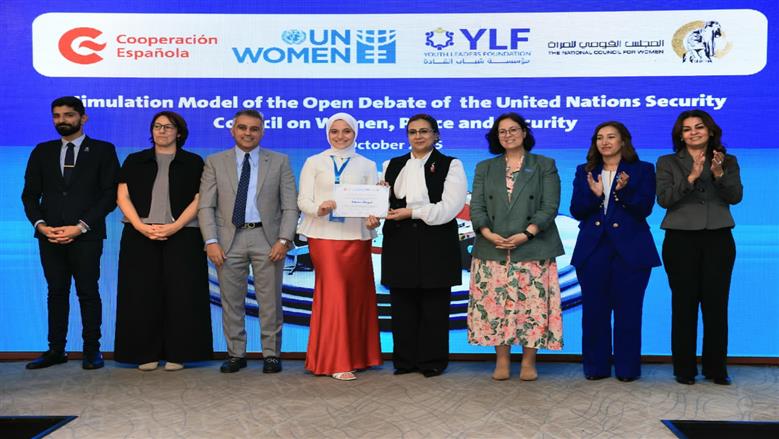

Egypt marked a significant milestone in youth empowerment and gender advocacy as Counselor Amal Ammar, President of Egypt’s National Council for Women (NCW), attended the closing ceremony of the first-ever global simulation model of the open debate of the UN Security Council on “Women, Peace, and Security.”
The initiative was organized by UN Women Egypt, in collaboration with the Leaders Foundation for Youth Development and the Spanish Agency for International Development Cooperation (AECID). The pioneering model brought together more than 250 students from universities across Egypt, making it the first of its kind worldwide.

The simulation aimed to prepare a new generation of Egyptian youth leaders capable of engaging in diplomacy, negotiation, and peacebuilding—particularly in the areas of women’s empowerment, security, and sustainable peace.
Next Gen. of Peace Leaders
The initiative featured multiple training stages covering UN Security Council dynamics, public speaking, negotiation and debate skills, and policy drafting related to the Women, Peace, and Security agenda.
Originally launched on October 5 in Cairo, the project will next be presented in Jordan in early December, marking the beginning of its regional and global expansion.
The final event included opening remarks, a documentary presentation of the training phases, and a student-led simulation representing 25 member states and international organizations. Participants debated the role of the international community in protecting women and girls during conflicts—focusing particularly on the situation in Gaza. The day concluded with final recommendations and certificate presentations.
Youth Diplomacy … Catalyst to Soft Power
In her speech, Counselor Amal Ammar expressed pride in witnessing the students’ growth and awareness, stating: “What you have achieved reflects the essence of the Women, Peace, and Security agenda, established under UN Security Council Resolution 1325.”
She emphasized that women’s participation in conflict prevention and peacebuilding is not a luxury, but a cornerstone of sustainable peace, aligning with Egypt’s New Republic Vision under President Abdel Fattah El-Sisi, which prioritizes the empowerment of youth and women alike.
Ammar described the participating students as the embodiment of “youth diplomacy” — a form of soft power that bridges divides and fosters dialogue.
Egypt’s Pioneering Policy Advocacy Model
Marwa Alam El-Din, Acting Head of UN Women Egypt, praised the participants, expressing confidence that this model would serve as a foundation for further youth leadership initiatives across the region.
In this regard, Rana Abou Gazia, Executive Director of the Leaders Foundation, highlighted the model’s value as a real-world platform enabling youth to practice global leadership and policy advocacy, particularly in addressing women’s roles in peace and security.
In a symbolic gesture reflecting gender inclusion, a female university student was selected to represent the role of the UN Secretary-General, demonstrating the capacity of young women to lead at the highest international levels.