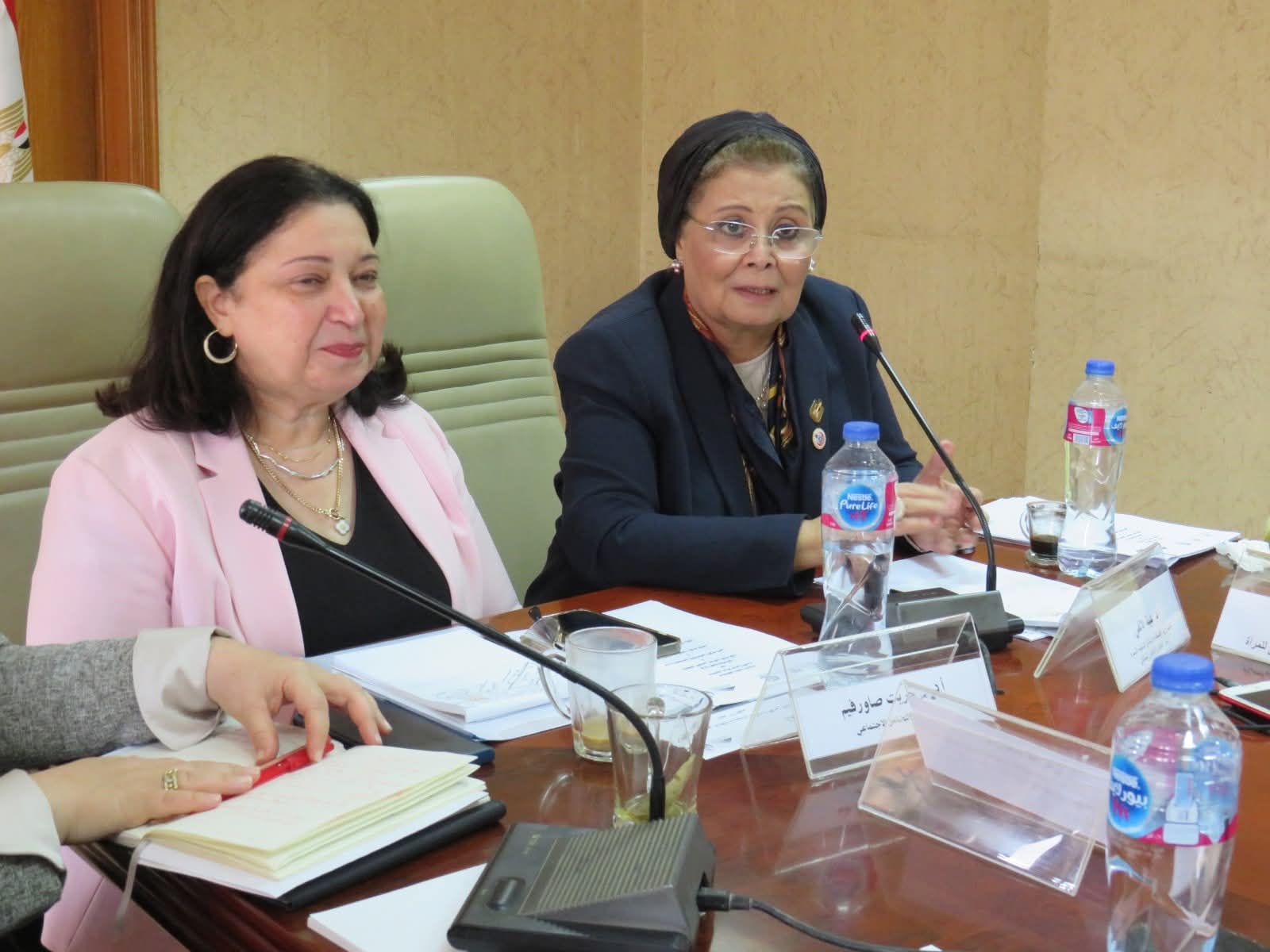

A high-level meeting was held to assess the progress of the National Family Development Project, chaired by Eng. Marguerite Sarofim, Deputy Minister of Social Solidarity, and Dr. Abla Al-Alfi, Deputy Minister of Health and Population. The meeting included representatives from the Ministries of Social Solidarity, Planning and Economic Development, the National Population Council, and other key national bodies focused on family and child welfare.
The session focused on reviewing completed project milestones, discussing areas aligned with the National Population and Development Strategy, evaluating recent performance indicators, and mapping out future implementation plans according to established timelines.

Eng. Marguerite Sarofim emphasized that the National Family Development Project is one of the state’s flagship initiatives, supported directly by national leadership, aimed at improving citizens’ quality of life and achieving sustainable development. She highlighted that the project embodies the state’s vision of human development and family empowerment, addressing population characteristics, raising public awareness, and enhancing women’s social and economic inclusion.
She further stressed the importance of developing comprehensive databases as strategic tools to support integrated operations, enable seamless and transparent information exchange among partner entities, and produce accurate performance indicators to provide a holistic view of services and activities. Sarofim also highlighted the need to ensure sustainability and continuity in programs to achieve measurable, lasting impact.
Dr. Randa Faris, Advisor to the Minister for Family and Child Health and Development and Director of the “Mawada” Program, detailed the Ministry’s achievements under the project. She noted that the economic empowerment component includes establishing and operating nurseries within Family Health and Development Centers, with 16 facilities now operational across Beheira, Sohag, Luxor, Qalyubia, Menoufia, Assiut, Aswan, and Sharqia.
The program has provided vocational training to approximately 567,000 participants, created over 191,500 employment opportunities through micro-projects, productive families, production units, and vocational training centers, and delivered 65,000 productive asset transfer projects.
On the service provision front, the Ministry of Social Solidarity has facilitated family planning services through civil society associations. Visits to 65 family development clinics totaled approximately 520,000 women, 460,000 of whom are utilizing family planning methods. In collaboration with the Ministry of Health, 32 additional clinics are being prepared for operation in high-need areas.
In terms of community awareness, social workers have been trained as change ambassadors to disseminate messages on family planning, birth spacing, harmful practices against girls, and financial inclusion, reaching an estimated 18 million awareness visits annually.
The “Mawada” Program, through its training, awareness campaigns, and digital platforms, provides targeted support for all family segments—from couples preparing for marriage to newlyweds and extended families. To date, the program has trained approximately 1.8 million young men and women, with the digital platform recording 5.2 million visits. In 2024, the program launched the “Ask Mawada” digital advisory service.
The meeting concluded with participants reaffirming the importance of collaboration and integration among partner entities to ensure the project’s objectives are achieved and agreeing on a shared vision for the next phase of implementation, aligned with national priorities.