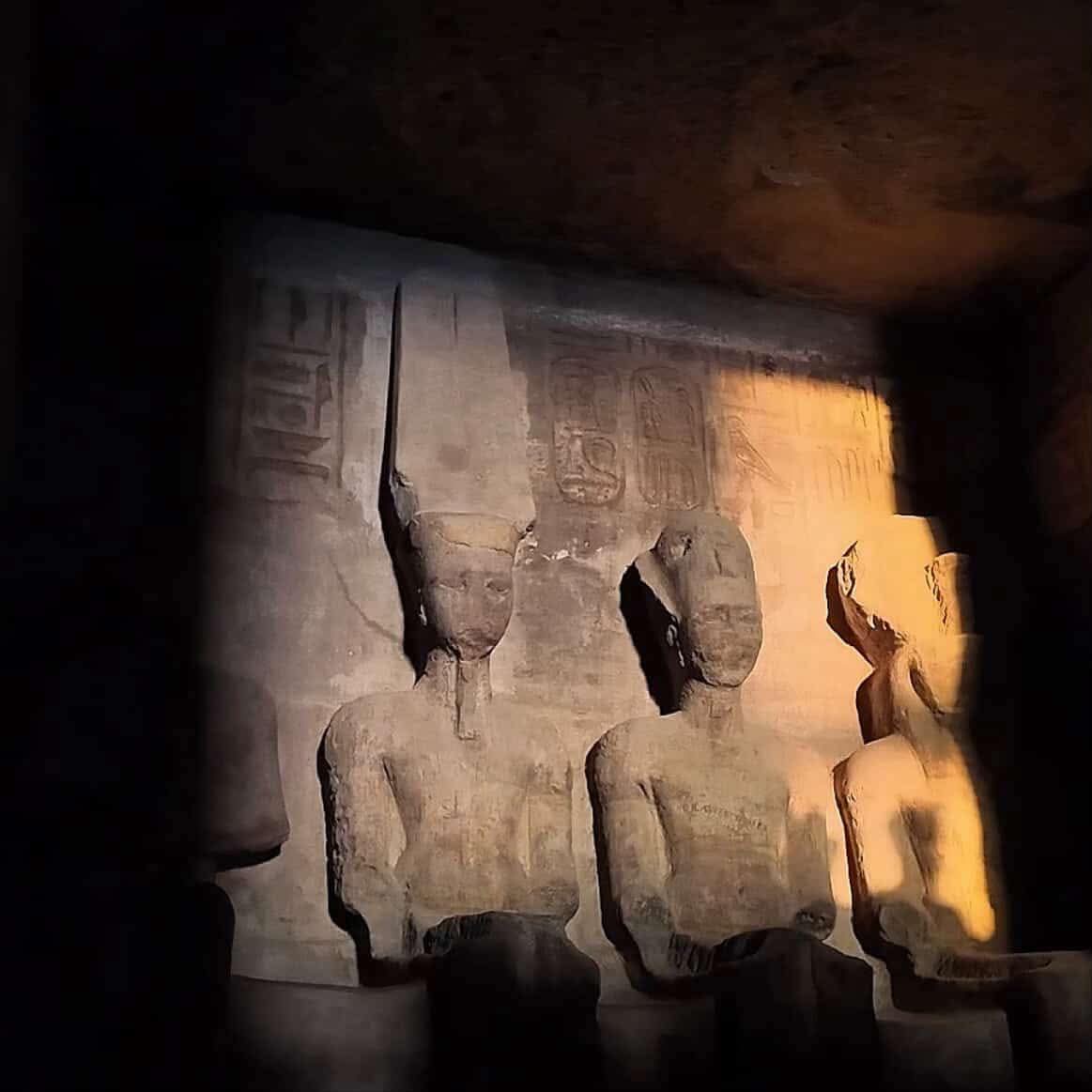

Early this morning, the sun aligned precisely with the inner sanctuary of the Great Temple of Abu Simbel, illuminating the face of Pharaoh Ramses II. The event, which occurs only twice a year—on October 22 and February 22—continues to draw attention for its precise astronomical and architectural design, developed more than 3,000 years ago.
The Solar Alignment Explained
At sunrise, sunlight travels 60 meters through the temple’s axis to reach the statues seated at the far end of the main hall. The statues of Ramses II, Amun-Re, and Ra-Horakhty are illuminated by the sun’s rays, while Ptah, the god of darkness, remains in shadow.

The alignment is believed to mark significant dates related to Ramses II’s reign:
- October 22 is commonly associated with his birthday.
- February 22 is thought to mark his coronation.
These dates demonstrate how ancient Egyptians integrated solar movement into temple design, aligning key monuments with astronomical events.
Public Attendance and Preservation
Thousands of local and international visitors attended the event before sunrise. The temple’s solar alignment was preserved during its relocation in the 1960s, when it was moved to avoid flooding caused by the Aswan High Dam. The relocation, led by UNESCO, ensured the alignment still occurs close to the original dates, with only a slight shift.
Cultural and Tourism Importance
The Ministry of Tourism reported a steady increase in visitors around both alignment dates each year. Local officials and tour guides use the event to highlight Egypt’s ancient knowledge of astronomy, engineering, and religious symbolism. The next sun alignment at Abu Simbel is expected to occur on February 22, 2026, shortly after sunrise.