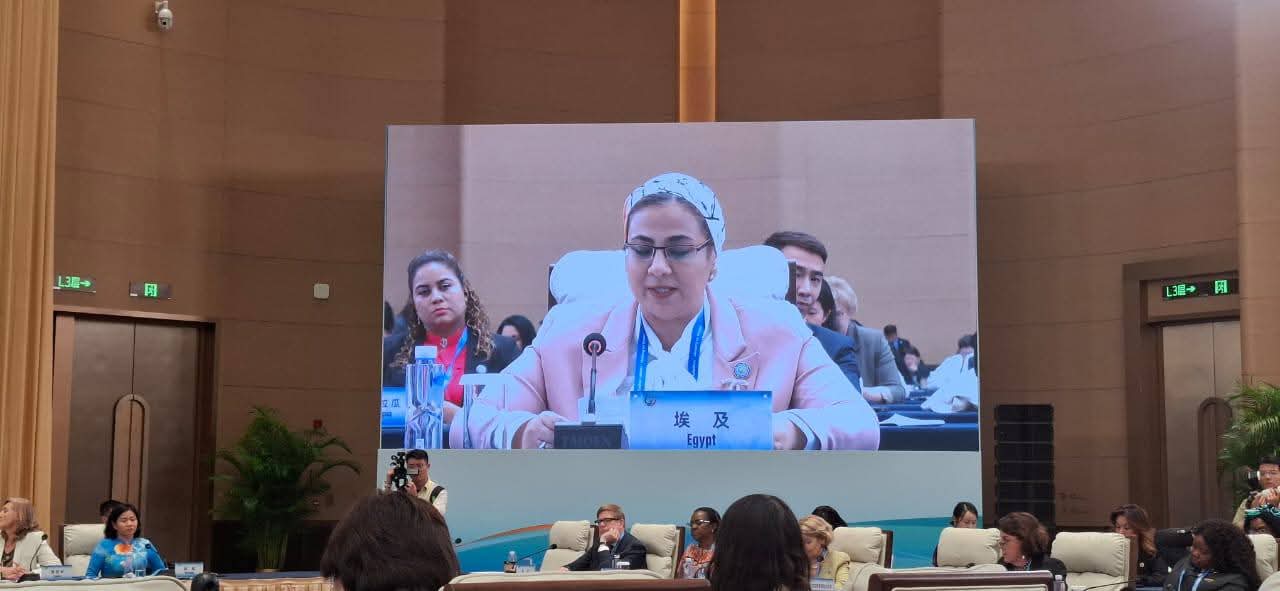

In a compelling address at the Global Summit of Women 2025, Counselor Amal Ammar, President of Egypt’s National Council for Women (NCW), reaffirmed her country’s steadfast commitment to gender equality and women’s empowerment. The summit, hosted in Beijing on October 13–14, marks the 30th anniversary of the Beijing Declaration and Platform for Action, a landmark global framework for advancing women’s rights.
Opening her remarks in the Chinese capital, Counselor Ammar paid tribute to Beijing’s role in shaping the international women’s agenda and drew a powerful parallel between Chinese and Egyptian civilizations — both of which, she noted, share ancient legacies and deep cultural roots.

“It is a privilege to visit Beijing, a city whose heritage echoes the depth of our own in Egypt, as we mark three decades since the adoption of the Beijing Declaration — a document that laid the groundwork for justice, equality, and the global amplification of women’s voices,” she said.
25 Years of Egypt’s Institutional Commitment to Women
Counselor Ammar emphasized that Egypt’s participation in the summit carries particular significance this year, as 2025 marks the 25th anniversary of the founding of the National Council for Women. The council, established in response to the principles of the 1995 Beijing Declaration, reflects the Egyptian state’s enduring commitment to gender justice.
She credited President Abdel Fattah El-Sisi for championing women’s rights and embedding gender equality as a core pillar of national development. Under his leadership, the country has launched a series of wide-reaching reforms and initiatives designed to elevate the role of women across all sectors of society.
Political Representation: From Milestones to Momentum
Egypt has seen a remarkable rise in women’s political participation. Women currently hold 27% of the seats in the House of Representatives and 14% in the Senate, marking a clear shift in parliamentary representation. For the first time in Egyptian history, women have been appointed as Presidential Advisors for National Security and Economic Development — breaking long-standing barriers and reshaping leadership at the highest levels of government.
Driving Economic Inclusion through Policy and Innovation
Egypt’s efforts to empower women economically have yielded measurable results. Through a dynamic partnership between the Central Bank of Egypt and the National Council for Women, the country recorded a 307% increase in financial inclusion among women. Over one million women have benefited from tailored financial services, including savings initiatives and entrepreneurship programs.
In the private sector, Egypt introduced the Gender Equality Seal — a certification program that encourages companies to create supportive, inclusive workplaces for women. At the same time, the government continues to invest in the care economy, recognizing its critical role in enabling women’s participation in the workforce.
Building a Social Framework That Supports Every Woman and Girl
Beyond legislation and economics, Egypt’s gender equality agenda also focuses heavily on social empowerment. Initiatives like “Haya Karima” (Decent Life) and the National Family Development Project have transformed lives in rural and underserved areas. These programs improve access to education, healthcare, and services, while fostering a culture of inclusion.
Counselor Ammar also highlighted two key programs — “Noura” and “Noor” — launched under the patronage of First Lady Entissar El-Sisi. These initiatives equip girls and boys with knowledge, life skills, and self-awareness, helping prepare a new generation to challenge stereotypes and lead change.
Prioritizing Protection and Access to Justice
Egypt has taken tangible steps to strengthen legal and institutional protections for women. A comprehensive legislative framework now targets all forms of gender-based violence, while modernized judicial procedures make it easier for women to access justice.
The state has created safe rooms in courts for victims and witnesses of violence, away from public view, and established the first Integrated Unit to Protect Women from Violence. Additionally, 49 public universities now house dedicated gender protection offices. The Women’s Complaints Office, supported by a nationwide hotline, offers legal, psychological, and social assistance to thousands of women annually.
Global Role in Gender, Peace, and Protection
On the international stage, Egypt remains deeply committed to the Women, Peace and Security Agenda. As one of the largest contributors to UN peacekeeping missions, the country continues to integrate gender perspectives into conflict resolution and peacebuilding efforts.
Egypt also provides a home to over 10 million refugees, many of whom are women and girls. These communities are actively included in Egypt’s protection and empowerment programs, reinforcing the country’s inclusive approach to human rights.
Counselor Ammar gave particular emphasis to Egypt’s solidarity with Palestinian women, praising their resilience in the face of ongoing hardship.
“Egypt renews its unwavering support for Palestinian women, in appreciation of their courage and the extraordinary burdens they bear to protect their land and identity,” she stated.
Counselor Ammar closed her address with warm appreciation for the Chinese leadership and the organizers of the summit. She emphasized the importance of multilateral cooperation and the continued global push for women’s rights.