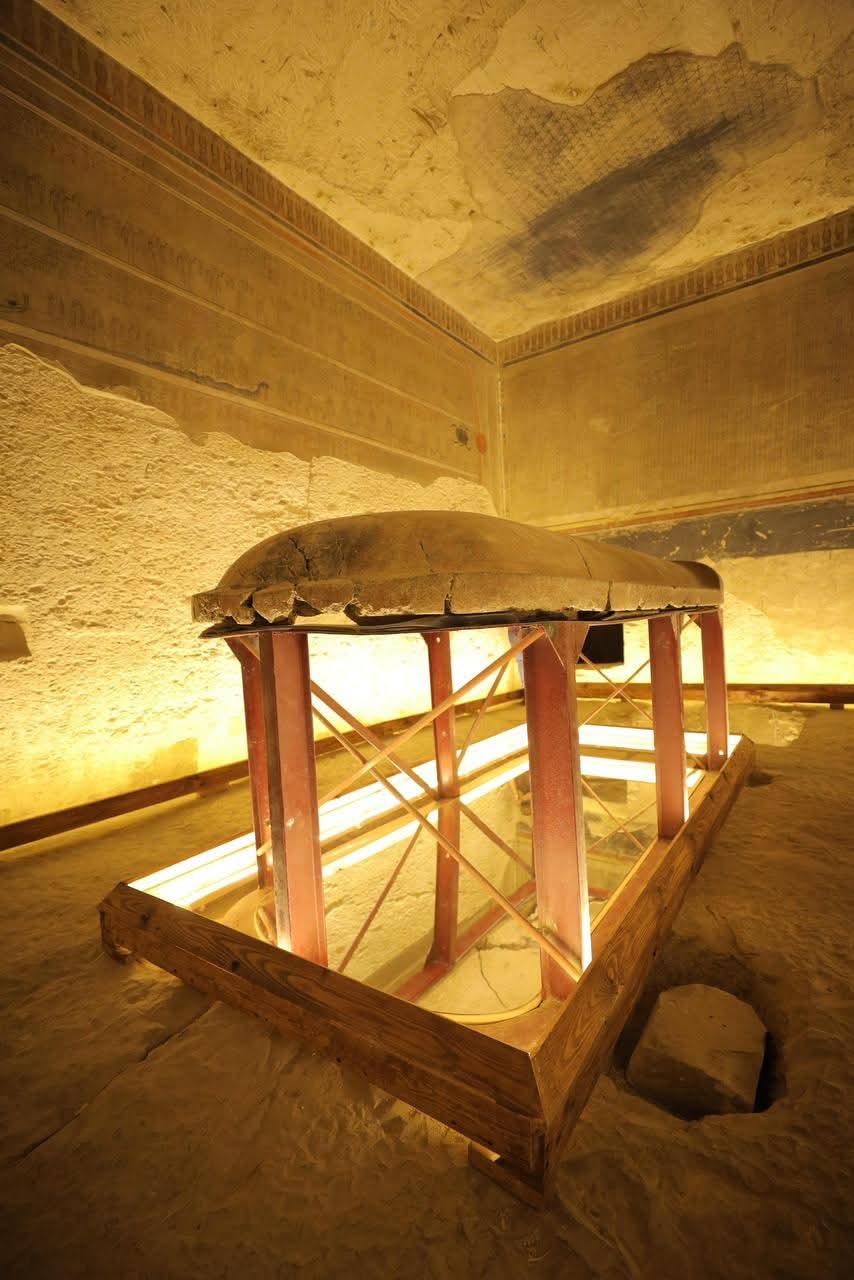

In a major milestone for Egyptian heritage preservation, Tourism and Antiquities Minister , Sherif Fathy, inaugurated the restored tomb of Pharaoh Amenhotep III (KV22) in the Valley of the Kings on the West Bank of Luxor on Sunday, marking the completion of a restoration project that spanned over 20 years.
Joined by senior officials and international partners including Dr. Mohamed Ismail Khaled, Secretary General of the Supreme Council of Antiquities; Dr. Hisham Abou Zeid, Deputy Governor of Luxorو Rana Gohar, Ministerial Advisor for International Relations; and Dr. Nuria Sanz, Director of UNESCO’s Cairo Office, the minister hailed the project as a landmark achievement in Egypt-Japan archaeological cooperation.

The tomb was reopened following the conclusion of the “Preservation of the Wall Paintings in the Tomb of Amenhotep III” project, implemented by the Supreme Council of Antiquities in partnership with Waseda and Higashi Nippon Universities of Japan, under the auspices of UNESCO and the Japanese Trust Fund.
A Model of International Cooperation
“This restoration is not only a technical accomplishment but a symbol of deep, long-standing Egyptian-Japanese cooperation in the field of antiquities,” said Minister Fathy during the opening ceremony. He extended heartfelt thanks to Japanese experts, UNESCO, and the Egyptian conservators and archaeologists who dedicated two decades to restoring one of the most richly decorated tombs of the New Kingdom.
In a heartfelt moment, the minister invited Mohamed Mahmoud, a veteran Egyptian restorer who had worked on the tomb since the project’s inception, to speak. Now retired, Mahmoud expressed emotional pride in witnessing the culmination of his life’s work.
Three Phases of Meticulous Conservation
The project unfolded in three distinct phases:
- Phase 1 (2001–2004): Initial assessment, stabilization, and early conservation of wall paintings.
- Phase 2 (2010–2012): Continued mural restoration and work on the granite sarcophagus lid, where over 200 fragments were reassembled and mounted.
- Phase 3 (2023–2024): Final cleaning, structural enhancements, updated lighting systems, and visitor interpretation.
The tomb’s entrance was upgraded with interpretive panels, guiding visitors through the tomb’s history, decorative program, and key restoration efforts.
A Masterpiece of New Kingdom Artistry
The tomb of King Amenhotep III, one of the most powerful rulers of the 18th Dynasty, stands among the largest and most artistically significant in the Valley of the Kings. Its walls depict elaborate religious iconography, the pharaoh’s journey through the afterlife, and interactions with deities and the soul of his father.
Unique features include:
- Ceilings painted with golden stars on deep blue backgrounds, representing the sky.
- Excerpts from the Book of Amduat, adorning the burial chamber.
- Architectural complexity spanning multiple rooms (E, I, J), richly decorated with vivid, symbolic art.
The tomb also reflects broader historical narratives: initial construction began under Thutmose IV, father of Amenhotep III, and was completed by his son. During the Third Intermediate Period, the tomb was looted, prompting priests to move Amenhotep III’s mummy to KV35 (Tomb of Amenhotep II) for safekeeping—a cache later rediscovered in the 19th century.
Restoration Challenges and Achievements
The tomb’s murals had deteriorated due to:
- Salt accumulation, causing pigment loss
- Cracks in columns and ceilings, threatening structural integrity
To combat this, the international team deployed:
- Specialists in stone conservation, mural painting, architectural engineering
- 3D scanning, geotechnical monitoring, and Egyptological research
The result: a transformation of the tomb’s interior, restoring its vivid imagery and structural safety for public visitation and scholarly study.
Global Cultural Commitment
Dr. Mohamed Ismail Khaled called the reopening “a major enhancement” for Egypt’s cultural tourism sector, particularly in Luxor, a cornerstone of global heritage.
UNESCO’s Dr. Nuria Sanz noted the significance of the project not just as a technical feat but as a celebration of cultural diplomacy, rigorous academic study, and a tribute to Amenhotep III, whom she called “one of the greatest monarchs of ancient Egypt.”
History of Discovery
Although known since antiquity—British explorer William George Browne referenced it in his writings—the tomb was officially rediscovered in 1799 by French engineers Prosper Jollois and Édouard de Villiers du Terrage during Napoleon’s Egyptian campaign. Full excavation was completed in 1915 by British archaeologist Howard Carter, best known for discovering Tutankhamun’s tomb.
This project stands as a model for international heritage preservation, demonstrating Egypt’s and its partners’ commitment to safeguarding ancient treasures for future generations.