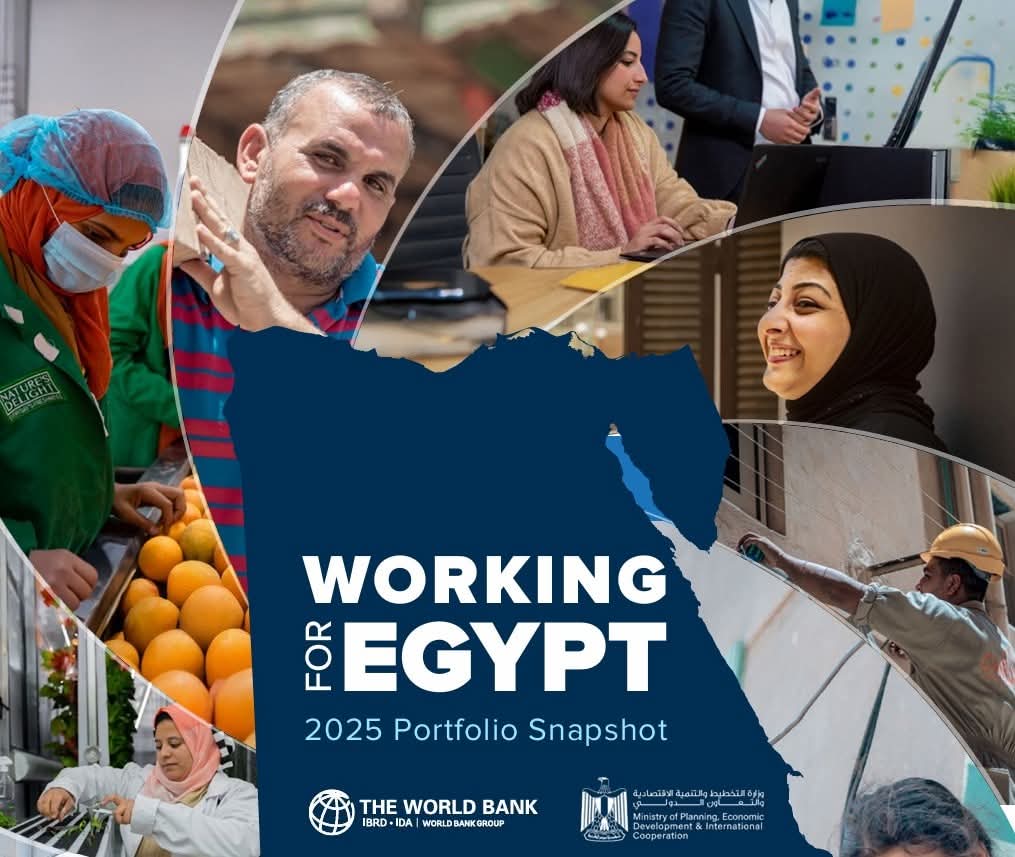

The World Bank has released an updated report reviewing the progress of its Country Partnership Framework (CPF) with the Egyptian government for the 2023–2027 period. The CPF aims to advance inclusive, sustainable development by providing concessional financing, technical assistance, and evidence-based policy support to Egypt.
WB- Egypt Partnership Built on National Priorities
Dr. Rania Al-Mashat, Egypt’s Minister of Planning, Economic Development, and International Cooperation, and Governor for Egypt at the World Bank Group, emphasized that Egypt’s partnership with the Bank is grounded in national ownership and fully aligned with Egypt Vision 2030. The strategic collaboration focuses on economic and structural reform, investment in human capital, private sector empowerment, and improved governance of public investment.

“Egypt is one of the founding members of the World Bank and its institutions. Over decades, this partnership has supported our national priorities—from education and health to private sector development and food security,” Al-Mashat said.
A Longstanding and Diverse Portfolio
According to the World Bank, Egypt is the third-largest stakeholder in the MENA region. Since 1959, Egypt has received funding for over 201 projects, totaling $27.5 billion, with an emphasis on infrastructure, economic reform, and human development.
The current CPF (2023–2027) supports:
- Job creation in the private sector
- Human capital development
- Enhanced resilience to economic and climate-related shocks
So far, the joint portfolio has yielded concrete development results:
- 6.3 million people benefited from health and food security programs
- 3.6 million students accessed better quality education
- 2.2 million individuals supported through food security measures
- 750,000 people accessed financial services
- 1.1 million received improved sanitation
- 30.3 million benefited from enhanced transportation, particularly rail
- 8 million people in Upper Egypt gained access to upgraded infrastructure
Focus on Human Capital and Social Safety Nets
A key component of the partnership is the long-running Takaful and Karama cash transfer program. As of June 2025, it supports 5.2 million households (about 17 million individuals), 75% of whom are women. The program enhances household resilience to shocks such as COVID-19, climate-related events, and regional economic challenges.
The report also notes collaboration on major public health initiatives, including the “100 Million Healthy Lives” campaign, which aims to eliminate Hepatitis C across Egypt.
Boosting Entrepreneurship and Job Creation
The Catalyzing Entrepreneurship for Job Creation Project has also made a significant impact—creating over 400,000 jobs and supporting over 200,000 entrepreneurs, including women (43%) and youth (43%). The initiative improves access to finance for small and medium enterprises (SMEs) and high-growth startups.
Supporting Evidence-Based Policy Through Diagnostics
The report highlights the value of economic diagnostics and public expenditure reviews in improving Egypt’s policy environment. Among these is the “Public Expenditure Review for Human Capital Sectors in Egypt”, which informs reforms in health and education.
Advancing Renewable Energy
In partnership with the IFC and MIGA, the World Bank supported Egypt’s Feed-in Tariff (FiT) policy, opening the energy market to private investment. This led to the development of the Benban Solar Park, which produces 1,465 MW of clean energy—a milestone in Egypt’s green transition.
A Growing Portfolio of Active Projects
Currently, Egypt and the World Bank are collaborating on 13 active projects totaling $6.5 billion in financing. These projects span critical areas including energy, education, health, transportation, agriculture, and social protection.
At Core of Egypt–World Bank 2023–2027 Strategy
While the report celebrates notable progress, the World Bank emphasizes that Egypt’s development journey is ongoing. The institution reaffirmed its long-term commitment to supporting Egypt’s goals, particularly in creating inclusive economic opportunities and improving quality of life for its citizens.