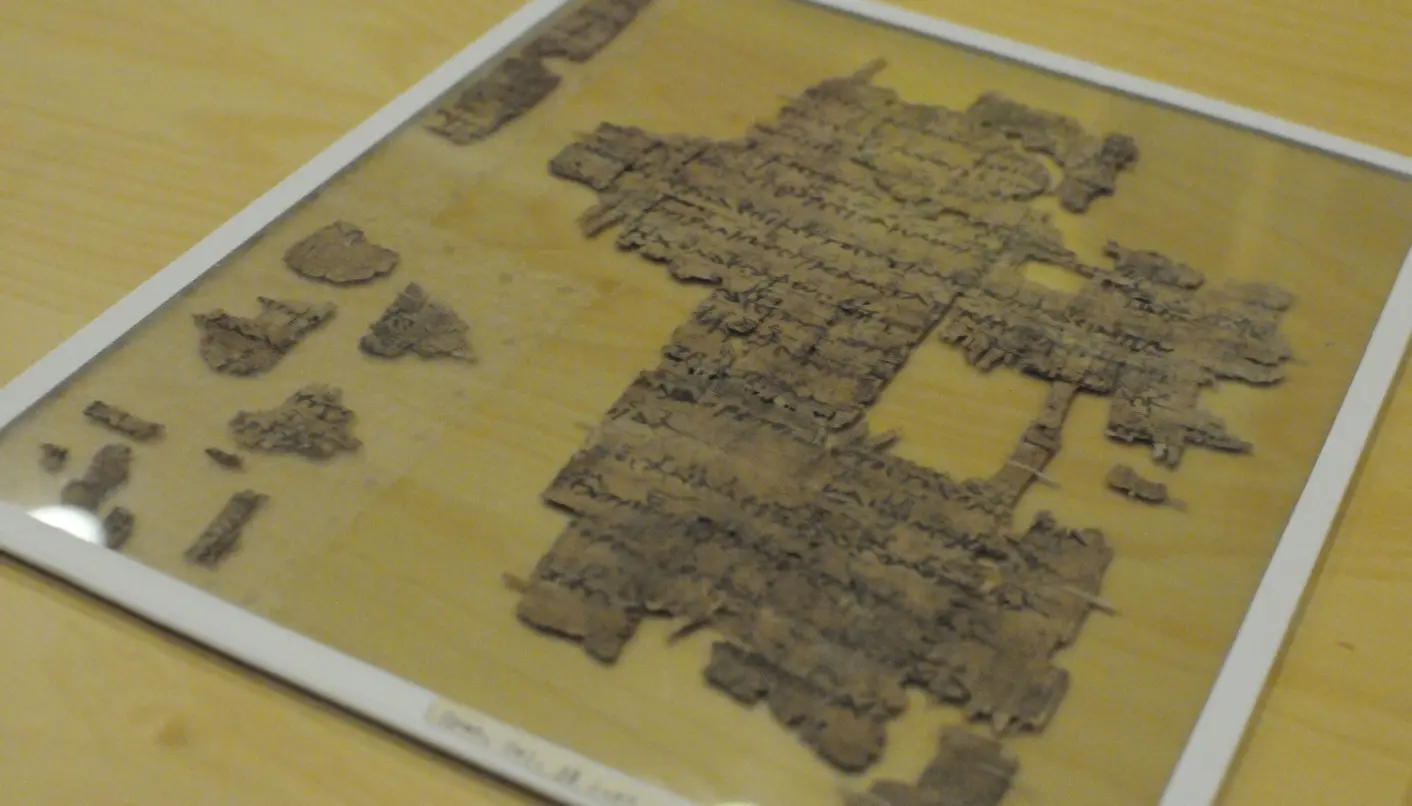

Tucked away on the fourth floor of the University of Oslo’s HumSam Library lies one of the world’s quietest yet most extraordinary archaeological collections: more than 2,200 fragments of ancient papyrus, many dating back nearly two millennia. Preserved behind glass and housed in minimalist display cases, these fragile sheets—inked by hands long gone—offer glimpses into both the everyday lives and intellectual worlds of Greco-Roman Egypt.
At the heart of this collection is papyrologist Federico Aurora, the library’s curator. On any given day, Aurora might be found carefully examining a 3rd-century scroll from Homer’s Odyssey or marveling at a rare 2nd-century CE copy of Plato’s The Statesman. But for all the literary gems the collection holds, the true value, Aurora insists, lies in the mundane.

“These are important documents that give us insight into daily life in Egypt over several centuries,” he says. “A letter about fish and beans can tell you as much as a fragment of Homer.”
A Hidden Archive of Egyptian Daily Life
While the collection includes fragments from literary giants like Homer and Herodotus, the majority of the material is far more grounded: personal letters, wills, horoscopes, tax receipts, loan agreements, and contracts related to homes, land, slaves, and even animals.
Many of these documents have remained unpublished for nearly a century. The last major release came in the 1920s and 1930s, with only a handful appearing in academic journals since. Now, for the first time in 90 years, Professor Anastasia Maravela—a leading papyrologist and scholar of Ancient Greek at the University of Oslo—is preparing two new volumes, covering approximately 80 previously unpublished texts.
“Not Extraordinary – But Essential”
Maravela emphasizes that while the texts may not seem remarkable individually, their cumulative significance is vast.
“They’re of great interest to philologists and historians,” she explains. “These fragments connect with documents from other papyrus collections and help us piece together the societal, legal, and cultural fabric of ancient Egypt.”
Among the upcoming releases are fragments of Homer’s Iliad, part of the ninth book of Herodotus, and private letters that reveal everything from business dealings to personal grievances. One example, a letter dubbed P.Oslo II 47, involves a man warning his friend about a dishonest fish seller.
A Medical Mystery: The Hippocratic Letters
Among the most intellectually intriguing pieces is P.Oslo inv. 1612, a small fragment believed to date between 100 BCE and 100 CE. It contains part of a decree honoring Hippocrates of Kos, often regarded as the father of modern medicine.
Crucially, this papyrus predates the earliest medieval manuscripts of the Hippocratic Letters by about 700 years, offering a critical glimpse into the evolution of one of medicine’s foundational mythologies.
Spells, Symbols, and the Supernatural
Perhaps the most visually arresting item in the Oslo collection is a 2.5-meter-long magical scroll from the 4th century CE—essentially, an ancient Egyptian spellbook. Designated P.Oslo.I 1, it was the first papyrus in the collection to be published and remains one of the most complete.
Filled with magical formulas and intricate illustrations, the scroll includes love spells, curses, and binding rituals. One spell instructs the reader on how to make someone fall in love; another explains how to control a rival. The process involved drawing symbols, reciting incantations, and using materials like wax or herbs—comparable in spirit to medieval European “black books.”
What It Means to “Publish” a Papyrus
Bringing these texts to the public is no simple task. Publication involves several steps: reading and transcribing the ancient Greek script, describing the physical dimensions of the fragment, dating it, and then providing historical commentary. Once complete, the texts are published in scholarly volumes and digitized for Papyri.info, an open-access online database.
But even reading the texts is an art form. Aurora describes spotting the Homeric word atrekeōs—meaning “without doubt”—as a clue that a fragment belongs to The Odyssey. Scholars compare such fragments with established literary databases, hoping to find matches or similar texts elsewhere.
An Ongoing Excavation of Knowledge
While Norway is not typically associated with ancient Egyptian heritage, the University of Oslo’s collection is part of a global patchwork of papyrological archives, including the vast holdings from Oxyrhynchus, Egypt, unearthed between 1896 and 1907. That cache alone yielded over 50,000 papyri, many of which remain unpublished and housed at the University of Oxford.