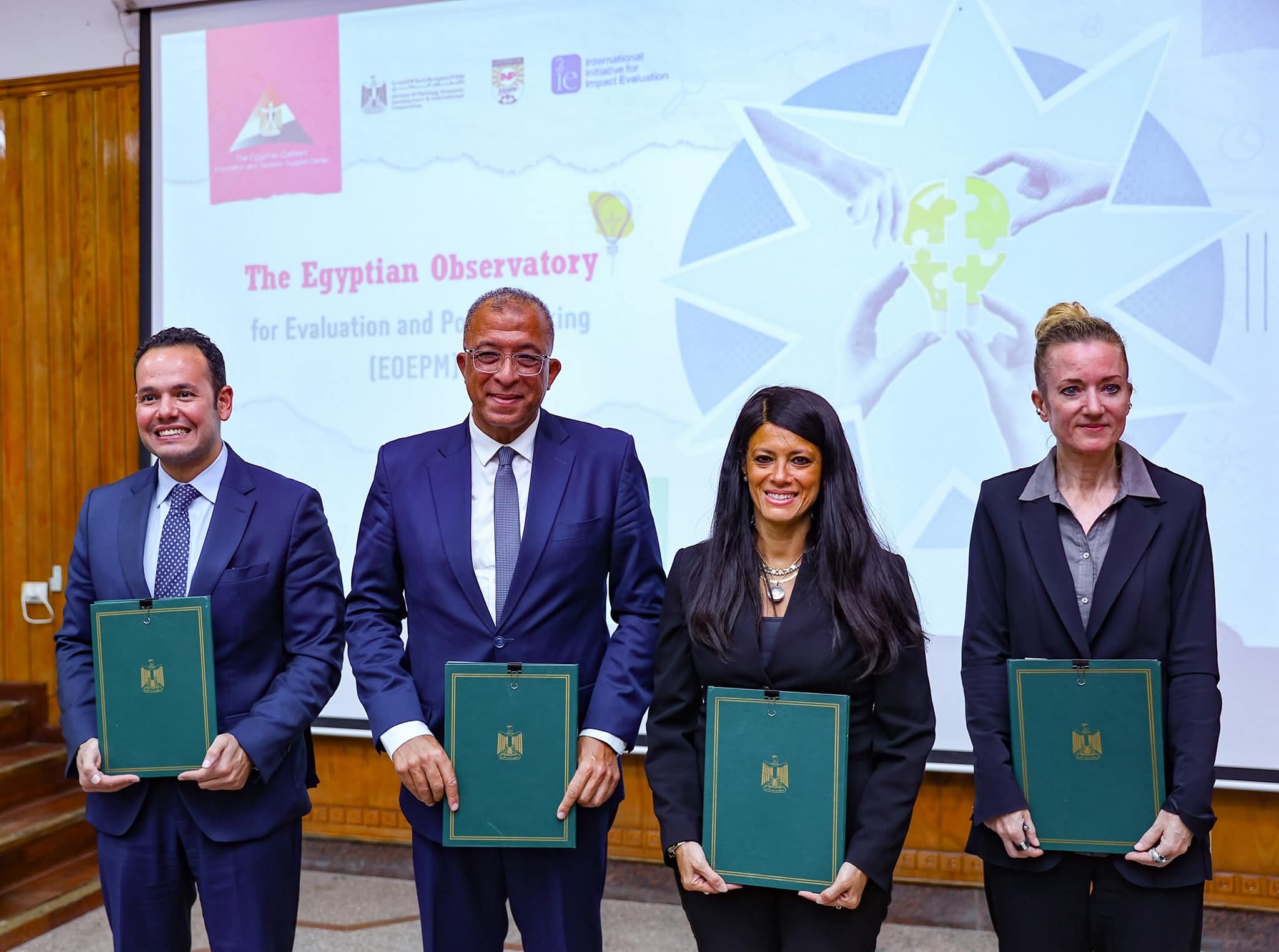

In a boost of evidence-based governance, Egypt’s Ministry of Planning has signed a landmark cooperation protocol with leading national and international institutions to establish the Egyptian Observatory for Evaluation and Policy Making.
The initiative, spearheaded by Minister of Planning Dr. Rania Al-Mashat, is the product of a multi-stakeholder agreement that includes the Cabinet’s Information and Decision Support Center (IDSC), the National Institute for Planning, and the International Initiative for Impact Evaluation (3ie)—a globally recognized organization supporting data-driven policymaking.

This strategic collaboration aims to institutionalize rigorous systems for monitoring, evaluation, and impact measurement across Egypt’s public sector. Through the observatory, Egypt seeks to elevate its development programs, align policymaking with scientific evidence, and ensure greater policy coherence with Egypt Vision 2030 and the Sustainable Development Goals (SDGs).
“Data Must Guide Decisions”
“Through this protocol, we are reaffirming our commitment to strategic guidance in monitoring, evaluation, and impact assessment,” Dr. Al-Mashat stated. “Our objective is to embed evidence-based practices at the heart of Egypt’s policymaking process, enhancing both national and sectoral development outcomes.”
Under the terms of the protocol, the Ministry will provide strategic direction for evaluation and impact analysis initiatives, ensure alignment with Egypt’s development priorities, and coordinate among relevant state agencies, including the Central Agency for Public Mobilization and Statistics (CAPMAS), the Egyptian Impact Lab, and others.
The Observatory will serve as a national hub for collecting, synthesizing, and utilizing data to enhance public sector performance and ensure measurable impact in socioeconomic development.
A Pillar of the “Government of the Future”
Dr. Osama El-Gohary, Assistant to the Prime Minister and Head of the IDSC, praised the creation of what he described as a “participatory impact evaluation laboratory,” calling it a cornerstone of Egypt’s vision for a modern, responsive government.
“This platform empowers policymakers with the tools to make rational, informed decisions,” he said, noting that the IDSC will also host the new observatory and contribute to shaping its research agenda in line with national priorities.
Dr. Ashraf El-Araby, President of the National Institute for Planning and former Minister of Planning, emphasized the importance of building research capacity within Egypt’s civil service. “We have a rich research agenda ahead, and the Observatory is pivotal in raising the analytical and evidence-based planning capabilities of our public administration,” he said.
3ie Brings Global Expertise
Representing the international dimension of the partnership, Dr. Marie Gaarder, Executive Director of 3ie, highlighted the organization’s global footprint and its experience in policy evaluation across Africa and other regions. “This partnership brings the best of global evidence to Egypt,” she noted, “empowering local decision-makers to craft policies that are not only ambitious but also measurably impactful.”
3ie will support the Observatory by providing methodological guidance, facilitating international partnerships, offering training aligned with global standards, and ensuring the integration of administrative and performance data into a national evidence framework.
Capacity Building at the Core
As part of its mandate, the Observatory will work closely with the National Institute for Planning to design specialized technical diplomas and professional training programs in Monitoring, Evaluation, and Learning (MEL). These will target civil servants at both the central and local government levels, strengthening institutional capacity and fostering a new generation of policy professionals grounded in analytical and results-oriented thinking.
The protocol also lays out a framework for organizing workshops, applied research programs, and joint studies focused on priority policy areas such as economic reform, legal modernization (including the forthcoming Planning Law and Unified Public Finance Law), and Egypt’s green transition strategy.
A Model for Regional Policy Innovation?
Egypt’s new observatory could serve as a regional model for integrating data and evaluation into policymaking. The country’s push toward institutionalizing monitoring and evaluation reflects a broader global trend in governance—one that prioritizes transparency, accountability, and measurable impact in the use of public resources.
By partnering with 3ie and establishing the Observatory, Egypt positions itself at the forefront of evidence-based development planning in the Middle East and Africa.