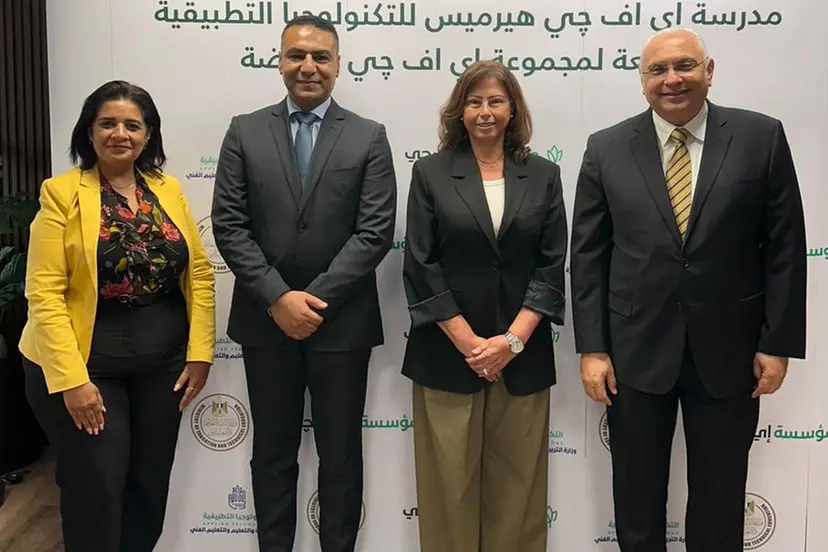

The EFG Foundation for Social Development, in strategic partnership with Egypt’s Ministry of Education and Technical Education, has officially launched the groundbreaking EFG Hermes Applied Technology School (ATS) for Agri-Tech in El Tod, Luxor. Spearheaded by Mona Zulficar, Chairperson of EFG Holding and the EFG Foundation, this initiative is set to revolutionize technical education by empowering youth with climate-smart agricultural skills critical for Egypt’s green economic future.
The EFG Hermes Applied Technology School for Agri-tech, announced Monday, represents a paradigm shift in Egypt’s approach to technical education, specifically targeting the intersection of climate resilience and agricultural innovation. The school will enroll an inaugural cohort of 75 students aged 14 to 18, with plans to graduate 225 students over the next three years.

Female Leadership Champions Educational Innovation
The initiative is being spearheaded by prominent women leaders who are reshaping Egypt’s approach to sustainable development and education. Hanaa Helmy, Group Chief Sustainability Officer of EFG Holding and CEO of the EFG Foundation, emphasized the transformative vision behind the project.
“This school reflects our commitment to empowering young people with the capabilities to thrive in a changing world,” Helmy said. “By investing in applied, future-ready education, we’re laying the groundwork for a generation of climate-conscious agricultural professionals who can lead Egypt’s green transition.”
Mona Zulficar, Chairperson of EFG Holding and the EFG Foundation, positioned the initiative within broader development goals. “Education is the cornerstone of inclusive development,” Zulficar stated. “With the launch of this Agri-Tech School, we are not only reimagining education, we are building a bridge between opportunity and impact for Egypt’s youth, especially in underserved regions.”
Cutting-Edge Competency-Based Education (CBE)
The three-year applied education program aligns with Egypt’s national technical education framework while introducing innovative elements specifically designed for the green economy. Students will receive comprehensive training in sustainable agriculture practices, agricultural waste recycling and composting, and smart farming techniques that integrate artificial intelligence, Internet of Things technology, and data analytics.
The school’s curriculum development process exemplifies a collaborative approach to educational innovation. The EFG Foundation, serving as the founding partner, led the design and implementation process in partnership with a diverse network of stakeholders including public and private academic institutions, international development agencies, industry pioneers, accelerators, agri-tech startups, civil society organizations, and digital learning platforms.
This multi-stakeholder approach has resulted in a Competency-Based Education (CBE) model that ensures the curriculum remains relevant, practical, and aligned with current and projected labor market needs. The program emphasizes three core pillars: technical green skills, entrepreneurship, and language proficiency, all underpinned by a cross-cutting focus on technology and climate resilience.
Government Partnership Strengthens Technical Education Framework
Amr Bosila, Head of Egypt’s Central Administration for the Development of Technical Education at the Ministry of Education and Technical Education, highlighted the initiative’s alignment with national education priorities.
“The signing of the protocol to establish the EFG Hermes Applied Technology School for Agri-Tech in Luxor Governorate, specializing in advanced agricultural technology, marks a new step in completing the system of establishing applied technology schools and supporting efforts to develop technical education, particularly in the field of sustainable agriculture,” Bosila stated.
Strategic Focus on Underserved Communities
The school’s establishment in Luxor holds particular significance for Egypt’s development strategy. Upper Egypt, historically underserved in terms of educational and economic opportunities, stands to benefit substantially from this investment in human capital development. The location also leverages the region’s agricultural heritage while introducing modern, sustainable practices that can be scaled across Egypt’s farming communities.
The launch of the agricultural technology school represents the latest chapter in the EFG Foundation’s expanding commitment to Luxor’s development. Since 2017, the organization has implemented several key projects in the governorate, including the Young Scholars’ Academy, the construction of 160 housing units, the development of sanitation infrastructure, and the establishment of the Future Pioneers School.
Foundation’s Comprehensive Development Approach
Established in 2006 as the corporate social responsibility arm of EFG Holding, the EFG Foundation has evolved into a significant player in Egypt’s development landscape. The organization’s portfolio spans health initiatives, including Hepatitis C awareness campaigns and vaccination programs, microfinance and poverty alleviation projects, and educational partnerships with institutions such as KidZania.
The Foundation’s approach to development emphasizes sustainability and innovation, leveraging EFG Holding’s financial expertise while creating measurable social impact. Previous initiatives have included comprehensive development programs in villages such as Ezbet Yacoub in Beni Sweif and Al Makhzan Village in Qena, implemented in collaboration with the Kuwaiti Initiative for the Support of the Egyptian People.
Preparing Next Generation for Green Economy Transition
The EFG Hermes Applied Technology School for Agri-tech represents more than an educational initiative; it embodies a strategic response to climate change that positions young Egyptians at the forefront of agricultural innovation.
The school’s success will likely influence similar initiatives across Egypt and the broader Middle East and North Africa region, where countries face comparable challenges in balancing agricultural productivity with environmental sustainability.