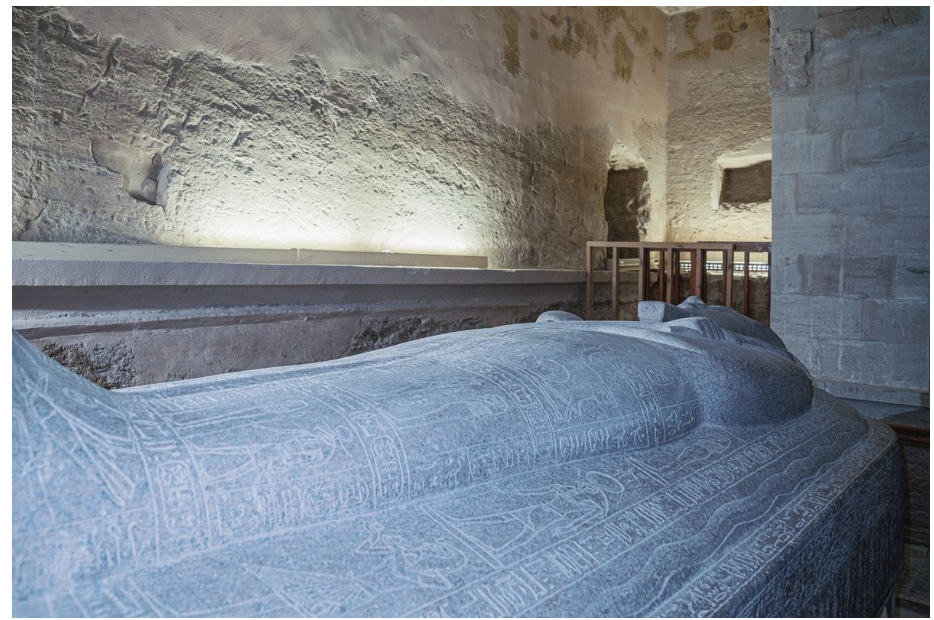

A joint Egyptian-Italian archaeological team has unearthed what experts are calling one of the most architecturally significant tombs from the Greco-Roman period, hidden beneath the western cliffs of the Nile near the Aga Khan Mausoleum in Aswan.
Tomb No. 38, as it is formally designated, was discovered nine steps down a stone staircase carved into the bedrock. At its heart lies a nearly six-foot-tall limestone sarcophagus, adorned with meticulously preserved hieroglyphic inscriptions and positioned atop a raised rock platform. The burial site, according to Egypt’s Ministry of Tourism and Antiquities, belonged to Ka-Mesiu, a high-ranking official whose name and status were recorded in vertical hieroglyphic columns running the length of the sarcophagus.

The tomb’s sealed interior contained multiple mummified bodies, including those of children, signaling its use as a family crypt and shedding light on burial practices across generations. Archaeologists described the anthropoid lid as bearing “a finely detailed human face, adorned with a decorative wig and remarkable painted features”—an artifact of exceptional craftsmanship from the Ptolemaic period.
“This find offers unprecedented insight into the cultural and social dynamics of southern Egypt under both the Ptolemaic and Roman administrations,” said H.E. Sherif Fathy, Minister of Tourism and Antiquities. “These tombs reflect not just the grandeur of Pharaonic heritage, but also its remarkable resilience and adaptability during successive foreign rules.”
The mission, conducted by Egypt’s Supreme Council of Antiquities in collaboration with the University of Milan, also uncovered several additional rock-cut tombs surrounding Tomb No. 38. Mudbrick benches lining the entry staircase suggest that the site was once used for elaborate funerary offerings and rituals. The tombs’ layered construction and reuse patterns suggest a shifting funerary landscape: elite families were buried atop the hill’s plateau, while middle-class graves were situated along its sloping base.
“We are looking at a necropolis that remained active for centuries,” said Dr. Mohamed Ismail Khaled, Secretary General of the Supreme Council of Antiquities. “The social stratification reflected in the tombs’ layout gives us an extraordinary window into the lived realities of Aswan’s inhabitants across political and dynastic change.”
The mummies discovered will undergo further analysis, including CT scans and DNA testing, to uncover details about their identities, health, and causes of death. Researchers also plan to conduct in-depth studies of the inscriptions and funerary objects, aiming to decode religious symbolism and shifts in ritual practices across Egypt’s later ancient history.
Mohamed Abdel-Badei, Head of the Egyptian Antiquities Sector, suggested that the recent find may be only the beginning. “The plateau is honeycombed with tombs yet to be explored—many of which likely date to the Ptolemaic era and were later repurposed under Roman rule. The potential for further discovery is enormous.”
As archaeologists carefully continue their work beneath the shadow of the Aga Khan Mausoleum, each uncovered stair and sarcophagus pushes the boundaries of our understanding of ancient Egypt’s enduring—and evolving—civilization..