
Egypt’s Ministry of Tourism and Antiquities has announced a major new archaeological discovery at the site of Tel El-Faraheen (Tel Nebasha) in the Al-Husseiniya district of Sharqia Governorate, marking the conclusion of the current excavation season led by a British archaeological team from the University of Manchester.
Minister Shereef Fathy praised the importance of the discovery, describing it as a vital addition to our understanding of ancient urban life in the Nile Delta. He reaffirmed the Ministry’s commitment to supporting excavation missions across Egypt as part of broader efforts to preserve cultural heritage and promote sustainable tourism and cultural development in alignment with the national development strategy.

Lost Urban Center from the Late Period
According to Dr. Mohamed Ismail Khaled, Secretary-General of the Supreme Council of Antiquities, excavations focused on the eastern mound of the site. Using remote sensing and Landsat satellite imagery, researchers identified dense mudbrick structures, leading to the discovery of what is believed to be multi-story residential buildings dating back to the early or mid-4th century BCE.
These “tower houses”—characterized by their thick foundation walls—were built to accommodate large numbers of inhabitants. This type of housing was prevalent in the Late Period through the Roman era, particularly across the Nile Delta. Additional buildings used for grain storage and livestock sheltering were also uncovered, indicating a complex urban infrastructure.
Temple Architecture and Ritual Practice
In the temple area, the mission discovered a large limestone pavement and remnants of two monumental mudbrick columns, possibly once plastered with gypsum. These remains are thought to belong to a structure built over a ceremonial processional route that once connected a Late Period pylon to the Temple of Wadjit, the local cobra goddess. Evidence suggests that the route had fallen out of use by the mid-Ptolemaic period.
The Temple of Wadjit, originally rebuilt during the reign of Ramses II and again under Amasis II, was later repurposed as a stone quarry during the Achaemenid period, reflecting the site’s evolving religious and economic significance.
Rare Artifacts Enhance Historical Understanding
Among the notable finds:
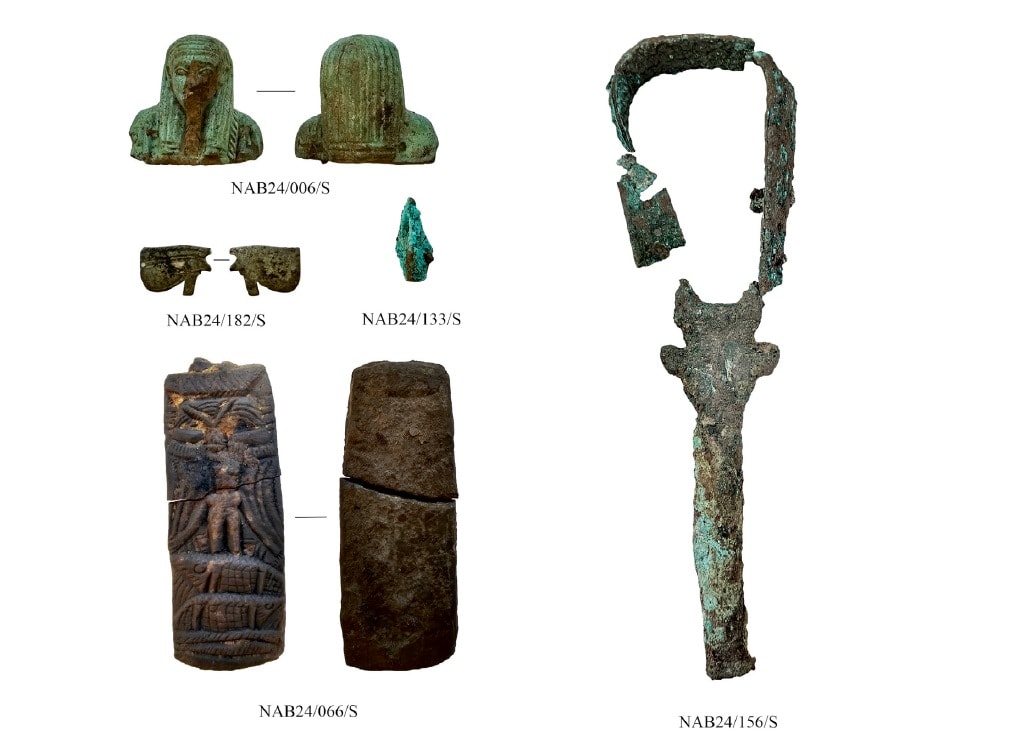
- The upper portion of a green faience Ushabti figurine, intricately crafted and dating to the 26th Dynasty.
- A carved stela depicting the god Horus standing on crocodiles and holding snakes, with the protective dwarf god Bes illustrated above—a classic apotropaic motif in Late Period religion.
- A bronze sistrum (ritual rattle) adorned with dual Hathor heads, dated to the end of the Late Period, offering insights into music and ritual worship in the temple complex.
Reconstructing the Ancient City of “Emet”
According to Dr. Nicky Nielsen, director of the British mission, the site corresponds to the ancient city of Emet, which was a major population center in Lower Egypt during the New Kingdom and Late Periods. The remains of the Temple of Wadjit still stand on the site’s western edge, providing architectural continuity across millennia.