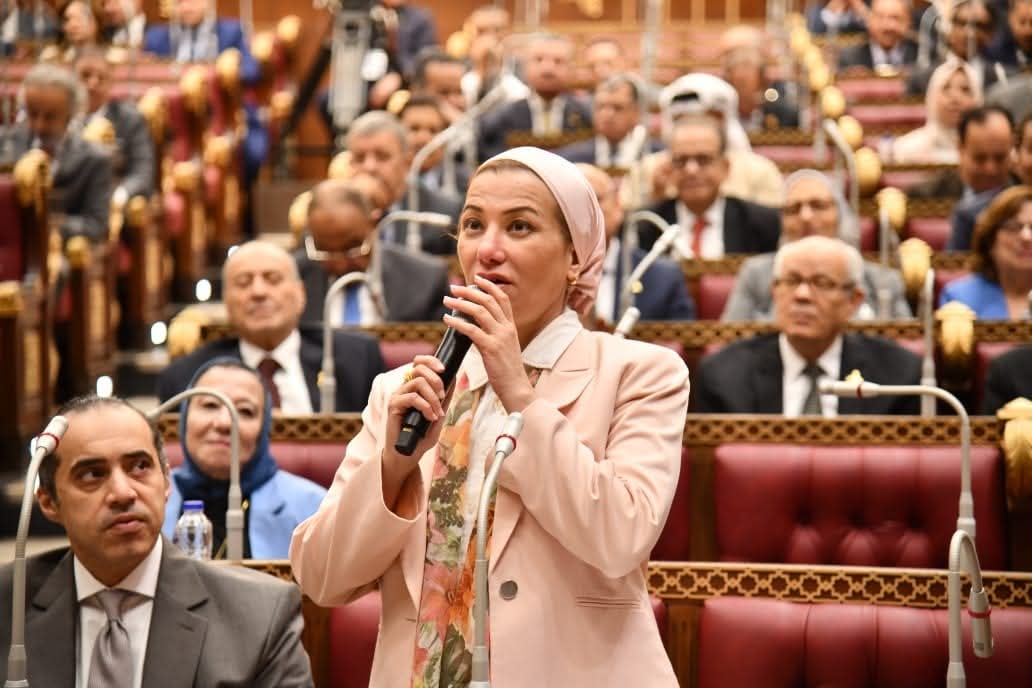

In an address before Egypt’s Senate General Session this week, Minister of Environment Dr. Yasmine Fouad placed women’s empowerment at the heart of Egypt’s environmental renaissance, highlighting the pivotal role that female leadership plays in shaping national sustainability strategies and confronting global climate challenges.
In a country often viewed through the prism of traditional gender roles, Dr. Fouad’s leadership stands as a compelling counter-narrative. Speaking before lawmakers in a joint session reviewing the legislative legacy of Law No. 102 of 1983 on natural reserves, Fouad not only argued for stronger environmental protections but also made a compelling case for the necessity of female leadership in policy, innovation, and climate action.

Presidential Endorsement of Women in Leadership
Opening her remarks, Dr. Fouad expressed deep gratitude to President Abdel Fattah El-Sisi, noting his unwavering support for the Ministry of Environment and, critically, his commitment to empowering Egyptian women. “The President’s trust is not simply symbolic,” she said. “It has enabled women to lead on some of the most vital national files—none more urgent than environmental and climate policy.”
This trust was further exemplified by her recent appointment as Executive Secretary of the United Nations Convention to Combat Desertification (UNCCD)—a landmark moment that not only reflects Egypt’s rising diplomatic stature but also underscores the competence of its female leaders on the global stage.
A Gendered Perspective on Environmental Justice
Dr. Fouad emphasized that gender equity is not peripheral to environmental governance—it is central. Women in Egypt, particularly in rural and climate-vulnerable areas, are disproportionately affected by environmental degradation, water scarcity, and land loss. “Yet, they are also the most powerful agents of change,” she stressed.
She cited examples of how local women in natural reserves such as Fayoum, St. Catherine, and Nabq have become stewards of biodiversity, supported by state initiatives to integrate communities into conservation efforts. “We don’t protect ecosystems apart from people. We protect them with people—especially women,” Fouad stated.
This inclusive model, she argued, must be enshrined in the revised Natural Reserves Law, currently under parliamentary review. Fouad advocated for legal provisions that empower women-led cooperatives, encourage gender-sensitive eco-tourism, and guarantee women’s representation in local conservation councils.
Institutional Transformation with Gender at the Core
Dr. Fouad outlined how the Ministry has restructured the Nature Protection Sector to ensure transparency, accountability, and equal opportunity. The new framework separates the roles of planning, management, and monitoring, with women increasingly occupying leadership positions across these pillars.
Further, she emphasized that sustainable finance mechanisms—from eco-lodge investments to carbon credit programs—must deliberately include women-led enterprises. “Our goal is not only ecological sustainability,” she said, “but social equity through green opportunity.”
The Eco-Egypt Model: Telling Women’s Stories
Through the ECO Egypt campaign, the Ministry has spotlighted 13 protected areas as destinations for eco-tourism—many of which feature stories of women leading local conservation, hospitality, and cultural initiatives. From Bedouin guides in South Sinai to craftswomen in the Western Desert, ECO Egypt is reframing the narrative of environmentalism in Egypt as one where women are not just beneficiaries, but architects of change.
Women at the Forefront of Climate Resilience
Addressing climate threats such as rising sea levels in Alexandria and recurring droughts in Upper Egypt, Fouad noted that adaptation planning must incorporate women’s knowledge and leadership. Egypt’s National Climate Change Strategy 2050, she explained, includes gender-responsive policies that prioritize women’s roles in agriculture, water resource management, and disaster preparedness.
In partnership with the Ministry of Agriculture and the Desert Research Center, Fouad’s ministry is also channeling international adaptation funding—including $12 million from the Adaptation Fund—towards women-led agricultural cooperatives to support climate-resilient crop development and sustainable grazing projects.
Green Entrepreneurship for Women-Led SMEs
As part of Egypt’s celebrations for World Environment Day 2025, the Ministry will launch a “Green Business Guide” for small and medium-sized enterprises, targeting women entrepreneurs. This initiative aims to demystify the green economy, helping female founders understand how to access financing, lower emissions, and create environmental value in sectors ranging from agriculture to clean tech.
“This is not charity. This is smart policy,” Dr. Fouad affirmed. “Green businesses led by women are more inclusive, more community-oriented, and more resilient.”
Conclusion: A Blueprint for Gendered Environmental Governance
Minister Fouad’s Senate appearance was more than a policy update—it was a vision for a future where environmental integrity and gender justice advance in tandem. At a moment when global climate discourse is increasingly technocratic, Egypt’s top environmental official reminded her nation—and the international community—that the most enduring solutions emerge when women are empowered not just to participate, but to lead.
In doing so, Dr. Yasmine Fouad has set a new standard for what environmental leadership looks like in the 21st century: strategic, inclusive, and unapologetically female.