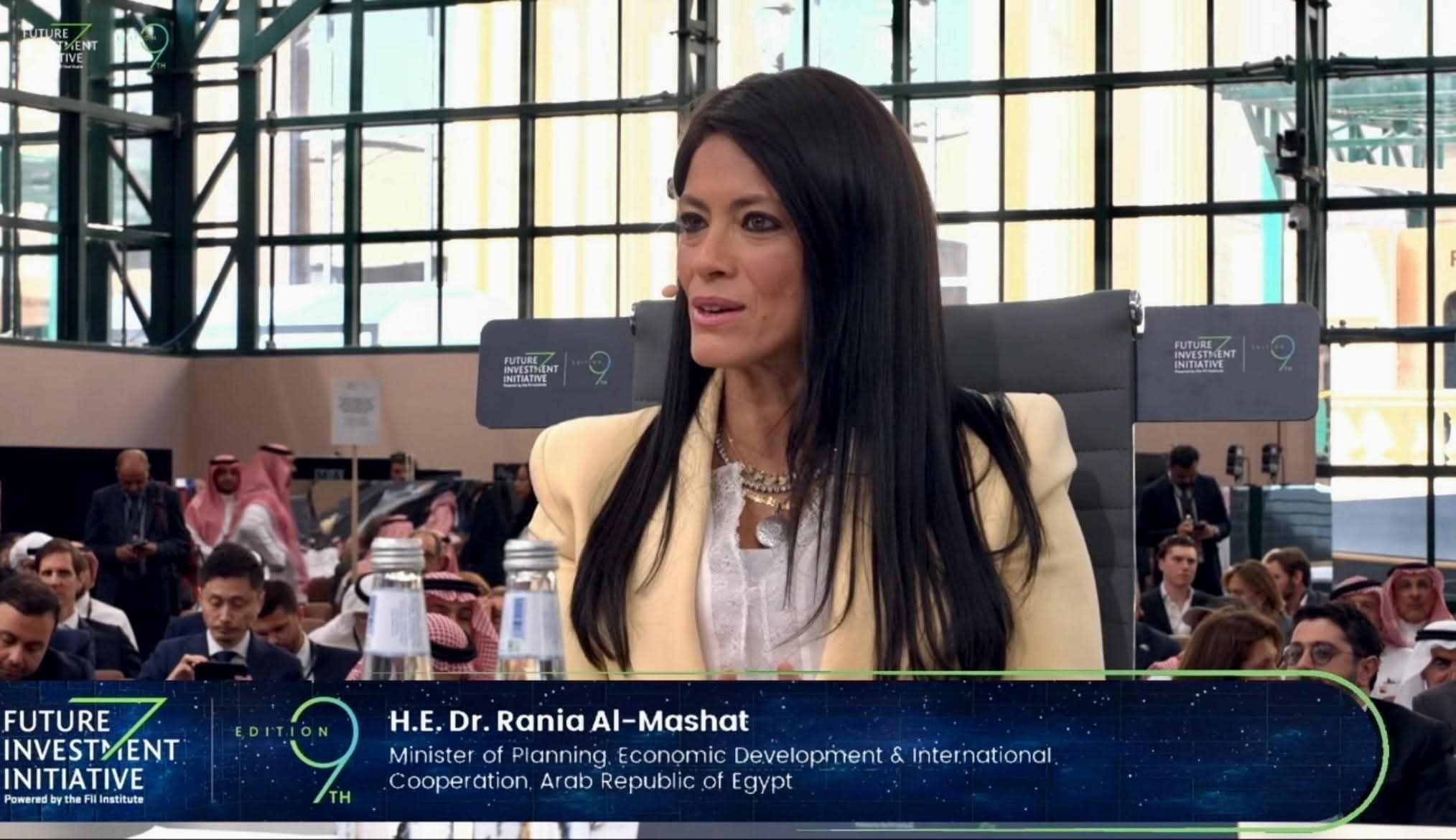

Egypt’s Minister of Planning, Economic Development, and International Cooperation, Dr. Rania Al-Mashat, emphasized the pivotal role of public–private partnerships in strengthening global economic resilience during her participation in the ninth edition of the Future Investment Initiative (FII), held in Riyadh under the theme “The New Compass: Key to Prosperity.”
Dr. Al-Mashat spoke during the conference’s main plenary session, titled “Council of Changemakers: Influential Leaders Across the Public and Private Sectors.” The panel brought together high-profile figures, including Khalid Al-Falih, Saudi Minister of Investment; Paul Chan, Financial Secretary of Hong Kong; Aliko Dangote, Founder and CEO of the Dangote Group; and Jim Fitterling, Chairman and CEO of Dow.

Public–Private Trust as the Foundation of Resilient Economies
In her remarks, Al-Mashat stressed that economic flexibility and resilience in today’s uncertain environment can only be achieved through effective collaboration between governments and the private sector. She noted that the world is facing a growing set of interconnected challenges—ranging from supply chain disruptions and energy crises to climate change and inflationary pressures—that cannot be managed by governments alone.
“Governments on their own cannot confront the scale of today’s economic challenges. A foundation of trust, clarity, and transparency between the public and private sectors is essential to ensuring stability and long-term growth,” Al-Mashat said.
She pointed to the 2025 FII Global Indicator, which identified cost of living and employment opportunities as the world’s most pressing concerns. Addressing these issues, she explained, requires policy coherence and shared responsibility between the two sectors to promote adaptability and sustained development.
Egypt’s National Framework for Sustainable Investment
Highlighting Egypt’s domestic progress, Al-Mashat underlined that the Egyptian government continues to move decisively toward creating an enabling investment climate to attract and expand private-sector participation.
She noted that Egypt recently launched its National Economic Development Narrative, a comprehensive framework integrating structural reforms and investment strategies that prioritize growth, job creation, and resilience. The country’s 2030 vision serves as the executive arm of this narrative, aligning public policy with private-sector priorities to achieve sustainable, inclusive growth.
“Egypt’s economic story is one of balance—containing public investment while expanding the role of the private sector,” Al-Mashat said, adding that private participation now accounts for approximately 57 percent of total national investments, reflecting a clear policy shift toward production-oriented sectors.
Regional Cooperation and Energy Integration
Citing Egypt’s expanding cooperation with Saudi Arabia, Al-Mashat described the Egypt–Saudi electricity interconnection project as a “model of regional integration and strategic alignment.” The initiative, she said, demonstrates how effective partnerships between governments and private entities can generate sustainable, high-impact infrastructure that benefits entire regions.
She added that Egypt’s earlier investments in logistics, ports, and power infrastructure have positioned the country as a regional hub for renewable energy, attracting leading companies such as ACWA Power and supporting Egypt’s growing role in green hydrogen and smart energy networks.
The Road Ahead: Innovation and Institutional Continuity
Al-Mashat emphasized that future economic growth will depend on emerging industries—including green hydrogen, AI-driven infrastructure, and smart grids—that require both technological capability and large-scale investment. These, she said, can only be achieved through robust and trusted partnerships between the public and private sectors.
She concluded by underlining the importance of institutional stability and policy continuity, noting that “strong institutions and long-term plans are what sustain investor confidence and reduce uncertainty.”
The Future Investment Initiative, widely regarded as one of the world’s premier economic and investment platforms, convenes more than 8,000 participants and 650 speakers from over 20 countries, bringing together global leaders to discuss the future of investment, innovation, and sustainable growth.