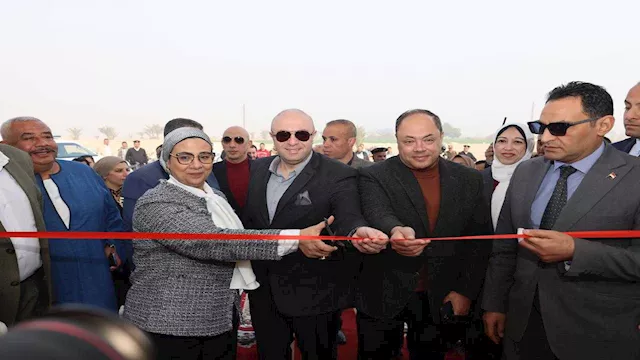

In a major step toward preserving traditional crafts and expanding economic opportunities for women in Upper Egypt, Counselor Amal Ammar, President of Egypt’s National Council for Women (NCW), on Monday inaugurated the Meidum Heritage Skills Development Center in Al-Wasiti district, Beni Suef Governorate.
The opening ceremony was attended by Dr. Mohamed Hany Ghoneim, Governor of Beni Suef; Maj. Gen. Eng. Amr Abdel Moneim Mostafa, Chairman of the Upper Egypt Development Authority; NCW members Dr. Essam El-Adawy and Dr. Amani Asfour; and Nermine Mahmoud, head of the NCW branch in Beni Suef, alongside senior officials from local and national institutions.

Empowering Women Through Heritage-Based Development
Speaking at the event, Ammar expressed deep appreciation for Governor Ghoneim’s continued support of women’s empowerment initiatives in Beni Suef, praising his efforts to remove obstacles facing development projects that expand training and employment opportunities for women.
“These initiatives play a critical role in strengthening women’s participation in the local economy and advancing sustainable development,” Ammar said.
She also commended Amr Abdel Moneim Mostafa for his commitment to inclusive development across Upper Egypt and for ensuring that women’s empowerment remains a core pillar of regional development strategies.
Ammar emphasized that the Meidum Center opens “real and sustainable opportunities” for women in Upper Egypt by linking training with production, marketing, and distribution. She stressed the importance of financial inclusion training, noting that equipping women with economic and financial skills is essential to supporting entrepreneurship and long-term independence.
Supporting Tourism, Culture, and Local Jobs
Governor Mohamed Hany Ghoneim described the project as part of a broader provincial plan to transform villages surrounding the Meidum Pyramid and Oasis into distinctive heritage and handicraft hubs that enhance cultural tourism.
“The center is a cornerstone in our vision to develop heritage-based villages that support tourism while creating jobs for local residents,” Ghoneim said. He added that the project is expected to generate 120 direct employment opportunities for residents of Ezbet Al-Nour and neighboring villages, contributing to improved living standards and local economic growth.
Preserving Traditional Crafts and Creating Sustainable Income
For his part, Amr Abdel Moneim Mostafa said the center reflects the political leadership’s directives to prioritize Upper Egypt, preserve traditional crafts, and integrate them into modern labor markets.
“By connecting heritage skills with market demand, we are creating sustainable income sources—especially for women and youth,” he said.
He explained that training at the Meidum Center is conducted in cooperation with the National Council for Women and is designed to raise trainees’ professional efficiency and align their skills with both local and international market needs.
Inside the Meidum Heritage Skills Development Center
Following the inauguration, Ammar, Ghoneim, and Mostafa toured the center’s facilities, including a workshop complex featuring 24 specialized training rooms. These rooms are dedicated to teaching women a wide range of traditional and handmade crafts, such as:
- Sewing and embroidery
- Leather production
- Wood veneer and shell craft
- Khayamiya (traditional appliqué textiles)
- Heritage accessories
- Amigurumi
- Stained glass
- Ceramics
- Carpet and rug weaving
The comprehensive training program aims to refine participants’ craftsmanship and enable them to enter the labor market or launch small businesses rooted in Egypt’s rich cultural heritage.
Literacy, Education, and Market Access
The delegation also visited a women’s literacy and adult education classroom affiliated with the General Authority for Adult Education, which focuses on enrolling and educating female learners to improve their basic skills alongside vocational training.
The tour concluded with a visit to a women-led products exhibition, showcasing a diverse collection of locally made goods, including clothing, bed linens, abayas, dresses, and household textiles—highlighting the center’s role in turning skills into market-ready products.
Broad Institutional Participation
The inauguration was attended by several senior officials, including Counselor Mohamed Afia and Counselor Mohamed Sweidan (NCW advisors), Noha Morsi, Head of the Central Administration for Governorates and Branches, Mai Mahmoud, Director General of the Women’s Skills Development Center, Ahmed Shawky, Director General of Protocol, Maj. Gen. Ayman Hamouda, Director General of Security, Ali Youssef, Head of Al-Wasiti Center, and Osama William, Head of the General Authority for Adult Education in Beni Suef.
A Model for Inclusive, Sustainable Development
The Meidum Heritage Skills Development Center stands as a model for integrating women’s empowerment, cultural preservation, and local economic development—positioning Beni Suef as a growing hub for heritage industries in Upper Egypt and reinforcing Egypt’s broader strategy of inclusive and sustainable growth.