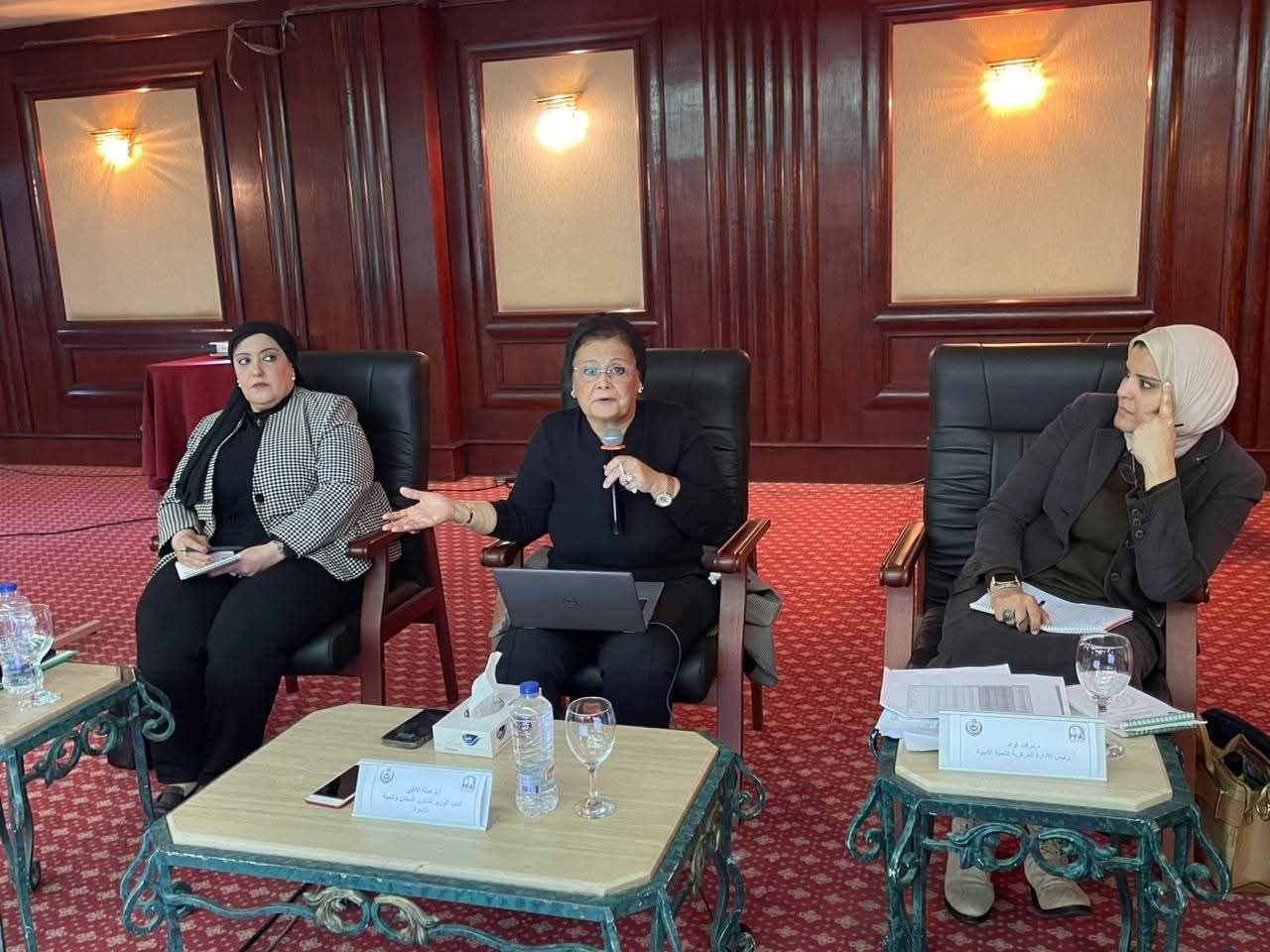

Egypt’s Deputy Minister of Health and Population for Population and Family Development Affairs, Dr. Abla Al-Alfi, has convened a series of intensive meetings and participatory workshops to review the outcomes of 2025 and finalize urgent executive plans for 2026–2027, as part of the National Population and Development Strategy.
According to a statement issued by the Ministry of Health and Population, the meetings included a high-level session with ministry undersecretaries, directors of health directorates and family development departments nationwide, as well as a participatory workshop focused on reviewing and integrating sectoral executive plans for the 2026–2027 period. The discussions were held within the framework of the national strategy, the emergency population action plan, and the National Family Development Program.

Broad Participation and International Support
The meetings were attended by Dr. Rasha Khidr, Head of the Primary Health Care and Family Development Sector, and Dr. Mirvat Fouad, Head of the Central Administration for Family Development, alongside population experts, consultants, representatives of the Central Agency for Public Mobilization and Statistics (CAPMAS), and partner institutions from across civil society. The activities were supported by the United Nations Population Fund (UNFPA).
Opening the sessions, Dr. Al-Alfi conveyed the greetings of Dr. Khaled Abdel Ghaffar, Deputy Prime Minister and Minister of Health and Population, and reaffirmed the ministry’s full commitment to achieving a total fertility rate of 2.1 children per woman by the end of 2027.
She described 2026 and 2027 as “years of challenge,” stressing the need to intensify efforts and strengthen intersectoral coordination to improve population characteristics, empower women, eradicate illiteracy, combat school dropout rates, and eliminate unmet needs for family planning services.
Reviewing 2025 Results and Regional Performance
Participants reviewed the 2025 performance outcomes, analyzing strengths and weaknesses across governorates and openly discussing challenges and proposed solutions. The discussions highlighted best-practice models in several governorates, including Port Said, which is approaching replacement-level fertility, as well as Menoufia, Beheira, Alexandria, Gharbia—which recorded a fertility rate of 1.99—and Minya, Assiut and Sohag in Upper Egypt. North Sinai and Matrouh were also commended for addressing population challenges within their unique geographic and cultural contexts.
Strengthening Task-sharing Approach
Dr. Rasha Khidr emphasized the importance of updating governorate-level action plans, closely monitoring family records, completing maintenance of mobile clinics, and ensuring the availability of drivers, particularly in remote areas. She also stressed activating the “task-sharing” approach to address physician shortages and praised successful models such as Port Said’s implementation of the Universal Health Insurance System.
Meanwhile, Dr. Mirvat Fouad underscored the central role of family counseling units as a cornerstone of population work, calling for expanded digitization and stronger integration with curative services. She highlighted the need for data accuracy and credibility, with future focus on premarital counseling and counseling during the first year of marriage.
Action-Oriented Planning
During the participatory workshop, Dr. Hussein Abdel Aziz presented the core principles for developing executive plans, emphasizing the importance of incorporating lessons learned, linking activities to measurable outcomes, and accounting for challenges such as reduced external funding.
The meetings concluded with agreement on a set of binding measures, including:
- Monthly evaluation of population indicators and linking incentives to performance outcomes
- Focusing on five key messages: birth spacing of 3–5 years, immediate postpartum family planning, preparedness for first pregnancy, reducing unjustified cesarean deliveries, and lowering contraceptive discontinuation rates
- Expanding training programs for internship doctors and nursing staff
- Partnering with universities to promote safe natural childbirth
- Delivering unified behavior-change communication messages
- Holding quarterly follow-up meetings
- Launching a nationwide competition to rank governorates based on data accuracy and indicator improvement
- Establishing a clear timeline to finalize updated executive plans
Commitment to Sustainable Development
The meetings reaffirm the Ministry of Health and Population’s commitment to institutional, participatory approaches in achieving the goals of the National Population Strategy, supporting sustainable development, and improving the quality of life for Egyptian families nationwide.