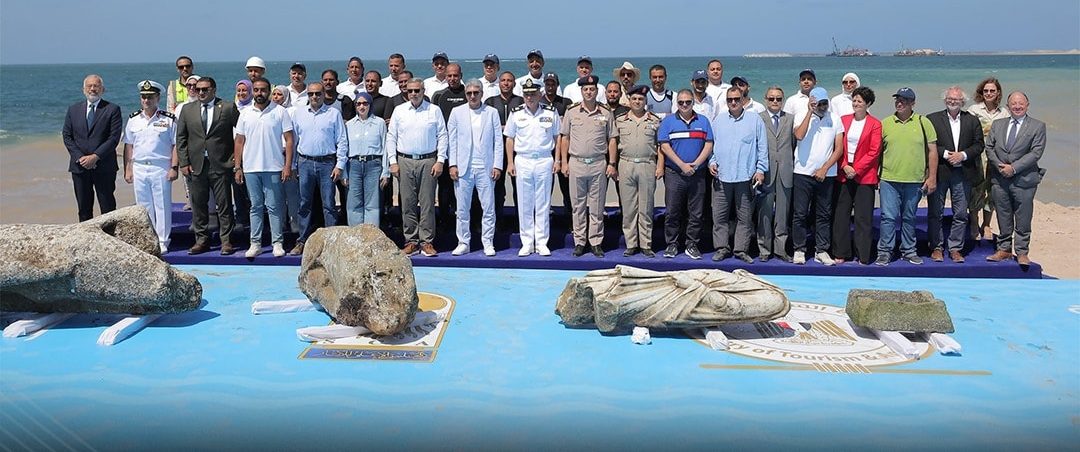

In a stunning archaeological breakthrough, Egyptian authorities announced the successful recovery of three monumental statues from the depths of the Mediterranean Sea at Abu Qir Bay, just off the coast of Alexandria. The discovery is part of an ongoing underwater excavation project in what is believed to be a fully equipped, submerged Roman-era city.
The recovered artifacts include:

- A colossal pink quartzite sphinx bearing the cartouche of Pharaoh Ramses II, one of ancient Egypt’s most powerful and celebrated rulers.
- A black granite statue of a prominent figure from the late Ptolemaic period, reflecting the transitional phase between Pharaonic and Greco-Roman rule.
- A white marble statue of a Roman nobleman, showcasing exquisite detail and craftsmanship consistent with high-ranking Roman aristocracy.
A Lost City Beneath the Waves
According to Egypt’s Supreme Council of Antiquities, the statues were found within the remains of a vast sunken city believed to date back to the Roman period. The submerged site contains evidence of temples, paved streets, port structures, and residential buildings—pointing to a once-flourishing metropolis now lost beneath the sea.
The Abu Qir Bay region is known to have been affected by a series of natural disasters in antiquity, including earthquakes and rising sea levels, which are thought to have caused large sections of the ancient coastline to slip underwater.
Advanced Technology Driving Underwater Archaeology
The operation involved advanced diving techniques, underwater mapping, and 3D scanning tools to safely extract the statues, which had rested on the seabed for nearly two millennia. The mission is being carried out by an Egyptian archaeological team in collaboration with marine experts from local and international institutions.
Egypt’s Ministry of Tourism and Antiquities confirmed that the underwater exploration will continue in the area, which is believed to contain further undiscovered treasures. Initial studies suggest that more statues, inscriptions, and possibly entire architectural structures may lie beneath layers of sediment and debris.
Tourism and Global Interest
The discovery is expected to draw significant attention from both the academic community and cultural tourism sector. Egypt has been actively working to position itself as a global hub for archaeological tourism, particularly following major discoveries like the Saqqara necropolis, the “lost golden city” in Luxor, and now, the submerged city of Abu Qir.
The Ministry has also hinted at plans to exhibit the recovered statues in a dedicated wing at the Grand Egyptian Museum (GEM), slated for its full opening in 2026.