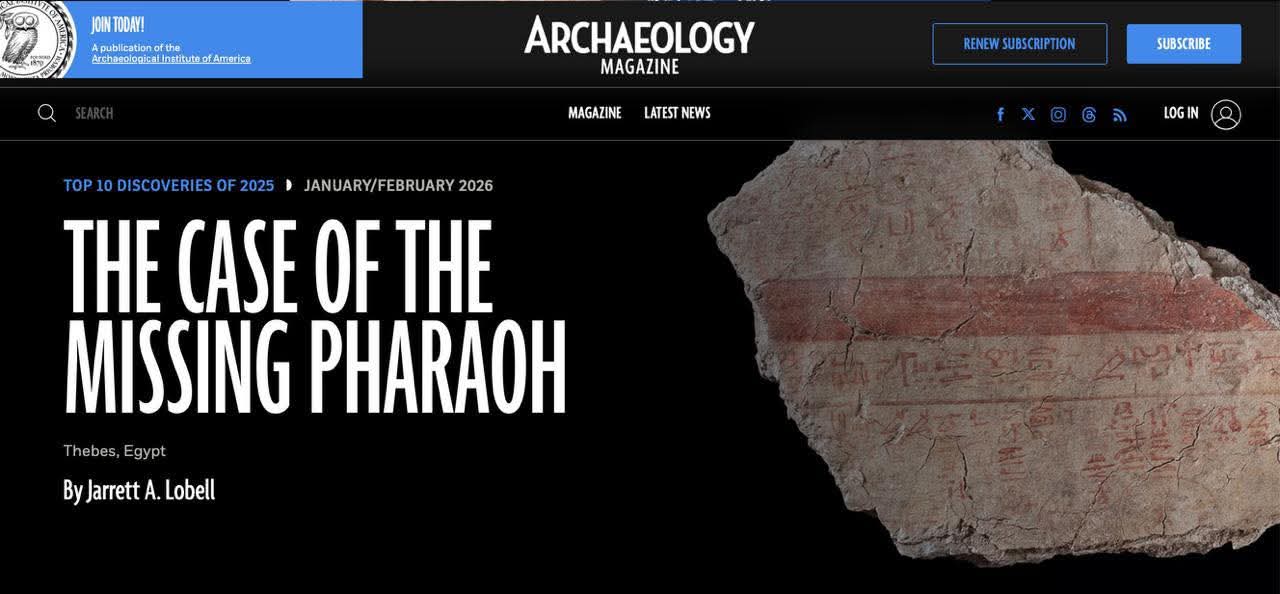

The tomb of King Thutmose II, discovered in the West Bank of Luxor, has been ranked among the top 10 archaeological discoveries of 2025 by Archaeology Magazine, one of the world’s most prestigious publications specializing in ancient history and archaeology. The announcement places the Egyptian discovery at the center of global archaeological attention and underscores Egypt’s enduring leadership in the field.
The tomb, whose discovery was officially announced by Egypt’s Ministry of Tourism and Antiquities in February 2025, is of exceptional historical significance. It represents the first royal tomb from Egypt’s 18th Dynasty to be discovered since the unearthing of King Tutankhamun’s tomb in 1922, marking a milestone more than a century in the making. Reflecting its importance, one of the newly discovered inscriptions from inside the tomb was featured on the cover of Archaeology Magazine’s January–February 2026 issue.

Global Recognition of Egypt’s Archaeological Legacy
Dr. Mohamed Ismail Khaled, Secretary-General of the Supreme Council of Antiquities, said the international recognition reaffirms the outstanding value of Egypt’s archaeological discoveries and highlights the country’s leading scientific standing in archaeological research.
“This achievement reflects the sustained efforts and fruitful cooperation between Egyptian and international archaeological missions,” Khaled said, noting that such discoveries contribute to reinterpreting ancient Egyptian history and enriching global human knowledge.
Discovery by Joint Egyptian–British Mission
The tomb was uncovered by a joint Egyptian–British archaeological mission led by the Supreme Council of Antiquities in cooperation with the New Kingdom Research Foundation. The discovery took place during excavation and archaeological survey work at Tomb C4 in the Theban Mountain on Luxor’s West Bank.
In the early stages of excavation, researchers initially believed the tomb belonged to a royal consort of one of the Thutmosid kings, due to its proximity to the tombs of the wives of King Thutmose III and near the tomb of Queen Hatshepsut. Hatshepsut’s tomb had originally been prepared for her as a royal wife before she ascended the throne as pharaoh and was later buried in the Valley of the Kings.
However, as excavations progressed, the mission uncovered decisive archaeological evidence confirming that the tomb belonged to King Thutmose II, resolving long-standing historical questions about his burial place.
Artistic and Architectural Significance
Among the most important finds inside the tomb were fragments of plaster bearing traces of blue inscriptions and yellow celestial stars, along with decorative elements and texts from the Book of Amduat, one of the most significant funerary texts of ancient Egypt.
Architecturally, the tomb is characterized by a simple yet highly influential design, considered a foundational model for the royal tombs constructed by subsequent pharaohs of the 18th Dynasty. Scholars believe this architectural layout played a key role in shaping later royal burial traditions during the New Kingdom period.
Reinforcing Egypt’s Place on the World Heritage Map
The inclusion of King Thutmose II’s tomb among the world’s most important archaeological discoveries of 2025 not only highlights the richness of Luxor’s West Bank but also reinforces Egypt’s central role in advancing archaeological science. As excavations and studies continue, experts expect the discovery to yield further insights into royal burial practices and the political and religious landscape of ancient Egypt’s 18th Dynasty.
The discovery stands as a testament to Egypt’s ongoing commitment to preserving, studying, and sharing its unparalleled cultural heritage with the world.