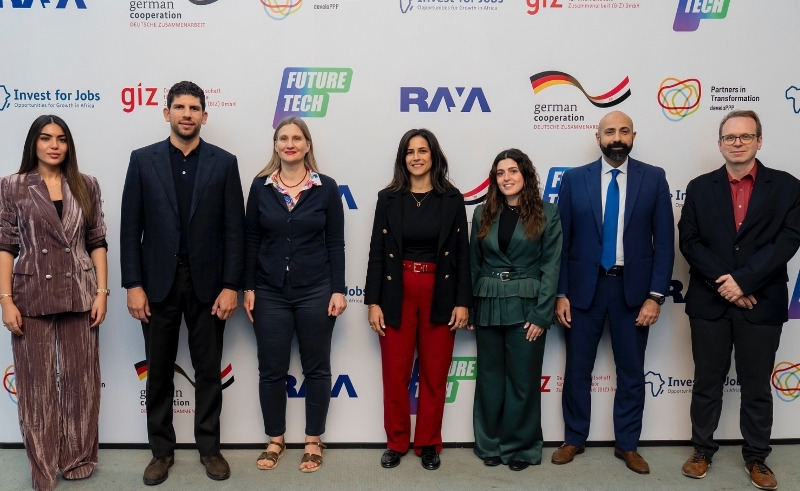

Raya Holding for Financial Investments announced the rebranding of its innovation platform to FutureTECH by Raya, marking the conclusion of a two-year partnership with German Agency for International Cooperation (GIZ) and signaling a strategic pivot from early-stage acceleration to deeper, growth-stage integration.
The initiative, launched under Germany’s develoPPP program — financed by the Federal Ministry for Economic Cooperation and Development — has supported 46 startups across four acceleration cycles. Participating companies, spanning fintech, logistics and artificial intelligence, collectively created 238 jobs and secured $2.3 million in investment, according to Raya.

The results, modest by global venture standards but notable in Egypt’s emerging innovation ecosystem, underscore a broader shift: large corporations are increasingly positioning themselves not as distant buyers of innovation, but as active incubators and partners.
From Acceleration to Integration
Ahmed Khalil, group chief executive of Raya Holding, described the rebrand as an evolution rather than a departure.
“This partnership with GIZ has demonstrated what happens when corporates and development institutions work with a shared purpose: innovation turns into opportunity, and opportunity into impact,” Khalil said in a statement marking the program’s conclusion.
Raya, an investment conglomerate with interests spanning information technology, financial services and consumer goods, has historically launched new ventures internally. Khalil noted that several of the group’s most successful subsidiaries began as greenfield concepts — an entrepreneurial lineage the company now seeks to extend outward.
With FutureTECH by Raya, the focus shifts from mentoring early-stage startups to embedding more mature ventures into Raya’s operational platforms, supply chains and customer networks — a move designed to shorten commercialization timelines and reduce market-entry barriers.
Development Partnerships and Economic Policy
The collaboration reflects a model increasingly favored by international development agencies: leveraging private-sector partnerships to accelerate economic diversification and job creation.
“Eliminating the traditional barriers between large corporations and agile startups is critical for sustainable growth,” said Elisabeth Richter, head of program at develoPPP, during the initiative’s closing event in Cairo. She cited measurable gains among participating firms in business readiness, technical capacity and market access.
Egypt, grappling with currency volatility and external debt pressures, has prioritized private-sector expansion and entrepreneurship as pillars of economic reform. Programs that combine foreign development funding with corporate infrastructure offer a hybrid model that policymakers hope can scale.
A Clean Mobility Push
With the formal GIZ partnership concluded, FutureTECH by Raya is already charting its next move: a planned electric vehicle accelerator in partnership with Raya Auto, the group’s automotive subsidiary. The initiative signals a strategic entry into clean mobility — a sector gaining traction in Egypt as the government pushes for greener transportation and energy diversification.
The new phase suggests Raya intends not only to support startups, but to integrate them into core industries poised for structural transformation.
Bridging a Structural Gap
In many emerging markets, startups struggle to access the capital, networks and procurement channels controlled by established corporations. Conversely, corporates often face bureaucratic inertia and cultural resistance to experimentation.
FutureTECH’s architects argue that sustained collaboration can close that gap — not merely by funding startups, but by embedding them within operating ecosystems.
If the platform succeeds in scaling beyond pilot cycles and into mainstream corporate strategy, it could offer a template for other conglomerates in the region.
For now, Raya’s rebrand represents both an endpoint and a beginning: the conclusion of a development-backed experiment and the launch of a corporate-led innovation strategy aimed at weaving entrepreneurship directly into the fabric of Egypt’s industrial growth.