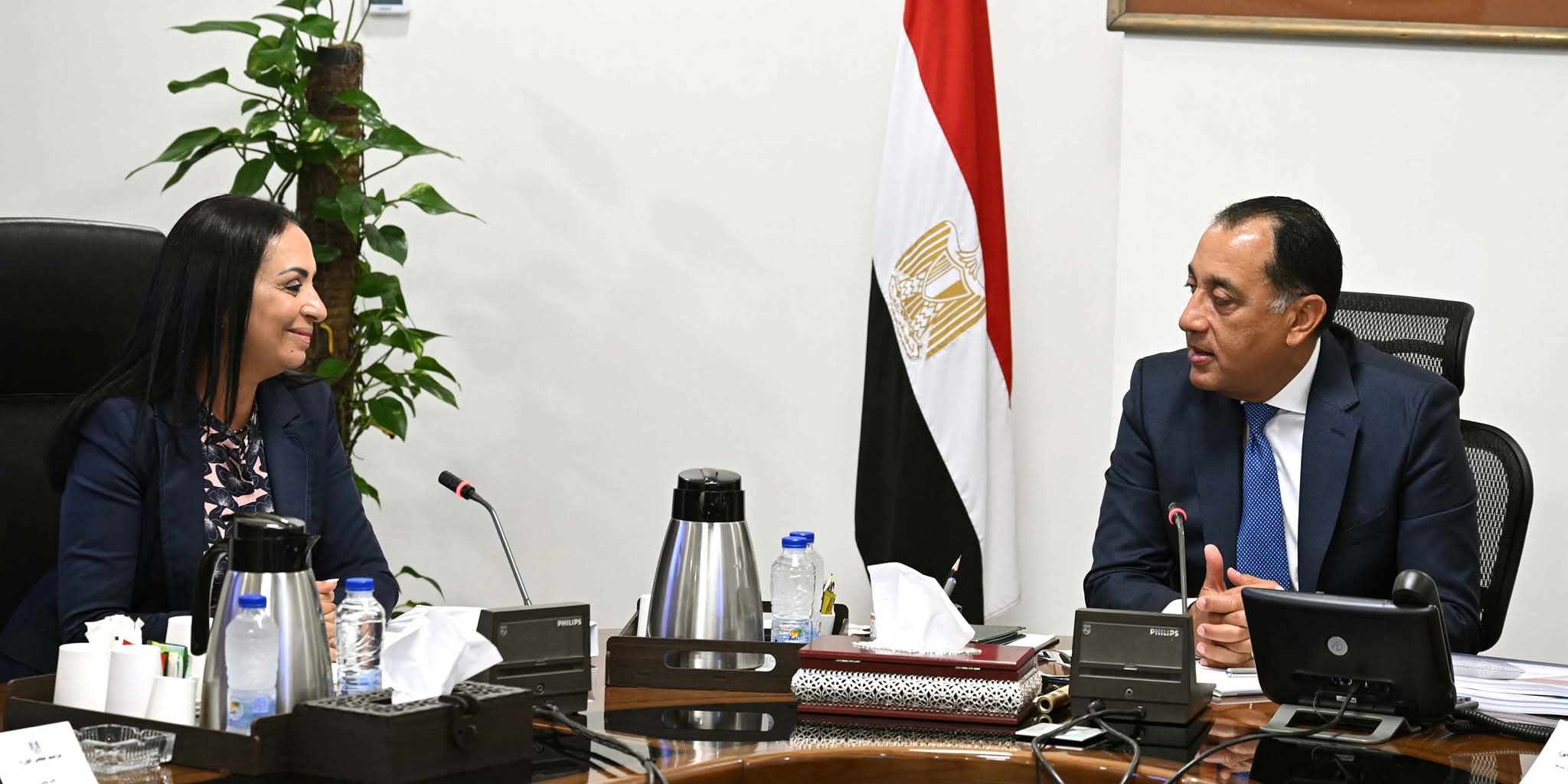

Egyptian Prime Minister Dr. Mostafa Madbouly held a high-level meeting today with Minister of Social Solidarity Dr. Maya Morsy to evaluate the Ministry’s latest initiatives, progress in national welfare programs, and the expansion of strategic efforts aimed at supporting vulnerable groups and fostering inclusive development.
At the core of the discussions was the Ministry’s commitment to a comprehensive framework for social protection. Minister Morsy confirmed that Egypt’s social protection system now comprises 22 distinct programs managed across multiple ministries, with her Ministry delivering approximately 60% of all services. She also emphasized a new directive from the Prime Minister to draft an integrated national framework for social protection, supported by a newly launched Social Protection Platform announced in May 2025.

“Takaful & Karama”: Expanded Reach and Increased Support
A central focus of the discussion was the “Takaful and Karama” cash assistance program. Minister Morsy reported that, between July 2024 and July 2025, approximately 800,000 new families were enrolled, while 600,000 families either graduated or were removed from the program. In a substantial move, the Ministry increased cash assistance by 25%, now benefiting 7.7 million households cumulatively, with approximately 3 million families having exited the program after achieving a degree of self-sufficiency.
Efforts to modernize and streamline benefits administration include completing the first phase of data integration with Egypt’s Universal Health Insurance System. Short message services (SMS) are now being used to alert families eligible for both health and cash support.
University-Based Solidarity Units and Economic Empowerment
Highlighting the expansion of social services into educational institutions, Minister Morsy detailed the University Solidarity Units Project. Active in 31 public universities, and with 12 more units planned in technological universities, the initiative supports “Takaful and Karama” beneficiaries, encourages civic engagement among students, and offers resources like assistive devices for persons with disabilities. These services are enhanced through partnerships with leading banks and companies to provide students with real-world skills in banking and digital marketing.
On economic inclusion, the Ministry has deployed an integrated digital financial ecosystem launched in March 2025. Tools like the platforms Tahwisha, Tamkeen, and Ayadi Masr provide marginalized families with access to financing, savings, and insurance, using a national network of over 20,000 service points. Citizens can also connect with services through hotlines, SMS, interactive voice response (IVR), and digital campaigns.
Boosting National Food Security and Handicrafts
Minister Morsy also shared updates on the “Ezraa” agricultural initiative, now in its fourth phase for the 2025–2026 farming season. Designed to enhance food security and reduce dependence on imports, the program supports 500,000 small-scale farmers in cultivating strategic crops like wheat.
Meanwhile, the “Diarna” crafts fair network has seen substantial growth, expanding to 36 fairs involving 1,776 exhibitors, benefiting 167,000 families—up from 22 fairs with 800 exhibitors and 105,000 families just a year ago.
Early Childhood Development and Family Preservation Programs
Under the Early Childhood Development initiative, the Ministry is strengthening nursery infrastructure and increasing access to quality early education. Through the “Hadanaty” initiative and a nationwide registry, the Ministry is working with civil society to build safe, well-regulated child care spaces that support working women.
Additionally, the Ministry’s “Mawadda” program to preserve family unity has reached over 23 million individuals. The campaign promotes healthy relationships through digital content, training manuals, and a cadre of over 640 trained professionals working across Egypt.
Digital Transformation and Social Care
As part of its digital transition, the Ministry is integrating all social welfare units and building national databases to monitor and evaluate services. This includes a newly developed control center for emergency response coordination.
In the field of child care, a pilot project is underway to digitally monitor orphanages and ensure compliance with care standards. Forty-nine non-compliant orphanages have been closed to protect children’s well-being.
Drug Testing, Crisis Response, and Gaza Relief
Following a fatal traffic incident involving schoolgirls in Monufia, the Ministry conducted drug testing on over 55,500 drivers between June 27 and July 27, 2025, in coordination with the Ministry of Interior. Around 13,700 drivers also benefited from awareness campaigns held across 20 governorates.
In humanitarian relief, Egypt continues to lead in aid delivery to Gaza. Since the conflict’s onset in October 2023, Egypt has delivered 533,000 tons of humanitarian supplies to the region, coordinated through the Egyptian Red Crescent. On July 27, 2025, a new relief convoy, “Zad El-Ezza… from Egypt to Gaza,” delivered over 1,200 tons of food and essential goods via the Kerem Shalom crossing.
In tandem, the Ministry has supported local crisis response—most notably in Kafr Sanabsa—by distributing aid, rehabilitating homes, and implementing over 870 interventions including clean water access, education, healthcare, and economic empowerment.
School Feeding and Community Nutrition
Minister Morsy also announced the results of the national feeding campaign, including the distribution of over 100 million meals in early 2025 and 2.5 million meals during Eid al-Adha. A pilot hot meal program in Fayoum reached more than 10,600 students and over 500 school staff, offering nutritious, balanced meals designed to support children’s cognitive and physical development.
Through coordinated initiatives, digital modernization, and a commitment to social equity, the Ministry of Social Solidarity continues to scale its impact across sectors—from education and agriculture to welfare and emergency response—reflecting Egypt’s strategic vision for inclusive and sustainable development.